This covers the divisibility rules for 3 (if the sum of its digits is divisible by 3) and for 9 (if the sum of its digits is divisible by 9). Questions involve applying these rules, often to find missing digits or prove properties.
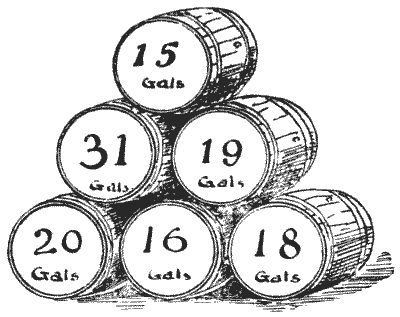
A man bought an odd lot of wine in barrels and one barrel containing beer. These are shown in the illustration, marked with the number of gallons that each barrel contained. He sold a quantity of the wine to one man and twice the quantity to another, but kept the beer to himself. The puzzle is to point out which barrel contains beer. Can you say which one it is? Of course, the man sold the barrels just as he bought them, without manipulating in any way the contents.
It is another good puzzle so to arrange the nine digits (the nought excluded) into two groups so that one group when divided by the other produces a given number without remainder. For example, `1` `3` `4` `5` `8` divided by `6` `7` `2` `9` gives `2`. Can the reader find similar arrangements producing `3, 4, 5, 6, 7, 8`, and `9` respectively? Also, can he find the pairs of smallest possible numbers in each case? Thus, `1` `4` `6` `5` `8` divided by `7` `3` `2` `9` is just as correct for `2` as the other example we have given, but the numbers are higher.
 Sources:Topics:Arithmetic Number Theory -> Modular Arithmetic / Remainder Arithmetic -> Divisibility Rules -> Divisibility Rules by 3 and 9 Algebra -> Word Problems Logic -> Reasoning / Logic