THE TWO HORSESHOES
Why horseshoes should be considered "lucky" is one of those things which no man can understand. It is a very old superstition, and John Aubrey (`1626-1700`) says, "Most houses at the West End of London have a horseshoe on the threshold." In Monmouth Street there were seventeen in `1813` and seven so late as `1855`. Even Lord Nelson had one nailed to the mast of the ship Victory. To-day we find it more conducive to "good luck" to see that they are securely nailed on the feet of the horse we are about to drive.
Nevertheless, so far as the horseshoe, like the Swastika and other emblems that I have had occasion at times to deal with, has served to symbolize health, prosperity, and goodwill towards men, we may well treat it with a certain amount of respectful interest. May there not, moreover, be some esoteric or lost mathematical mystery concealed in the form of a horseshoe? I have been looking into this matter, and I wish to draw my readers' attention to the very remarkable fact that the pair of horseshoes shown in my illustration are related in a striking and beautiful manner to the circle, which is the symbol of eternity. I present this fact in the form of a simple problem, so that it may be seen how subtly this relation has been concealed for ages and ages. My readers will, I know, be pleased when they find the key to the mystery.
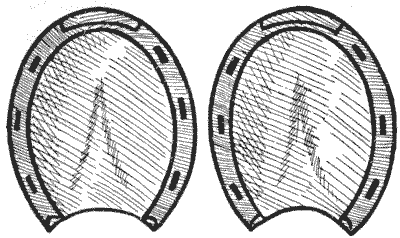
Cut out the two horseshoes carefully round the outline and then cut them into four pieces, all different in shape, that will fit together and form a perfect circle. Each shoe must be cut into two pieces and all the part of the horse's hoof contained within the outline is to be used and regarded as part of the area.
- Amusements in Mathematics, Henry Ernest Dudeney Question 160