Algebra, Equations, Diophantine Equations
Diophantine equations are polynomial equations, usually with integer coefficients, for which only integer solutions are sought. Questions involve finding these integer solutions, determining if solutions exist, or finding the number of solutions (e.g., linear Diophantine equations `ax+by=c`).
-
THE NINE TREASURE BOXES
The following puzzle will illustrate the importance on occasions of being able to fix the minimum and maximum limits of a required number. This can very frequently be done. For example, it has not yet been ascertained in how many different ways the knight's tour can be performed on the chess board; but we know that it is fewer than the number of combinations of `168` things taken `63` at a time and is greater than `31,054,144`—for the latter is the number of routes of a particular type. Or, to take a more familiar case, if you ask a man how many coins he has in his pocket, he may tell you that he has not the slightest idea. But on further questioning you will get out of him some such statement as the following: "Yes, I am positive that I have more than three coins, and equally certain that there are not so many as twenty-five." Now, the knowledge that a certain number lies between `2` and `12` in my puzzle will enable the solver to find the exact answer; without that information there would be an infinite number of answers, from which it would be impossible to select the correct one.
This is another puzzle received from my friend Don Manuel Rodriguez, the cranky miser of New Castile. On New Year's Eve in `1879` he showed me nine treasure boxes, and after informing me that every box contained a square number of golden doubloons, and that the difference between the contents of A and B was the same as between B and C, D and E, E and F, G and H, or H and I, he requested me to tell him the number of coins in every one of the boxes. At first I thought this was impossible, as there would be an infinite number of different answers, but on consideration I found that this was not the case. I discovered that while every box contained coins, the contents of A, B, C increased in weight in alphabetical order; so did D, E, F; and so did G, H, I; but D or E need not be heavier than C, nor G or H heavier than F. It was also perfectly certain that box A could not contain more than a dozen coins at the outside; there might not be half that number, but I was positive that there were not more than twelve. With this knowledge I was able to arrive at the correct answer.
In short, we have to discover nine square numbers such that A, B, C; and D, E, F; and G, H, I are three groups in arithmetical progression, the common difference being the same in each group, and A being less than `12`. How many doubloons were there in every one of the nine boxes?
Sources:Topics:Number Theory Algebra -> Sequences -> Arithmetic Progression / Arithmetic Sequence Algebra -> Equations -> Diophantine Equations- Amusements in Mathematics, Henry Ernest Dudeney Question 132
-
THE FIVE BRIGANDS
The five Spanish brigands, Alfonso, Benito, Carlos, Diego, and Esteban, were counting their spoils after a raid, when it was found that they had captured altogether exactly `200` doubloons. One of the band pointed out that if Alfonso had twelve times as much, Benito three times as much, Carlos the same amount, Diego half as much, and Esteban one-third as much, they would still have altogether just `200` doubloons. How many doubloons had each?
There are a good many equally correct answers to this question. Here is one of them:
A 6 × 12 = 72 B 12 × 3 = 36 C 17 × 1 = 17 D 120 × ½ = 60 E 45 × 1/3 = 15 200 200 The puzzle is to discover exactly how many different answers there are, it being understood that every man had something and that there is to be no fractional money—only doubloons in every case.
This problem, worded somewhat differently, was propounded by Tartaglia (died `1559`), and he flattered himself that he had found one solution; but a French mathematician of note (M.A. Labosne), in a recent work, says that his readers will be astonished when he assures them that there are `6,639` different correct answers to the question. Is this so? How many answers are there?
Sources:Topics:Number Theory Arithmetic Algebra -> Word Problems Algebra -> Sequences -> Arithmetic Progression / Arithmetic Sequence Combinatorics -> Case Analysis / Checking Cases -> Processes / Procedures Algebra -> Equations -> Diophantine Equations- Amusements in Mathematics, Henry Ernest Dudeney Question 133
-
THE DUTCHMEN'S WIVES
I wonder how many of my readers are acquainted with the puzzle of the "Dutchmen's Wives"—in which you have to determine the names of three men's wives, or, rather, which wife belongs to each husband. Some thirty years ago it was "going the rounds," as something quite new, but I recently discovered it in the Ladies' Diary for `1739-40`, so it was clearly familiar to the fair sex over one hundred and seventy years ago. How many of our mothers, wives, sisters, daughters, and aunts could solve the puzzle to-day? A far greater proportion than then, let us hope.
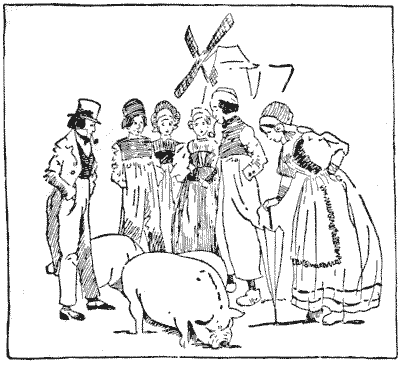
Three Dutchmen, named Hendrick, Elas, and Cornelius, and their wives, Gurtrün, Katrün, and Anna, purchase hogs. Each buys as many as he (or she) gives shillings for one. Each husband pays altogether three guineas more than his wife. Hendrick buys twenty-three more hogs than Katrün, and Elas eleven more than Gurtrün. Now, what was the name of each man's wife?
 Sources:Topics:Number Theory -> Prime Numbers Arithmetic Algebra -> Word Problems Algebra -> Equations -> Diophantine Equations
- Amusements in Mathematics, Henry Ernest Dudeney Question 139
-
FIND ADA'S SURNAME
This puzzle closely resembles the last one, my remarks on the solution of which the reader may like to apply in another case. It was recently submitted to a Sydney evening newspaper that indulges in "intellect sharpeners," but was rejected with the remark that it is childish and that they only published problems capable of solution! Five ladies, accompanied by their daughters, bought cloth at the same shop. Each of the ten paid as many farthings per foot as she bought feet, and each mother spent `8`s. `5`¼d. more than her daughter. Mrs. Robinson spent `6`s. more than Mrs. Evans, who spent about a quarter as much as Mrs. Jones. Mrs. Smith spent most of all. Mrs. Brown bought `21` yards more than Bessie—one of the girls. Annie bought `16` yards more than Mary and spent £`3, 0`s. `8`d. more than Emily. The Christian name of the other girl was Ada. Now, what was her surname? Sources:- Amusements in Mathematics, Henry Ernest Dudeney Question 140