THE FIVE DOGS PUZZLE
In `1863`, C.F. de Jaenisch first discussed the "Five Queens Puzzle"—to place five queens on the chessboard so that every square shall be attacked or occupied—which was propounded by his friend, a "Mr. de R." Jaenisch showed that if no queen may attack another there are ninety-one different ways of placing the five queens, reversals and reflections not counting as different. If the queens may attack one another, I have recorded hundreds of ways, but it is not practicable to enumerate them exactly. 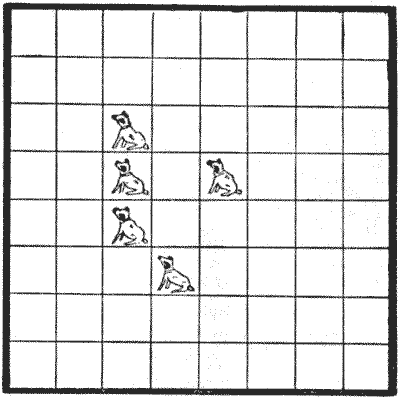 The illustration is supposed to represent an arrangement of sixty-four kennels. It will be seen that five kennels each contain a dog, and on further examination it will be seen that every one of the sixty-four kennels is in a straight line with at least one dog—either horizontally, vertically, or diagonally. Take any kennel you like, and you will find that you can draw a straight line to a dog in one or other of the three ways mentioned. The puzzle is to replace the five dogs and discover in just how many different ways they may be placed in five kennels in a straight row, so that every kennel shall always be in line with at least one dog. Reversals and reflections are here counted as different.
The illustration is supposed to represent an arrangement of sixty-four kennels. It will be seen that five kennels each contain a dog, and on further examination it will be seen that every one of the sixty-four kennels is in a straight line with at least one dog—either horizontally, vertically, or diagonally. Take any kennel you like, and you will find that you can draw a straight line to a dog in one or other of the three ways mentioned. The puzzle is to replace the five dogs and discover in just how many different ways they may be placed in five kennels in a straight row, so that every kennel shall always be in line with at least one dog. Reversals and reflections are here counted as different.
来源:
There are no comments yet.