Number Theory, Division
Division is one of the four basic arithmetic operations, representing the splitting of a quantity into equal parts or finding how many times one number is contained within another. Questions involve performing division, understanding concepts like dividend, divisor, quotient, and remainder, and solving related word problems.
Parity (Even/Odd)-
The Disguised Digits
In the following division exercise, (almost) all the digits are disguised!
What is the dividend?
\(\begin{align*} &\text{ }\text{ }\text{ }\text{ }\text{ }\text{ }\text{ }\text{ }**\text{ }8**\\ &\overline{* * * * * * *\text{ } *}| * *\text{ } *\\ &\underline{\text{ }\text{ }* *\text{ } *}\\ &\text{ }\text{ }\text{ }\text{ }\text{ }* * * *\\ &\text{ }\text{ }\text{ }\text{ }\text{ }\text{ }\underline{\text{ }\text{ }* *\text{ } *}\\ &\text{ }\text{ }\text{ }\text{ }\text{ }\text{ }\text{ }\text{ }\text{ }\text{ }\text{ }* * * *\\ &\text{ }\text{ }\text{ }\text{ }\text{ }\text{ }\text{ }\text{ }\text{ }\text{ }\text{ }\text{ }\underline{* * *\text{ } *}\\ \end{align*}\)
Sources: -
Question
The numbers from 1 to `10^9` (inclusive) are written on the board. The numbers divisible by 3 are written in red, and the rest of the numbers are written in blue. The sum of all the red numbers is equal to `X`, and the sum of all the blue numbers is equal to `Y`. Which number is larger, `2X` or `Y`, and by how much?
Sources:Topics:Arithmetic Number Theory -> Modular Arithmetic / Remainder Arithmetic -> Divisibility Rules -> Divisibility Rules by 3 and 9 Logic -> Reasoning / Logic Algebra -> Sequences Algebra -> Inequalities -> Averages / Means Number Theory -> Division- Beno Arbel Olympiad, 2017, Grade 8 Question 2
-
JUDKINS'S CATTLE
Hiram B. Judkins, a cattle-dealer of Texas, had five droves of animals, consisting of oxen, pigs, and sheep, with the same number of animals in each drove. One morning he sold all that he had to eight dealers. Each dealer bought the same number of animals, paying seventeen dollars for each ox, four dollars for each pig, and two dollars for each sheep; and Hiram received in all three hundred and one dollars. What is the greatest number of animals he could have had? And how many would there be of each kind?Sources:Topics:Arithmetic Number Theory -> Modular Arithmetic / Remainder Arithmetic -> Divisibility Rules Algebra -> Word Problems Number Theory -> Division- Amusements in Mathematics, Henry Ernest Dudeney Question 35
-
THE BAG OF NUTS
Three boys were given a bag of nuts as a Christmas present, and it was agreed that they should be divided in proportion to their ages, which together amounted to `17 1/2` years. Now the bag contained `770` nuts, and as often as Herbert took four Robert took three, and as often as Herbert took six Christopher took seven. The puzzle is to find out how many nuts each had, and what were the boys' respective ages.
Sources:Topics:Algebra -> Word Problems Arithmetic -> Fractions Algebra -> Inequalities -> Averages / Means Number Theory -> Division- Amusements in Mathematics, Henry Ernest Dudeney Question 50
-
THE WAPSHAW'S WHARF MYSTERY
There was a great commotion in Lower Thames Street on the morning of January `12, 1887`. When the early members of the staff arrived at Wapshaw's Wharf they found that the safe had been broken open, a considerable sum of money removed, and the offices left in great disorder. The night watchman was nowhere to be found, but nobody who had been acquainted with him for one moment suspected him to be guilty of the robbery. In this belief the proprietors were confirmed when, later in the day, they were informed that the poor fellow's body had been picked up by the River Police. Certain marks of violence pointed to the fact that he had been brutally attacked and thrown into the river. A watch found in his pocket had stopped, as is invariably the case in such circumstances, and this was a valuable clue to the time of the outrage. But a very stupid officer (and we invariably find one or two stupid individuals in the most intelligent bodies of men) had actually amused himself by turning the hands round and round, trying to set the watch going again. After he had been severely reprimanded for this serious indiscretion, he was asked whether he could remember the time that was indicated by the watch when found. He replied that he could not, but he recollected that the hour hand and minute hand were exactly together, one above the other, and the second hand had just passed the forty-ninth second. More than this he could not remember.
What was the exact time at which the watchman's watch stopped? The watch is, of course, assumed to have been an accurate one.
Sources:- Amusements in Mathematics, Henry Ernest Dudeney Question 60
-
THE TEN COUNTERS
In this case we use the nought in addition to the `1, 2, 3, 4, 5, 6, 7, 8, 9`. The puzzle is, as in the last case, so to arrange the ten counters that the products of the two multiplications shall be the same, and you may here have one or more figures in the multiplier, as you choose. The above is a very easy feat; but it is also required to find the two arrangements giving pairs of the highest and lowest products possible. Of course every counter must be used, and the cipher may not be placed to the left of a row of figures where it would have no effect. Vulgar fractions or decimals are not allowed.Sources:Topics:Arithmetic Combinatorics -> Case Analysis / Checking Cases -> Processes / Procedures Number Theory -> Division- Amusements in Mathematics, Henry Ernest Dudeney Question 82
-
DIGITAL DIVISION
It is another good puzzle so to arrange the nine digits (the nought excluded) into two groups so that one group when divided by the other produces a given number without remainder. For example, `1` `3` `4` `5` `8` divided by `6` `7` `2` `9` gives `2`. Can the reader find similar arrangements producing `3, 4, 5, 6, 7, 8`, and `9` respectively? Also, can he find the pairs of smallest possible numbers in each case? Thus, `1` `4` `6` `5` `8` divided by `7` `3` `2` `9` is just as correct for `2` as the other example we have given, but the numbers are higher.Sources:Topics:Arithmetic Number Theory -> Modular Arithmetic / Remainder Arithmetic -> Divisibility Rules -> Divisibility Rules by 3 and 9 Number Theory -> Division- Amusements in Mathematics, Henry Ernest Dudeney Question 88
-
THE FOUR SEVENS
Sources: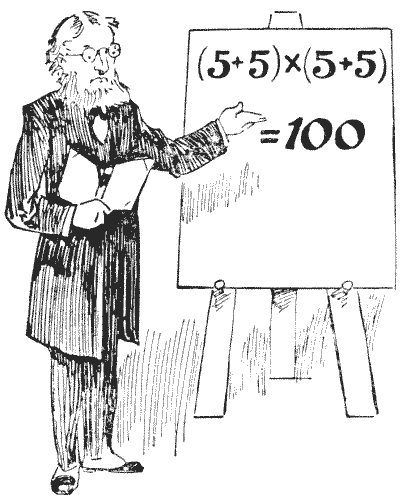 In the illustration Professor Rackbrane is seen demonstrating one of the little posers with which he is accustomed to entertain his class. He believes that by taking his pupils off the beaten tracks he is the better able to secure their attention, and to induce original and ingenious methods of thought. He has, it will be seen, just shown how four `5`'s may be written with simple arithmetical signs so as to represent `100`. Every juvenile reader will see at a glance that his example is quite correct. Now, what he wants you to do is this: Arrange four `7`'s (neither more nor less) with arithmetical signs so that they shall represent `100`. If he had said we were to use four `9`'s we might at once have written `99 9/9`, but the four `7`'s call for rather more ingenuity. Can you discover the little trick?
- Amusements in Mathematics, Henry Ernest Dudeney Question 95
-
A PUZZLING LEGACY
A man left a hundred acres of land to be divided among his three sons—Alfred, Benjamin, and Charles—in the proportion of one-third, one-fourth, and one-fifth respectively. But Charles died. How was the land to be divided fairly between Alfred and Benjamin? Sources:- Amusements in Mathematics, Henry Ernest Dudeney Question 112
-
SIMPLE MULTIPLICATION
If we number six cards `1, 2, 4, 5, 7`, and `8`, and arrange them on the table in this order:—
`1\ \ \ 4\ \ \ 2\ \ \ 8\ \ \ 5\ \ \ 7`
We can demonstrate that in order to multiply by `3` all that is necessary is to remove the `1` to the other end of the row, and the thing is done. The answer is `428571`. Can you find a number that, when multiplied by `3` and divided by `2`, the answer will be the same as if we removed the first card (which in this case is to be a `3`) From the beginning of the row to the end?
Sources:Topics:Arithmetic Number Theory -> Modular Arithmetic / Remainder Arithmetic -> Divisibility Rules Number Theory -> Division- Amusements in Mathematics, Henry Ernest Dudeney Question 126