Puzzles and Rebuses
This is a general category for brain-teasers that require cleverness, lateral thinking, or pattern recognition. Rebuses are word puzzles using pictures, symbols, or letters to represent words or phrases. Math-related versions might involve numerical or operational clues hidden in a visual format.
Matchstick Puzzles Reconstruct the Exercise / Cryptarithmetic-
Question
Insert arithmetic operation symbols and parentheses so that the equality becomes correct:
5 5 5 = 0
-
Question
Insert arithmetic operation symbols and parentheses to make the equation correct:
5 5 5 = 2
-
Question
From a chessboard, two opposite corners are removed (the squares `a1` and `h8`, for example). Can you tile the remaining board with dominoes?
-
Sun Minus Five
In the following arithmetic problems, different letters replace different digits, and identical letters replace
Sources:
identical digits.
`5 = ש + מ + ח`
`9 = ש + מ + ש`
Calculate the value of the expression: `ח + ש` -
How Much is Happy?
In the following arithmetic exercises, different letters replace different digits, and identical letters replace identical digits.
Sources:
`19 = ט + מ + ח + ש`
`10 = ק + ח + ש + מ`
Calculate the value of the expression: `ח + מ + ש` -
A FAMILY PARTY
A certain family party consisted of `1` grandfather, `1` grandmother, `2` fathers, `2` mothers, `4` children, `3` grandchildren, `1` brother, `2` sisters, `2` sons, `2` daughters, `1` father-in-law, `1` mother-in-law, and `1` daughter-in-law. Twenty-three people, you will say. No; there were only seven persons present. Can you show how this might be? Sources:- Amusements in Mathematics, Henry Ernest Dudeney Question 54
-
A MIXED PEDIGREE
Joseph Bloggs: "I can't follow it, my dear boy. It makes me dizzy!"
John Snoggs: "It's very simple. Listen again! You happen to be my father's brother-in-law, my brother's father-in-law, and also my father-in-law's brother. You see, my father was——"
But Mr. Bloggs refused to hear any more. Can the reader show how this extraordinary triple relationship might have come about?
Sources:- Amusements in Mathematics, Henry Ernest Dudeney Question 55
-
WILSON'S POSER
"Speaking of perplexities——" said Mr. Wilson, throwing down a magazine on the table in the commercial room of the Railway Hotel.
"Who was speaking of perplexities?" inquired Mr. Stubbs.
"Well, then, reading about them, if you want to be exact—it just occurred to me that perhaps you three men may be interested in a little matter connected with myself."
It was Christmas Eve, and the four commercial travellers were spending the holiday at Grassminster. Probably each suspected that the others had no homes, and perhaps each was conscious of the fact that he was in that predicament himself. In any case they seemed to be perfectly comfortable, and as they drew round the cheerful fire the conversation became general.
"What is the difficulty?" asked Mr. Packhurst.
"There's no difficulty in the matter, when you rightly understand it. It is like this. A man named Parker had a flying-machine that would carry two. He was a venturesome sort of chap—reckless, I should call him—and he had some bother in finding a man willing to risk his life in making an ascent with him. However, an uncle of mine thought he would chance it, and one fine morning he took his seat in the machine and she started off well. When they were up about a thousand feet, my nephew suddenly——"
"Here, stop, Wilson! What was your nephew doing there? You said your uncle," interrupted Mr. Stubbs.
"Did I? Well, it does not matter. My nephew suddenly turned to Parker and said that the engine wasn't running well, so Parker called out to my uncle——"
"Look here," broke in Mr. Waterson, "we are getting mixed. Was it your uncle or your nephew? Let's have it one way or the other."
"What I said is quite right. Parker called out to my uncle to do something or other, when my nephew——"
"There you are again, Wilson," cried Mr. Stubbs; "once for all, are we to understand that both your uncle and your nephew were on the machine?"
"Certainly. I thought I made that clear. Where was I? Well, my nephew shouted back to Parker——"
"Phew! I'm sorry to interrupt you again, Wilson, but we can't get on like this. Is it true that the machine would only carry two?"
"Of course. I said at the start that it only carried two."
"Then what in the name of aerostation do you mean by saying that there were three persons on board?" shouted Mr. Stubbs.
"Who said there were three?"
"You have told us that Parker, your uncle, and your nephew went up on this blessed flying-machine."
"That's right."
"And the thing would only carry two!"
"Right again."
"Wilson, I have known you for some time as a truthful man and a temperate man," said Mr. Stubbs, solemnly. "But I am afraid since you took up that new line of goods you have overworked yourself."
"Half a minute, Stubbs," interposed Mr. Waterson. "I see clearly where we all slipped a cog. Of course, Wilson, you meant us to understand that Parker is either your uncle or your nephew. Now we shall be all right if you will just tell us whether Parker is your uncle or nephew."
"He is no relation to me whatever."
The three men sighed and looked anxiously at one another. Mr. Stubbs got up from his chair to reach the matches, Mr. Packhurst proceeded to wind up his watch, and Mr. Waterson took up the poker to attend to the fire. It was an awkward moment, for at the season of goodwill nobody wished to tell Mr. Wilson exactly what was in his mind.
"It's curious," said Mr. Wilson, very deliberately, "and it's rather sad, how thick-headed some people are. You don't seem to grip the facts. It never seems to have occurred to either of you that my uncle and my nephew are one and the same man."
"What!" exclaimed all three together.
"Yes; David George Linklater is my uncle, and he is also my nephew. Consequently, I am both his uncle and nephew. Queer, isn't it? I'll explain how it comes about.
"Mr. Wilson put the case so very simply that the three men saw how it might happen without any marriage within the prohibited degrees. Perhaps the reader can work it out for himself.
Sources:- Amusements in Mathematics, Henry Ernest Dudeney Question 56
-
THE VILLAGE SIMPLETON
A facetious individual who was taking a long walk in the country came upon a yokel sitting on a stile. As the gentleman was not quite sure of his road, he thought he would make inquiries of the local inhabitant; but at the first glance he jumped too hastily to the conclusion that he had dropped on the village idiot. He therefore decided to test the fellow's intelligence by first putting to him the simplest question he could think of, which was, "What day of the week is this, my good man?" The following is the smart answer that he received:—
"When the day after to-morrow is yesterday, to-day will be as far from Sunday as to-day was from Sunday when the day before yesterday was to-morrow."
Can the reader say what day of the week it was? It is pretty evident that the countryman was not such a fool as he looked. The gentleman went on his road a puzzled but a wiser man.
Sources:- Amusements in Mathematics, Henry Ernest Dudeney Question 66
-
THE NUMBER CHECKS PUZZLE
Where a large number of workmen are employed on a building it is customary to provide every man with a little disc bearing his number. These are hung on a board by the men as they arrive, and serve as a check on punctuality. Now, I once noticed a foreman remove a number of these checks from his board and place them on a split-ring which he carried in his pocket. This at once gave me the idea for a good puzzle. In fact, I will confide to my readers that this is just how ideas for puzzles arise. You cannot really create an idea: it happens—and you have to be on the alert to seize it when it does so happen.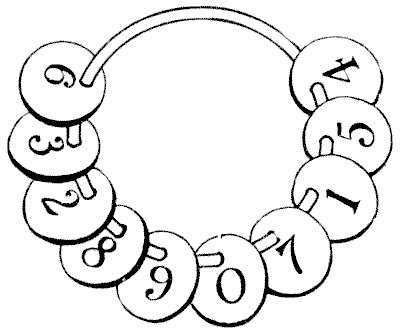 It will be seen from the illustration that there are ten of these checks on a ring, numbered `1` to `9` and `0`. The puzzle is to divide them into three groups without taking any off the ring, so that the first group multiplied by the second makes the third group. For example, we can divide them into the three groups, `2`—`8` `9` `7`—`1` `5` `4` `6` `3`, by bringing the `6` and the `3` round to the `4`, but unfortunately the first two when multiplied together do not make the third. Can you separate them correctly? Of course you may have as many of the checks as you like in any group. The puzzle calls for some ingenuity, unless you have the luck to hit on the answer by chance.
Sources:Topics:Number Theory Arithmetic Combinatorics -> Case Analysis / Checking Cases -> Processes / Procedures Puzzles and Rebuses
It will be seen from the illustration that there are ten of these checks on a ring, numbered `1` to `9` and `0`. The puzzle is to divide them into three groups without taking any off the ring, so that the first group multiplied by the second makes the third group. For example, we can divide them into the three groups, `2`—`8` `9` `7`—`1` `5` `4` `6` `3`, by bringing the `6` and the `3` round to the `4`, but unfortunately the first two when multiplied together do not make the third. Can you separate them correctly? Of course you may have as many of the checks as you like in any group. The puzzle calls for some ingenuity, unless you have the luck to hit on the answer by chance.
Sources:Topics:Number Theory Arithmetic Combinatorics -> Case Analysis / Checking Cases -> Processes / Procedures Puzzles and Rebuses- Amusements in Mathematics, Henry Ernest Dudeney Question 87