Number Theory, Modular Arithmetic / Remainder Arithmetic, Divisibility Rules
Divisibility rules are shortcuts to determine if an integer is exactly divisible by another smaller integer without performing the full division. Questions involve applying these rules for various divisors (e.g., 2, 3, 4, 5, 9, 10, 11) to test numbers or find missing digits.
Divisibility Rules by 2, 4, and 8 Divisibility Rules by 3 and 9 Divisibility Rule by 11 Divisibility Rules by 5 and 25-
JUDKINS'S CATTLE
Hiram B. Judkins, a cattle-dealer of Texas, had five droves of animals, consisting of oxen, pigs, and sheep, with the same number of animals in each drove. One morning he sold all that he had to eight dealers. Each dealer bought the same number of animals, paying seventeen dollars for each ox, four dollars for each pig, and two dollars for each sheep; and Hiram received in all three hundred and one dollars. What is the greatest number of animals he could have had? And how many would there be of each kind?Sources:Topics:Arithmetic Number Theory -> Modular Arithmetic / Remainder Arithmetic -> Divisibility Rules Algebra -> Word Problems Number Theory -> Division- Amusements in Mathematics, Henry Ernest Dudeney Question 35
-
DIGITS AND SQUARES
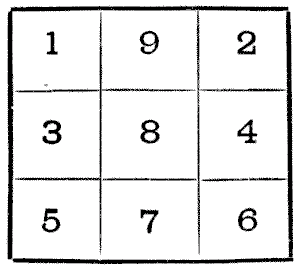 It will be seen in the diagram that we have so arranged the nine digits in a square that the number in the second row is twice that in the first row, and the number in the bottom row three times that in the top row. There are three other ways of arranging the digits so as to produce the same result. Can you find them?
Sources:Topics:Arithmetic Number Theory -> Modular Arithmetic / Remainder Arithmetic -> Divisibility Rules Combinatorics -> Case Analysis / Checking Cases -> Processes / Procedures
It will be seen in the diagram that we have so arranged the nine digits in a square that the number in the second row is twice that in the first row, and the number in the bottom row three times that in the top row. There are three other ways of arranging the digits so as to produce the same result. Can you find them?
Sources:Topics:Arithmetic Number Theory -> Modular Arithmetic / Remainder Arithmetic -> Divisibility Rules Combinatorics -> Case Analysis / Checking Cases -> Processes / Procedures- Amusements in Mathematics, Henry Ernest Dudeney Question 77
-
THE CAB NUMBERS
A London policeman one night saw two cabs drive off in opposite directions under suspicious circumstances. This officer was a particularly careful and wide-awake man, and he took out his pocket-book to make an entry of the numbers of the cabs, but discovered that he had lost his pencil. Luckily, however, he found a small piece of chalk, with which he marked the two numbers on the gateway of a wharf close by. When he returned to the same spot on his beat he stood and looked again at the numbers, and noticed this peculiarity, that all the nine digits (no nought) were used and that no figure was repeated, but that if he multiplied the two numbers together they again produced the nine digits, all once, and once only. When one of the clerks arrived at the wharf in the early morning, he observed the chalk marks and carefully rubbed them out. As the policeman could not remember them, certain mathematicians were then consulted as to whether there was any known method for discovering all the pairs of numbers that have the peculiarity that the officer had noticed; but they knew of none. The investigation, however, was interesting, and the following question out of many was proposed: What two numbers, containing together all the nine digits, will, when multiplied together, produce another number (the highest possible) containing also all the nine digits? The nought is not allowed anywhere.Sources:Topics:Arithmetic Combinatorics Number Theory -> Modular Arithmetic / Remainder Arithmetic -> Divisibility Rules- Amusements in Mathematics, Henry Ernest Dudeney Question 85
-
THE CENTURY PUZZLE
Can you write `100` in the form of a mixed number, using all the nine digits once, and only once? The late distinguished French mathematician, Edouard Lucas, found seven different ways of doing it, and expressed his doubts as to there being any other ways. As a matter of fact there are just eleven ways and no more. Here is one of them, `91 5742/638`. Nine of the other ways have similarly two figures in the integral part of the number, but the eleventh expression has only one figure there. Can the reader find this last form?
Sources:Topics:Number Theory -> Modular Arithmetic / Remainder Arithmetic -> Divisibility Rules Logic -> Reasoning / Logic Arithmetic -> Fractions Combinatorics -> Case Analysis / Checking Cases -> Processes / Procedures- Amusements in Mathematics, Henry Ernest Dudeney Question 90
-
SIMPLE MULTIPLICATION
If we number six cards `1, 2, 4, 5, 7`, and `8`, and arrange them on the table in this order:—
`1\ \ \ 4\ \ \ 2\ \ \ 8\ \ \ 5\ \ \ 7`
We can demonstrate that in order to multiply by `3` all that is necessary is to remove the `1` to the other end of the row, and the thing is done. The answer is `428571`. Can you find a number that, when multiplied by `3` and divided by `2`, the answer will be the same as if we removed the first card (which in this case is to be a `3`) From the beginning of the row to the end?
Sources:Topics:Arithmetic Number Theory -> Modular Arithmetic / Remainder Arithmetic -> Divisibility Rules Number Theory -> Division- Amusements in Mathematics, Henry Ernest Dudeney Question 126
-
A CALENDAR PUZZLE
If the end of the world should come on the first day of a new century, can you say what are the chances that it will happen on a Sunday? Sources:- Amusements in Mathematics, Henry Ernest Dudeney Question 416
-
Question
Given a three-digit prime number with all its digits distinct. It is known that its last digit is equal to the sum of the other two digits. Find all the possibilities for the last digit of this number.
Sources:Topics:Number Theory -> Prime Numbers Number Theory -> Modular Arithmetic / Remainder Arithmetic -> Divisibility Rules -> Divisibility Rules by 2, 4, and 8 Number Theory -> Modular Arithmetic / Remainder Arithmetic -> Divisibility Rules -> Divisibility Rules by 3 and 9 Logic -> Reasoning / Logic Combinatorics -> Case Analysis / Checking Cases -> Processes / Procedures -
Question
All the even numbers from `12` to `34` are written on the board without spaces. As a result, the following number was obtained:
`121416182022242628303234`
Is this number divisible by `24`?
Sources: -
Question
The number `100` is written on the board. Find a digit that satisfies the following condition:
If we add it to the notation of the number written on the board once to the left and once to the right, we get a number that is divisible by `12`.
Sources:Topics:Arithmetic Number Theory -> Modular Arithmetic / Remainder Arithmetic -> Divisibility Rules -> Divisibility Rules by 2, 4, and 8 Number Theory -> Modular Arithmetic / Remainder Arithmetic -> Divisibility Rules -> Divisibility Rules by 3 and 9 Number Theory -> Prime Numbers -> Prime Factorization -
Question
How many numbers between `1` and `100` are not divisible by `2` or `5`?
Topics:Arithmetic Number Theory -> Modular Arithmetic / Remainder Arithmetic -> Divisibility Rules -> Divisibility Rules by 2, 4, and 8 Number Theory -> Modular Arithmetic / Remainder Arithmetic -> Divisibility Rules -> Divisibility Rules by 5 and 25 Number Theory -> Greatest Common Divisor (GCD) and Least Common Multiple (LCM) Set Theory Number Theory -> Division