An arithmetic sequence is one where the difference between consecutive terms is constant (this constant is called the common difference). Questions involve finding the `n`-th term, the sum of the first `n` terms, the common difference, or other properties based on given information.
It will be seen that I have played six dominoes, in the illustration, in accordance with the ordinary rules of the game, `4` against `4, 1` against `1`, and so on, and yet the sum of the spots on the successive dominoes, `4, 5, 6, 7, 8, 9`, are in arithmetical progression; that is, the numbers taken in order have a common difference of `1`. In how many different ways may we play six dominoes, from an ordinary box of twenty-eight, so that the numbers on them may lie in arithmetical progression? We must always play from left to right, and numbers in decreasing arithmetical progression (such as `9, 8, 7, 6, 5, 4`) are not admissible.
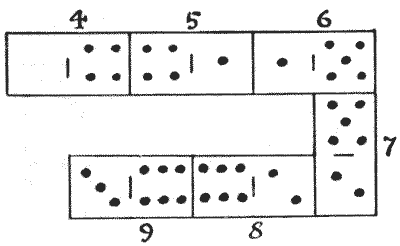 It will be seen that I have played six dominoes, in the illustration, in accordance with the ordinary rules of the game, `4` against `4, 1` against `1`, and so on, and yet the sum of the spots on the successive dominoes, `4, 5, 6, 7, 8, 9`, are in arithmetical progression; that is, the numbers taken in order have a common difference of `1`. In how many different ways may we play six dominoes, from an ordinary box of twenty-eight, so that the numbers on them may lie in arithmetical progression? We must always play from left to right, and numbers in decreasing arithmetical progression (such as `9, 8, 7, 6, 5, 4`) are not admissible.
Sources:Topics:Algebra -> Sequences -> Arithmetic Progression / Arithmetic Sequence Combinatorics -> Case Analysis / Checking Cases -> Processes / Procedures
It will be seen that I have played six dominoes, in the illustration, in accordance with the ordinary rules of the game, `4` against `4, 1` against `1`, and so on, and yet the sum of the spots on the successive dominoes, `4, 5, 6, 7, 8, 9`, are in arithmetical progression; that is, the numbers taken in order have a common difference of `1`. In how many different ways may we play six dominoes, from an ordinary box of twenty-eight, so that the numbers on them may lie in arithmetical progression? We must always play from left to right, and numbers in decreasing arithmetical progression (such as `9, 8, 7, 6, 5, 4`) are not admissible.
Sources:Topics:Algebra -> Sequences -> Arithmetic Progression / Arithmetic Sequence Combinatorics -> Case Analysis / Checking Cases -> Processes / Procedures