These problems, also known as optimization problems, involve finding the smallest (minimum) or largest (maximum) value of a quantity or function under given constraints. Techniques can range from algebraic inequalities, geometric reasoning, to calculus (if applicable).
This is a puzzle based on a pretty little idea first dealt with by the late Mr. Sam Loyd. A man had nine pieces of chain, as shown in the illustration. He wanted to join these fifty links into one endless chain. It will cost a penny to open any link and twopence to weld a link together again, but he could buy a new endless chain of the same character and quality for `2`s. `2`d. What was the cheapest course for him to adopt? Unless the reader is cunning he may find himself a good way out in his answer.
Here is an interesting little puzzle suggested to me by Mr. W. T. Whyte. Mark off on a sheet of paper a rectangular space `5` inches by `3` inches, and then find the greatest number of halfpennies that can be placed within the enclosure under the following conditions. A halfpenny is exactly an inch in diameter. Place your first halfpenny where you like, then place your second coin at exactly the distance of an inch from the first, the third an inch distance from the second, and so on. No halfpenny may touch another halfpenny or cross the boundary. Our illustration will make the matter perfectly clear. No. `2` coin is an inch from No. `1`; No. `3` an inch from No. `2`; No. `4` an inch from No. `3`; but after No. `10` is placed we can go no further in this attempt. Yet several more halfpennies might have been got in. How many can the reader place?
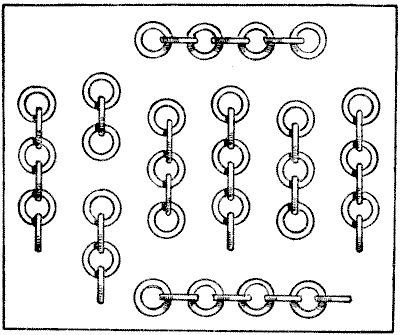 This is a puzzle based on a pretty little idea first dealt with by the late Mr. Sam Loyd. A man had nine pieces of chain, as shown in the illustration. He wanted to join these fifty links into one endless chain. It will cost a penny to open any link and twopence to weld a link together again, but he could buy a new endless chain of the same character and quality for `2`s. `2`d. What was the cheapest course for him to adopt? Unless the reader is cunning he may find himself a good way out in his answer.
Sources:
This is a puzzle based on a pretty little idea first dealt with by the late Mr. Sam Loyd. A man had nine pieces of chain, as shown in the illustration. He wanted to join these fifty links into one endless chain. It will cost a penny to open any link and twopence to weld a link together again, but he could buy a new endless chain of the same character and quality for `2`s. `2`d. What was the cheapest course for him to adopt? Unless the reader is cunning he may find himself a good way out in his answer.
Sources:
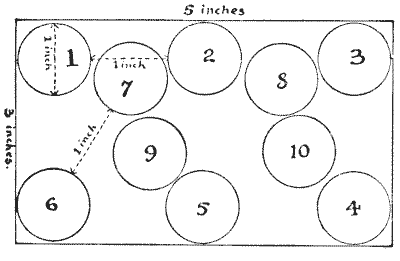 Here is an interesting little puzzle suggested to me by Mr. W. T. Whyte. Mark off on a sheet of paper a rectangular space `5` inches by `3` inches, and then find the greatest number of halfpennies that can be placed within the enclosure under the following conditions. A halfpenny is exactly an inch in diameter. Place your first halfpenny where you like, then place your second coin at exactly the distance of an inch from the first, the third an inch distance from the second, and so on. No halfpenny may touch another halfpenny or cross the boundary. Our illustration will make the matter perfectly clear. No. `2` coin is an inch from No. `1`; No. `3` an inch from No. `2`; No. `4` an inch from No. `3`; but after No. `10` is placed we can go no further in this attempt. Yet several more halfpennies might have been got in. How many can the reader place?
Sources:
Here is an interesting little puzzle suggested to me by Mr. W. T. Whyte. Mark off on a sheet of paper a rectangular space `5` inches by `3` inches, and then find the greatest number of halfpennies that can be placed within the enclosure under the following conditions. A halfpenny is exactly an inch in diameter. Place your first halfpenny where you like, then place your second coin at exactly the distance of an inch from the first, the third an inch distance from the second, and so on. No halfpenny may touch another halfpenny or cross the boundary. Our illustration will make the matter perfectly clear. No. `2` coin is an inch from No. `1`; No. `3` an inch from No. `2`; No. `4` an inch from No. `3`; but after No. `10` is placed we can go no further in this attempt. Yet several more halfpennies might have been got in. How many can the reader place?
Sources: