Arithmetic is the fundamental branch of mathematics dealing with numbers and the basic operations: addition, subtraction, multiplication, and division. Questions involve performing these operations, understanding number properties (like integers, fractions, decimals), and solving related word problems.
Two ladies went into a shop where, through some curious eccentricity, no change was given, and made purchases amounting together to less than five shillings. "Do you know," said one lady, "I find I shall require no fewer than six current coins of the realm to pay for what I have bought." The other lady considered a moment, and then exclaimed: "By a peculiar coincidence, I am exactly in the same dilemma." "Then we will pay the two bills together." But, to their astonishment, they still required six coins. What is the smallest possible amount of their purchases—both different?
Every one is familiar with the difficulties that frequently arise over the giving of change, and how the assistance of a third person with a few coins in his pocket will sometimes help us to set the matter right. Here is an example. An Englishman went into a shop in New York and bought goods at a cost of thirty-four cents. The only money he had was a dollar, a three-cent piece, and a two-cent piece. The tradesman had only a half-dollar and a quarter-dollar. But another customer happened to be present, and when asked to help produced two dimes, a five-cent piece, a two-cent piece, and a one-cent piece. How did the tradesman manage to give change? For the benefit of those readers who are not familiar with the American coinage, it is only necessary to say that a dollar is a hundred cents and a dime ten cents. A puzzle of this kind should rarely cause any difficulty if attacked in a proper manner.
Most people know that if you take any sum of money in pounds, shillings, and pence, in which the number of pounds (less than £`12`) exceeds that of the pence, reverse it (calling the pounds pence and the pence pounds), find the difference, then reverse and add this difference, the result is always £`12, 18`s. `11`d. But if we omit the condition, "less than £`12`," and allow nought to represent shillings or pence—(`1`) What is the lowest amount to which the rule will not apply? (`2`) What is the highest amount to which it will apply? Of course, when reversing such a sum as £`14, 15`s. `3`d. it may be written £`3, 16`s. `2`d., which is the same as £`3, 15`s. `14`d.
A country "grocer and draper" had two rival assistants, who prided themselves on their rapidity in serving customers. The young man on the grocery side could weigh up two one-pound parcels of sugar per minute, while the drapery assistant could cut three one-yard lengths of cloth in the same time. Their employer, one slack day, set them a race, giving the grocer a barrel of sugar and telling him to weigh up forty-eight one-pound parcels of sugar While the draper divided a roll of forty-eight yards of cloth into yard pieces. The two men were interrupted together by customers for nine minutes, but the draper was disturbed seventeen times as long as the grocer. What was the result of the race?
Hiram B. Judkins, a cattle-dealer of Texas, had five droves of animals, consisting of oxen, pigs, and sheep, with the same number of animals in each drove. One morning he sold all that he had to eight dealers. Each dealer bought the same number of animals, paying seventeen dollars for each ox, four dollars for each pig, and two dollars for each sheep; and Hiram received in all three hundred and one dollars. What is the greatest number of animals he could have had? And how many would there be of each kind?
"My husband's age," remarked a lady the other day, "is represented by the figures of my own age reversed. He is my senior, and the difference between our ages is one-eleventh of their sum."
The above clock face indicates a little before `42` minutes past `4`. The hands will again point at exactly the same spots a little after `23` minutes past `8`. In fact, the hands will have changed places. How many times do the hands of a clock change places between three o'clock p.m. and midnight? And out of all the pairs of times indicated by these changes, what is the exact time when the minute hand will be nearest to the point IX?
On Friday, April `1, 1898`, three new clocks were all set going precisely at the same time—twelve noon. At noon on the following day it was found that clock A had kept perfect time, that clock B had gained exactly one minute, and that clock C had lost exactly one minute. Now, supposing that the clocks B and C had not been regulated, but all three allowed to go on as they had begun, and that they maintained the same rates of progress without stopping, on what date and at what time of day would all three pairs of hands again point at the same moment at twelve o'clock?
During a visit to the seaside Tommy and Evangeline insisted on having a donkey race over the mile course on the sands. Mr. Dobson and some of his friends whom he had met on the beach acted as judges, but, as the donkeys were familiar acquaintances and declined to part company the whole way, a dead heat was unavoidable. However, the judges, being stationed at different points on the course, which was marked off in quarter-miles, noted the following results:—The first three-quarters were run in six and three-quarter minutes, the first half-mile took the same time as the second half, and the third quarter was run in exactly the same time as the last quarter. From these results Mr. Dobson amused himself in discovering just how long it took those two donkeys to run the whole mile. Can you give the answer?
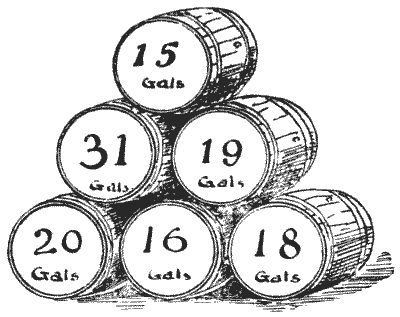
A man bought an odd lot of wine in barrels and one barrel containing beer. These are shown in the illustration, marked with the number of gallons that each barrel contained. He sold a quantity of the wine to one man and twice the quantity to another, but kept the beer to himself. The puzzle is to point out which barrel contains beer. Can you say which one it is? Of course, the man sold the barrels just as he bought them, without manipulating in any way the contents.
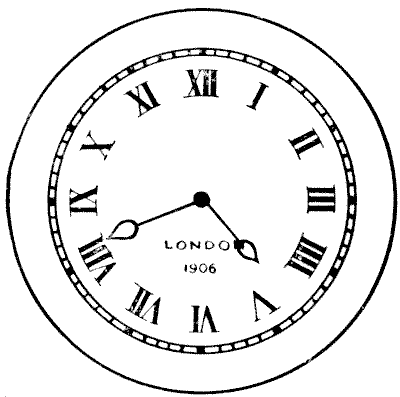 The above clock face indicates a little before `42` minutes past `4`. The hands will again point at exactly the same spots a little after `23` minutes past `8`. In fact, the hands will have changed places. How many times do the hands of a clock change places between three o'clock p.m. and midnight? And out of all the pairs of times indicated by these changes, what is the exact time when the minute hand will be nearest to the point IX?
Sources:
The above clock face indicates a little before `42` minutes past `4`. The hands will again point at exactly the same spots a little after `23` minutes past `8`. In fact, the hands will have changed places. How many times do the hands of a clock change places between three o'clock p.m. and midnight? And out of all the pairs of times indicated by these changes, what is the exact time when the minute hand will be nearest to the point IX?
Sources:
 Sources:Topics:Arithmetic Number Theory -> Modular Arithmetic / Remainder Arithmetic -> Divisibility Rules -> Divisibility Rules by 3 and 9 Algebra -> Word Problems Logic -> Reasoning / Logic