Algebra
Algebra is a broad branch of mathematics that uses symbols (usually letters) to represent numbers and to state rules and relationships. It involves manipulating expressions, solving equations and inequalities, and studying functions and structures. Questions cover a wide range of these topics.
Algebraic Techniques Equations Inequalities Word Problems Sequences-
A DEAL IN EGGS
A man went recently into a dairyman's shop to buy eggs. He wanted them of various qualities. The salesman had new-laid eggs at the high price of fivepence each, fresh eggs at one penny each, eggs at a halfpenny each, and eggs for electioneering purposes at a greatly reduced figure, but as there was no election on at the time the buyer had no use for the last. However, he bought some of each of the three other kinds and obtained exactly one hundred eggs for eight and fourpence. Now, as he brought away exactly the same number of eggs of two of the three qualities, it is an interesting puzzle to determine just how many he bought at each price. Sources:- Amusements in Mathematics, Henry Ernest Dudeney Question 22
-
THE CHRISTMAS-BOXES
Some years ago a man told me he had spent one hundred English silver coins in Christmas-boxes, giving every person the same amount, and it cost him exactly £`1, 10`s. `1`d. Can you tell just how many persons received the present, and how he could have managed the distribution? That odd penny looks queer, but it is all right. Sources:- Amusements in Mathematics, Henry Ernest Dudeney Question 23
-
A SHOPPING PERPLEXITY
Two ladies went into a shop where, through some curious eccentricity, no change was given, and made purchases amounting together to less than five shillings. "Do you know," said one lady, "I find I shall require no fewer than six current coins of the realm to pay for what I have bought." The other lady considered a moment, and then exclaimed: "By a peculiar coincidence, I am exactly in the same dilemma." "Then we will pay the two bills together." But, to their astonishment, they still required six coins. What is the smallest possible amount of their purchases—both different? Sources:- Amusements in Mathematics, Henry Ernest Dudeney Question 24
-
CHINESE MONEY
The Chinese are a curious people, and have strange inverted ways of doing things. It is said that they use a saw with an upward pressure instead of a downward one, that they plane a deal board by pulling the tool toward them instead of pushing it, and that in building a house they first construct the roof and, having raised that into position, proceed to work downwards. In money the currency of the country consists of taels of fluctuating value. The tael became thinner and thinner until `2,000` of them piled together made less than three inches in height. The common cash consists of brass coins of varying thicknesses, with a round, square, or triangular hole in the centre, as in our illustration.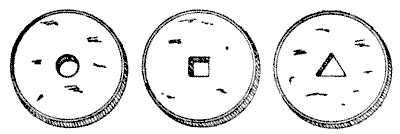 These are strung on wires like buttons. Supposing that eleven coins with round holes are worth fifteen ching-changs, that eleven with square holes are worth sixteen ching-changs, and that eleven with triangular holes are worth seventeen ching-changs, how can a Chinaman give me change for half a crown, using no coins other than the three mentioned? A ching-chang is worth exactly twopence and four-fifteenths of a ching-chang.
Sources:
These are strung on wires like buttons. Supposing that eleven coins with round holes are worth fifteen ching-changs, that eleven with square holes are worth sixteen ching-changs, and that eleven with triangular holes are worth seventeen ching-changs, how can a Chinaman give me change for half a crown, using no coins other than the three mentioned? A ching-chang is worth exactly twopence and four-fifteenths of a ching-chang.
Sources:
- Amusements in Mathematics, Henry Ernest Dudeney Question 25
-
THE JUNIOR CLERK'S PUZZLE
Two youths, bearing the pleasant names of Moggs and Snoggs, were employed as junior clerks by a merchant in Mincing Lane. They were both engaged at the same salary—that is, commencing at the rate of £`50` a year, payable half-yearly. Moggs had a yearly rise of £`10`, and Snoggs was offered the same, only he asked, for reasons that do not concern our puzzle, that he might take his rise at £`2, 10`s. half-yearly, to which his employer (not, perhaps, unnaturally!) had no objection.
Now we come to the real point of the puzzle. Moggs put regularly into the Post Office Savings Bank a certain proportion of his salary, while Snoggs saved twice as great a proportion of his, and at the end of five years they had together saved £`268, 15`s. How much had each saved? The question of interest can be ignored.
Sources:- Amusements in Mathematics, Henry Ernest Dudeney Question 26
-
GIVING CHANGE
Every one is familiar with the difficulties that frequently arise over the giving of change, and how the assistance of a third person with a few coins in his pocket will sometimes help us to set the matter right. Here is an example. An Englishman went into a shop in New York and bought goods at a cost of thirty-four cents. The only money he had was a dollar, a three-cent piece, and a two-cent piece. The tradesman had only a half-dollar and a quarter-dollar. But another customer happened to be present, and when asked to help produced two dimes, a five-cent piece, a two-cent piece, and a one-cent piece. How did the tradesman manage to give change? For the benefit of those readers who are not familiar with the American coinage, it is only necessary to say that a dollar is a hundred cents and a dime ten cents. A puzzle of this kind should rarely cause any difficulty if attacked in a proper manner. Sources:- Amusements in Mathematics, Henry Ernest Dudeney Question 27
-
THE BROKEN COINS
A man had three coins—a sovereign, a shilling, and a penny—and he found that exactly the same fraction of each coin had been broken away. Now, assuming that the original intrinsic value of these coins was the same as their nominal value—that is, that the sovereign was worth a pound, the shilling worth a shilling, and the penny worth a penny—what proportion of each coin has been lost if the value of the three remaining fragments is exactly one pound? Sources:- Amusements in Mathematics, Henry Ernest Dudeney Question 29
-
DOMESTIC ECONOMY
Young Mrs. Perkins, of Putney, writes to me as follows: "I should be very glad if you could give me the answer to a little sum that has been worrying me a good deal lately. Here it is: We have only been married a short time, and now, at the end of two years from the time when we set up housekeeping, my husband tells me that he finds we have spent a third of his yearly income in rent, rates, and taxes, one-half in domestic expenses, and one-ninth in other ways. He has a balance of £`190` remaining in the bank. I know this last, because he accidentally left out his pass-book the other day, and I peeped into it. Don't you think that a husband ought to give his wife his entire confidence in his money matters? Well, I do; and—will you believe it?—he has never told me what his income really is, and I want, very naturally, to find out. Can you tell me what it is from the figures I have given you?"
Yes; the answer can certainly be given from the figures contained in Mrs. Perkins's letter. And my readers, if not warned, will be practically unanimous in declaring the income to be—something absurdly in excess of the correct answer!
Sources:- Amusements in Mathematics, Henry Ernest Dudeney Question 31
-
A PUZZLE IN REVERSALS
Most people know that if you take any sum of money in pounds, shillings, and pence, in which the number of pounds (less than £`12`) exceeds that of the pence, reverse it (calling the pounds pence and the pence pounds), find the difference, then reverse and add this difference, the result is always £`12, 18`s. `11`d. But if we omit the condition, "less than £`12`," and allow nought to represent shillings or pence—(`1`) What is the lowest amount to which the rule will not apply? (`2`) What is the highest amount to which it will apply? Of course, when reversing such a sum as £`14, 15`s. `3`d. it may be written £`3, 16`s. `2`d., which is the same as £`3, 15`s. `14`d.Sources:Topics:Arithmetic Algebra -> Word Problems Combinatorics -> Case Analysis / Checking Cases -> Processes / Procedures- Amusements in Mathematics, Henry Ernest Dudeney Question 33
-
THE GROCER AND DRAPER
A country "grocer and draper" had two rival assistants, who prided themselves on their rapidity in serving customers. The young man on the grocery side could weigh up two one-pound parcels of sugar per minute, while the drapery assistant could cut three one-yard lengths of cloth in the same time. Their employer, one slack day, set them a race, giving the grocer a barrel of sugar and telling him to weigh up forty-eight one-pound parcels of sugar While the draper divided a roll of forty-eight yards of cloth into yard pieces. The two men were interrupted together by customers for nine minutes, but the draper was disturbed seventeen times as long as the grocer. What was the result of the race?Sources:Topics:Arithmetic Algebra -> Word Problems Algebra -> Inequalities -> Averages / Means Units of Measurement- Amusements in Mathematics, Henry Ernest Dudeney Question 34