Young Mathematician Olympiad, 2018-2019, Final, Grades 5-6
-
Question 1 - Parentheses
Add parentheses to make the result as large as possible:
`10000-1000-100-10-1`
Additional sources: -
Question 2 - The Beaver and the Mole
There is a plot of land in the shape of a square `4 times 4` divided into cells of `1 times 1`. The beaver wants to build a house on it that occupies 4 cells, which from a top-down view looks like this:
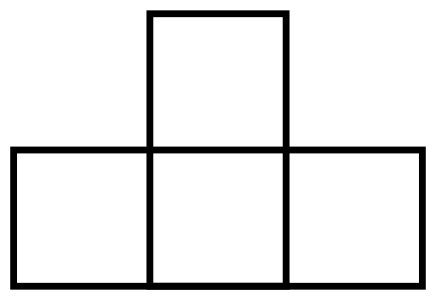
The mole wants to disturb him. For this purpose, it can dig holes, each of which occupies one cell. It is impossible to build on the cells that have become holes. What is the smallest number of holes the mole needs to dig so that the beaver cannot build the house?
Additional sources: -
Question 3 - Another Donkey in the Middle
Avi, Beni, and Gadi played "Donkey in the Middle" - at any given moment, someone is in the middle, trying to catch a ball that the other two are passing to each other.
If he succeeds, one of the other two replaces him. After the game, Avi said that he was in the middle 8 times,
Beni said he was in the middle 4 times, and Gadi forgot how many times he was in the middle.
They also remember that Beni was the last one in the middle. Describe all the possibilities for the number of times Gadi was in the middle, -
Question 4 - Consecutive Numbers
a. Avi wants to find 10 consecutive numbers whose sum is divisible by 90. Will he succeed?
b. Benny wants to find 11 consecutive numbers such that their sum is divisible by 90. Will he succeed? -
Question 5 - 6 on the Board
The number 6 is written on the board. At each step, you can add the digit 6 to the end of the number (so that it is the units digit,) or replace the number with the sum of its digits.
Which numbers can be obtained in this way? Describe the entire set of numbers and explain why there are no moreAdditional sources:Topics:Arithmetic Number Theory -> Modular Arithmetic / Remainder Arithmetic -> Divisibility Rules -> Divisibility Rules by 3 and 9 Combinatorics -> Induction (Mathematical Induction) Logic -> Reasoning / Logic Number Theory -> Division -> Parity (Even/Odd) Algebra -> Sequences Combinatorics -> Case Analysis / Checking Cases -> Processes / Procedures -
Question 6 - Numbers on the Board
The following numbers are written on the board:`1/3,1/2,1,2,3`. In each step, you are allowed to choose any two numbers written on the board and replace each of them with their product.
Can you reach a quintet of numbers in this way whose sum is `4 1/4`? -
Question 7 - The Parallelogram
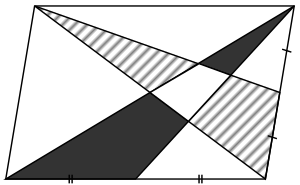
In the drawing, there is a parallelogram with its diagonals drawn and the midpoints of two of its sides connected to opposite vertices.
Which area is larger: the shaded or the striped?