Combinatorics, Case Analysis / Checking Cases, Processes / Procedures
This category covers problems involving sequences of operations or steps that evolve over time or iterations. Questions might ask about the outcome of a process, whether it terminates, or properties of its state after a certain number of steps. Often related to algorithms or invariants.
-
Question
A box contains pencils in three colors: red, green, and blue, totaling `20` pencils. There are `6` times more blue pencils than green pencils. There are fewer red pencils than green pencils. How many red pencils are in the box?
-
Question
A grasshopper can jump `80` centimeters forward or `50` centimeters backward. Can the grasshopper move away from its starting point in fewer than `7` jumps to a distance of exactly one meter and `70` cm?
-
Birds and Seeds
Nine identical birds eat less than `1001` seeds for lunch, and ten such birds eat more than `1100` seeds for lunch. How many seeds does one bird eat for lunch?
-
Question
Find all natural numbers with the following property: when divided by 7, their remainder is equal to their quotient.
-
Question
Find all two-digit numbers `A` such that the square of the sum of its digits is equal to the sum of the digits of `A^2`.
-
Question
Can the product of two consecutive natural numbers be equal to the product of two consecutive even numbers?
-
Question
`10` identical books cost more than `11` dollars, and `9` books of the same type cost less than `10` dollars. How much does one book cost?
Topics:Algebra -> Inequalities Algebra -> Word Problems Combinatorics -> Case Analysis / Checking Cases -> Processes / Procedures -
Ants on a Stick
On a stick that is one meter long, there are `10` ants, `5` from each side, at distances of one centimeter (see the picture). The ants on the left side of the stick move to the right, and the ants on the right side of the stick move to the left. The speed of each ant is constant and equal to one centimeter per second. When two ants meet, they both reverse direction and start moving away from each other. When any ant reaches the end of the stick, it falls off (ants are particularly stupid creatures).
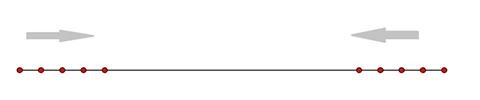
a. Will all the ants fall off the stick, and if so, in how much time?
b. How many collisions will occur between the ants?
-
Who Broke the Glass?
One of the following four students: Avi, Benny, Gili, and Danny – broke a glass. The principal asks them who did it. Here are the answers she received:
Avi: I know for certain that whoever broke the glass, it was not me or Benny.
Benny: I know for certain that whoever broke the glass, it was not me or Danny.
Gili: I know for certain that whoever broke the glass, it was not me or Benny.
Danny: I know for certain that whoever broke the glass, it was not me or Avi.
It is known that only one of them broke the glass, and it is also known that three of the students told the truth, and one lied. So who broke the glass?
-
Question
A two-digit number is written on the board. Avi claims that the units digit of the number is twice the tens digit. Beni claims that the number is divisible by `9`. Gal claims that the number is divisible by `4`. Dani claims that the number is divisible by `27`. It is known that one of them is wrong, and the rest are correct. What number is written on the board?
Topics:Number Theory -> Modular Arithmetic / Remainder Arithmetic -> Divisibility Rules -> Divisibility Rules by 2, 4, and 8 Number Theory -> Modular Arithmetic / Remainder Arithmetic -> Divisibility Rules -> Divisibility Rules by 3 and 9 Algebra -> Word Problems Logic -> Reasoning / Logic Combinatorics -> Case Analysis / Checking Cases -> Processes / Procedures