Combinatorics, Case Analysis / Checking Cases, Processes / Procedures
This category covers problems involving sequences of operations or steps that evolve over time or iterations. Questions might ask about the outcome of a process, whether it terminates, or properties of its state after a certain number of steps. Often related to algorithms or invariants.
-
The Beaver and the Mole
There is a plot of land in the shape of a square `4 times 4` divided into cells of `1 times 1`. The beaver wants to build a house on it that occupies 4 cells, which from a top-down view looks like this:
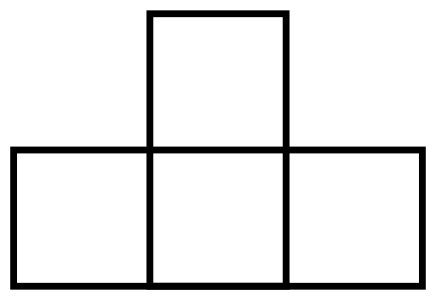
The mole wants to disturb him. For this purpose, it can dig holes, each of which occupies one cell. It is impossible to build on the cells that have become holes. What is the smallest number of holes the mole needs to dig so that the beaver cannot build the house?
Sources: -
Doughnuts
Ayala, Benny, Gili, Danny, and Hadas received a package of doughnuts containing
- 10 doughnuts with dulce de leche
- 8 doughnuts with peanut butter
- 9 doughnuts with chocolate
- 11 with strawberry jam
Each of them has their favorite type of doughnut.
- Ayala ate 5 doughnuts of her favorite type
- Benny ate 6 doughnuts of his favorite type
- Gili ate 7 doughnuts of her favorite type
- Danny ate 8 doughnuts of his favorite type
- Hadas ate 9 doughnuts of her favorite type
After that, they were left with 3 doughnuts of different types. What is each of their favorite type of doughnut?
Sources: -
6 on the Board
The number 6 is written on the board. At each step, you can add the digit 6 to the end of the number (so that it is the units digit,) or replace the number with the sum of its digits.
Which numbers can be obtained in this way? Describe the entire set of numbers and explain why there are no moreSources:Topics:Arithmetic Number Theory -> Modular Arithmetic / Remainder Arithmetic -> Divisibility Rules -> Divisibility Rules by 3 and 9 Combinatorics -> Induction (Mathematical Induction) Logic -> Reasoning / Logic Number Theory -> Division -> Parity (Even/Odd) Algebra -> Sequences Combinatorics -> Case Analysis / Checking Cases -> Processes / Procedures -
Another Donkey in the Middle
Avi, Beni, and Gadi played "Donkey in the Middle" - at any given moment, someone is in the middle, trying to catch a ball that the other two are passing to each other.
Sources:
If he succeeds, one of the other two replaces him. After the game, Avi said that he was in the middle 8 times,
Beni said he was in the middle 4 times, and Gadi forgot how many times he was in the middle.
They also remember that Beni was the last one in the middle. Describe all the possibilities for the number of times Gadi was in the middle, -
Ten-Digit Number
Yael writes ten-digit numbers in whose decimal representation each of the digits `0, 1, 2, 3, 4, 5, 6, 7, 8, 9` appears exactly once.
Sources:
In the numbers that Yael writes, the difference between any two adjacent digits is at least 2. What is the smallest number Yael can write?
-
The Round Table
Around a round table are 12 chairs, with knights sitting on some of them. Arthur wants to join the meeting,
Sources:
and it turns out that no matter where he sits, someone is definitely sitting next to him.
What is the smallest number of knights that can be around the table to ensure this is true? (not including Arthur) -
Two Hashes
What is the maximum number of "domino" shapes (rectangles `1 times 2` or `2 times 1`) that can be placed inside the orange shape,
such that they do not overlap and do not extend beyond the boundaries of the shape?
Sources: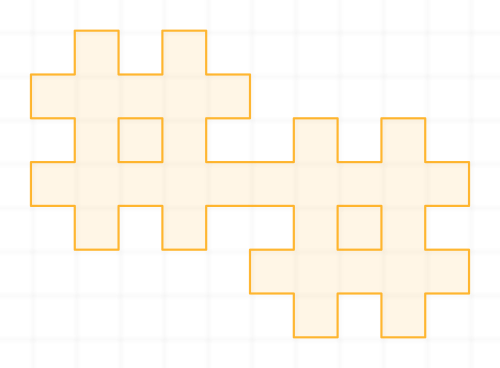
-
How many triangles?
How many triangles are there in the picture?
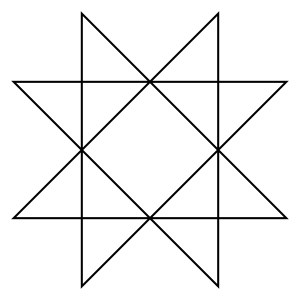 Sources:Topics:Geometry -> Plane Geometry -> Triangles Combinatorics -> Case Analysis / Checking Cases -> Processes / Procedures Geometry -> Plane Geometry -> Angle Calculation Number Theory -> Division
 -
The Number
Given a positive integer less than 2000.
If it is not divisible by 43, then it is divisible by 41,
If it is not divisible by 53, then it is divisible by 43,
If it is not divisible by 41, then it is divisible by 53.
Find the number.Sources:Topics:Number Theory -> Prime Numbers Arithmetic Number Theory -> Modular Arithmetic / Remainder Arithmetic -> Divisibility Rules Logic -> Reasoning / Logic Number Theory -> Greatest Common Divisor (GCD) and Least Common Multiple (LCM) Combinatorics -> Case Analysis / Checking Cases -> Processes / Procedures Number Theory -> Division -
SLV LVS BLS
In the following expression, different letters represent different digits, and identical letters represent identical digits:
SLV = LVS + BLS
Find the number SLV.
Sources: