Amusements in Mathematics, Henry Ernest Dudeney
-
Question 71 - SIR EDWYN DE TUDOR
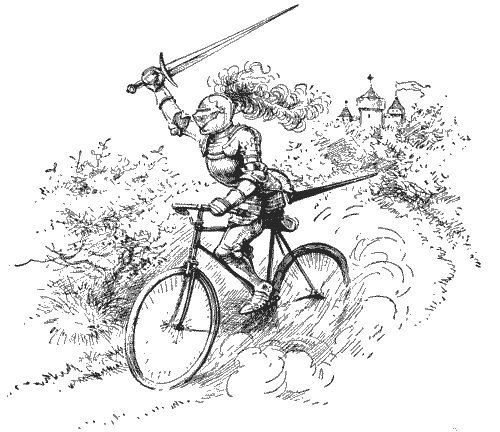 In the illustration we have a sketch of Sir Edwyn de Tudor going to rescue his lady-love, the fair Isabella, who was held a captive by a neighbouring wicked baron. Sir Edwyn calculated that if he rode fifteen miles an hour he would arrive at the castle an hour too soon, while if he rode ten miles an hour he would get there just an hour too late. Now, it was of the first importance that he should arrive at the exact time appointed, in order that the rescue that he had planned should be a success, and the time of the tryst was five o'clock, when the captive lady would be taking her afternoon tea. The puzzle is to discover exactly how far Sir Edwyn de Tudor had to ride.
-
Question 72 - THE HYDROPLANE QUESTION
The inhabitants of Slocomb-on-Sea were greatly excited over the visit of a certain flying man. All the town turned out to see the flight of the wonderful hydroplane, and, of course, Dobson and his family were there. Master Tommy was in good form, and informed his father that Englishmen made better airmen than Scotsmen and Irishmen because they are not so heavy. "How do you make that out?" asked Mr. Dobson. "Well, you see," Tommy replied, "it is true that in Ireland there are men of Cork and in Scotland men of Ayr, which is better still, but in England there are lightermen." Unfortunately it had to be explained to Mrs. Dobson, and this took the edge off the thing. The hydroplane flight was from Slocomb to the neighbouring watering-place Poodleville—five miles distant. But there was a strong wind, which so helped the airman that he made the outward journey in the short time of ten minutes, though it took him an hour to get back to the starting point at Slocomb, with the wind dead against him. Now, how long would the ten miles have taken him if there had been a perfect calm? Of course, the hydroplane's engine worked uniformly throughout. -
Question 73 - DONKEY RIDING
During a visit to the seaside Tommy and Evangeline insisted on having a donkey race over the mile course on the sands. Mr. Dobson and some of his friends whom he had met on the beach acted as judges, but, as the donkeys were familiar acquaintances and declined to part company the whole way, a dead heat was unavoidable. However, the judges, being stationed at different points on the course, which was marked off in quarter-miles, noted the following results:—The first three-quarters were run in six and three-quarter minutes, the first half-mile took the same time as the second half, and the third quarter was run in exactly the same time as the last quarter. From these results Mr. Dobson amused himself in discovering just how long it took those two donkeys to run the whole mile. Can you give the answer? -
Question 74 - THE BASKET OF POTATOES
A man had a basket containing fifty potatoes. He proposed to his son, as a little recreation, that he should place these potatoes on the ground in a straight line. The distance between the first and second potatoes was to be one yard, between the second and third three yards, between the third and fourth five yards, between the fourth and fifth seven yards, and so on—an increase of two yards for every successive potato laid down. Then the boy was to pick them up and put them in the basket one at a time, the basket being placed beside the first potato. How far would the boy have to travel to accomplish the feat of picking them all up? We will not consider the journey involved in placing the potatoes, so that he starts from the basket with them all laid out.Topics:Algebra -> Word Problems Algebra -> Sequences -> Arithmetic Progression / Arithmetic Sequence -
Question 75 - THE PASSENGER'S FARE
At first sight you would hardly think there was matter for dispute in the question involved in the following little incident, yet it took the two persons concerned some little time to come to an agreement. Mr. Smithers hired a motor-car to take him from Addleford to Clinkerville and back again for £`3`. At Bakenham, just midway, he picked up an acquaintance, Mr. Tompkins, and agreed to take him on to Clinkerville and bring him back to Bakenham on the return journey. How much should he have charged the passenger? That is the question. What was a reasonable fare for Mr. Tompkins?
Topics:Algebra -> Word Problems -
Question 76 - THE BARREL OF BEER
A man bought an odd lot of wine in barrels and one barrel containing beer. These are shown in the illustration, marked with the number of gallons that each barrel contained. He sold a quantity of the wine to one man and twice the quantity to another, but kept the beer to himself. The puzzle is to point out which barrel contains beer. Can you say which one it is? Of course, the man sold the barrels just as he bought them, without manipulating in any way the contents.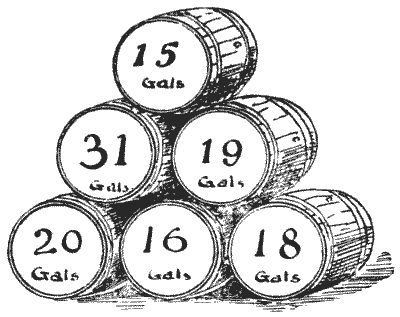
-
Question 77 - DIGITS AND SQUARES
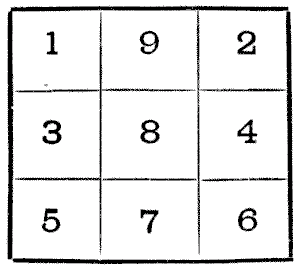 It will be seen in the diagram that we have so arranged the nine digits in a square that the number in the second row is twice that in the first row, and the number in the bottom row three times that in the top row. There are three other ways of arranging the digits so as to produce the same result. Can you find them?
-
Question 78 - ODD AND EVEN DIGITS
The odd digits, `1, 3, 5, 7`, and `9`, add up `25`, while the even figures, `2, 4, 6`, and `8`, only add up `20`. Arrange these figures so that the odd ones and the even ones add up alike. Complex and improper fractions and recurring decimals are not allowed.Topics:Arithmetic -> Fractions -
Question 79 - THE LOCKERS PUZZLE
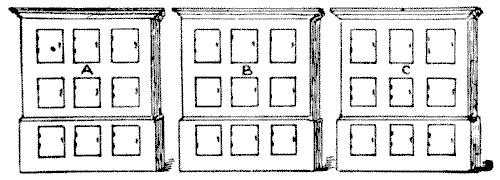
A man had in his office three cupboards, each containing nine lockers, as shown in the diagram. He told his clerk to place a different one-figure number on each locker of cupboard A, and to do the same in the case of B, and of C. As we are here allowed to call nought a digit, and he was not prohibited from using nought as a number, he clearly had the option of omitting any one of ten digits from each cupboard.
Now, the employer did not say the lockers were to be numbered in any numerical order, and he was surprised to find, when the work was done, that the figures had apparently been mixed up indiscriminately. Calling upon his clerk for an explanation, the eccentric lad stated that the notion had occurred to him so to arrange the figures that in each case they formed a simple addition sum, the two upper rows of figures producing the sum in the lowest row. But the most surprising point was this: that he had so arranged them that the addition in A gave the smallest possible sum, that the addition in C gave the largest possible sum, and that all the nine digits in the three totals were different. The puzzle is to show how this could be done. No decimals are allowed and the nought may not appear in the hundreds place.
-
Question 80 - THE THREE GROUPS
There appeared in "Nouvelles Annales de Mathématiques" the following puzzle as a modification of one of my "Canterbury Puzzles." Arrange the nine digits in three groups of two, three, and four digits, so that the first two numbers when multiplied together make the third. Thus, `12` × `483` = `5,796`. I now also propose to include the cases where there are one, four, and four digits, such as `4` × `1,738` = `6,952`. Can you find all the possible solutions in both cases?