Young Mathematician Olympiad, 2018-2019, Stage B, Grades 3-4
-
Question 1
A two-digit number is written on the board.
Avi said: "The units digit of the number is 3"
Beni said: "It's a square number"
Gili said: "This number is a multiple of 12"
Then the teacher said: "There are two correct statements and one wrong one here."
What number was written on the board? -
Question 2
Vered subtracted a number composed of the same digits written in reverse order from a three-digit number.
As a result, she obtained a two-digit number. Find the two-digit number she obtained. -
Question 3 - The Secret Area
Daniel drew four rectangles whose sides are parallel to each other. The rectangles created four intersection areas (see drawing).
Given the areas of three of the four. Find the area of the fourth intersection.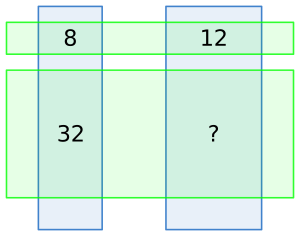
-
Question 4 - Candies
In a class, there are a number of students and each has a number of candies:
Additional sources:
There are exactly 10 children with at least one candy,
Exactly 8 children with at least two candies,
Exactly 6 children with at least 3,
Exactly 4 children with at least 4,
And exactly 2 children with 5 candies.
It is known that no one has more than 5 candies. How many candies are there in the class? -
Question 5 - Squares
You have many cardboard squares of sizes `1 times 1`, `2 times 2`, and `3 times 3`, and you must assemble them into a square of size `7 times 7`.
What is the smallest possible number of squares you will need? -
Question 6 - 2 or 5 but not 3
How many two-digit numbers are divisible by 2 or 5, and not divisible by 3?
-
Question 7 - Hexagon and Triangle
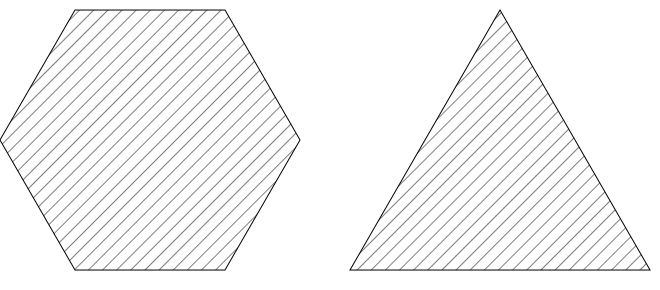
A regular hexagon and an equilateral triangle have the same perimeter. The area of the triangle is known to be 60. Find the area of the hexagon.
Additional sources: