Game Theory is the study of strategic decision-making where multiple players' choices interact. Questions involve analyzing games (like Nim, chess variants, or strategic puzzles) to find optimal strategies, determine winning/losing positions, or understand concepts like equilibrium.
A man has twenty-five dog kennels all communicating with each other by doorways, as shown in the illustration. He wishes to arrange his twenty dogs so that they shall form a knight's string from dog No. `1` to dog No. `20`, the bottom row of five kennels to be left empty, as at present. This is to be done by moving one dog at a time into a vacant kennel. The dogs are well trained to obedience, and may be trusted to remain in the kennels in which they are placed, except that if two are placed in the same kennel together they will fight it out to the death. How is the puzzle to be solved in the fewest possible moves without two dogs ever being together?
Some years ago the puzzle was proposed to construct an imaginary game of chess, in which White shall be stalemated in the fewest possible moves with all the thirty-two pieces on the board. Can you build up such a position in fewer than twenty moves?
Set up the position shown in the diagram. Then the condition of the puzzle is—White to play and checkmate in six moves. Notwithstanding the complexities, I will show how the manner of play may be condensed into quite a few lines, merely stating here that the first two moves of White cannot be varied.
The following is a prize puzzle propounded by me some years ago. Produce a game of chess which, after sixteen moves, shall leave White with all his sixteen men on their original squares and Black in possession of his king alone (not necessarily on his own square). White is then to force mate in three moves.
Starting from the ordinary arrangement of the pieces as for a game, what is the smallest possible number of moves necessary in order to arrive at the following position? The moves for both sides must, of course, be played strictly in accordance with the rules of the game, though the result will necessarily be a very weird kind of chess.
My next puzzle is supposed to be Chinese, many hundreds of years old, and never fails to interest. White to play and mate, moving each of the three pieces once, and once only.
Here is a little game of solitaire that is quite easy, but not so easy as to be uninteresting. You can either rule out the squares on a sheet of cardboard or paper, or you can use a portion of your chessboard. I have shown numbered counters in the illustration so as to make the solution easy and intelligible to all, but chess pawns or draughts will serve just as well in practice. The puzzle is to remove all the counters except one, and this one that is left must be No. `1`. You remove a counter by jumping over another counter to the next space beyond, if that square is vacant, but you cannot make a leap in a diagonal direction. The following moves will make the play quite clear: `1-9`, `2-10`, `1-2`, and so on. Here `1` jumps over `9`, and you remove `9` from the board; then `2` jumps over `10`, and you remove `10`; then `1` jumps over `2`, and you remove `2`. Every move is thus a capture, until the last capture of all is made by No. `1`.
Here is an extension of the last game of solitaire. All you need is a chessboard and the thirty-two pieces, or the same number of draughts or counters. In the illustration numbered counters are used. The puzzle is to remove all the counters except two, and these two must have originally been on the same side of the board; that is, the two left must either belong to the group `1` to `16` or to the other group, `17` to `32`. You remove a counter by jumping over it with another counter to the next square beyond, if that square is vacant, but you cannot make a leap in a diagonal direction. The following moves will make the play quite clear: `3-11`, `4-12`, `3-4`, `13-3`. Here `3` jumps over `11`, and you remove `11`; `4` jumps over `12`, and you remove `12`; and so on. It will be found a fascinating little game of patience, and the solution requires the exercise of some ingenuity.
Here is an interesting little puzzle game that I used to play with an acquaintance on the beach at Slocomb-on-Sea. Two players place an odd number of pebbles, we will say fifteen, between them. Then each takes in turn one, two, or three pebbles (as he chooses), and the winner is the one who gets the odd number. Thus, if you get seven and your opponent eight, you win. If you get six and he gets nine, he wins. Ought the first or second player to win, and how? When you have settled the question with fifteen pebbles try again with, say, thirteen.
This is a puzzle game for two players. Each player has a single rook. The first player places his rook on any square of the board that he may choose to select, and then the second player does the same. They now play in turn, the point of each play being to capture the opponent's rook. But in this game you cannot play through a line of attack without being captured. That is to say, if in the diagram it is Black's turn to play, he cannot move his rook to his king's knight's square, or to his king's rook's square, because he would enter the "line of fire" when passing his king's bishop's square. For the same reason he cannot move to his queen's rook's seventh or eighth squares. Now, the game can never end in a draw. Sooner or later one of the rooks must fall, unless, of course, both players commit the absurdity of not trying to win. The trick of winning is ridiculously simple when you know it. Can you solve the puzzle?
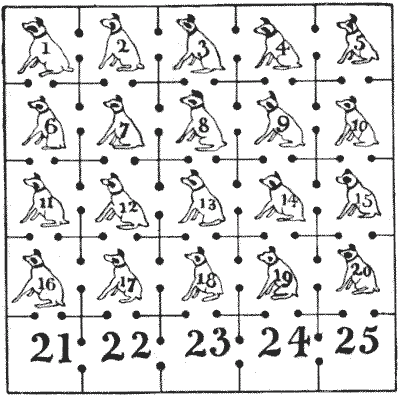 A man has twenty-five dog kennels all communicating with each other by doorways, as shown in the illustration. He wishes to arrange his twenty dogs so that they shall form a knight's string from dog No. `1` to dog No. `20`, the bottom row of five kennels to be left empty, as at present. This is to be done by moving one dog at a time into a vacant kennel. The dogs are well trained to obedience, and may be trusted to remain in the kennels in which they are placed, except that if two are placed in the same kennel together they will fight it out to the death. How is the puzzle to be solved in the fewest possible moves without two dogs ever being together?
Sources:Topics:Combinatorics -> Game Theory
A man has twenty-five dog kennels all communicating with each other by doorways, as shown in the illustration. He wishes to arrange his twenty dogs so that they shall form a knight's string from dog No. `1` to dog No. `20`, the bottom row of five kennels to be left empty, as at present. This is to be done by moving one dog at a time into a vacant kennel. The dogs are well trained to obedience, and may be trusted to remain in the kennels in which they are placed, except that if two are placed in the same kennel together they will fight it out to the death. How is the puzzle to be solved in the fewest possible moves without two dogs ever being together?
Sources:Topics:Combinatorics -> Game Theory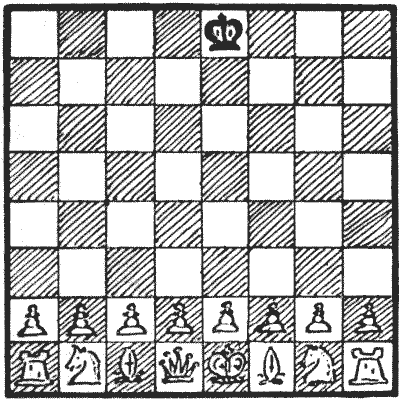 Set up the position shown in the diagram. Then the condition of the puzzle is—White to play and checkmate in six moves. Notwithstanding the complexities, I will show how the manner of play may be condensed into quite a few lines, merely stating here that the first two moves of White cannot be varied.
Sources:Topics:Combinatorics -> Game Theory
Set up the position shown in the diagram. Then the condition of the puzzle is—White to play and checkmate in six moves. Notwithstanding the complexities, I will show how the manner of play may be condensed into quite a few lines, merely stating here that the first two moves of White cannot be varied.
Sources:Topics:Combinatorics -> Game Theory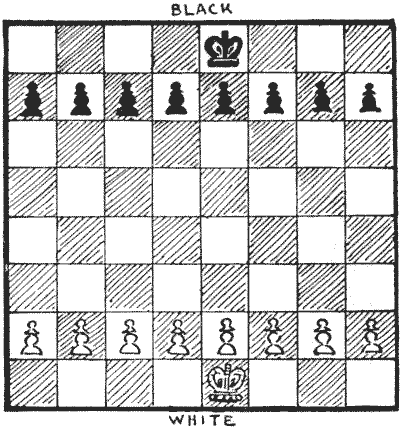 Sources:Topics:Combinatorics -> Game Theory
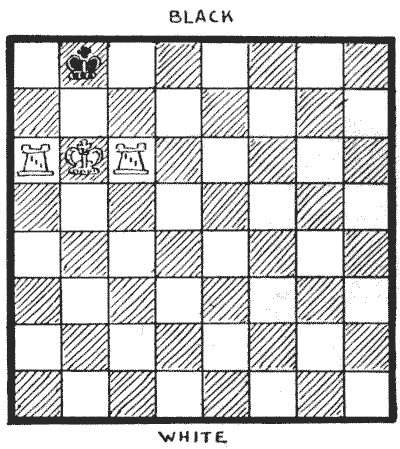 My next puzzle is supposed to be Chinese, many hundreds of years old, and never fails to interest. White to play and mate, moving each of the three pieces once, and once only.
Sources:
My next puzzle is supposed to be Chinese, many hundreds of years old, and never fails to interest. White to play and mate, moving each of the three pieces once, and once only.
Sources:
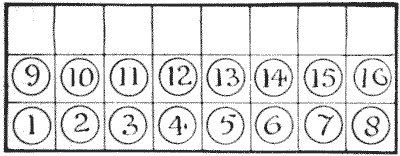 The puzzle is to remove all the counters except one, and this one that is left must be No. `1`. You remove a counter by jumping over another counter to the next space beyond, if that square is vacant, but you cannot make a leap in a diagonal direction. The following moves will make the play quite clear: `1-9`, `2-10`, `1-2`, and so on. Here `1` jumps over `9`, and you remove `9` from the board; then `2` jumps over `10`, and you remove `10`; then `1` jumps over `2`, and you remove `2`. Every move is thus a capture, until the last capture of all is made by No. `1`.
Sources:Topics:Combinatorics -> Game Theory Combinatorics -> Case Analysis / Checking Cases -> Processes / Procedures Puzzles and Rebuses
The puzzle is to remove all the counters except one, and this one that is left must be No. `1`. You remove a counter by jumping over another counter to the next space beyond, if that square is vacant, but you cannot make a leap in a diagonal direction. The following moves will make the play quite clear: `1-9`, `2-10`, `1-2`, and so on. Here `1` jumps over `9`, and you remove `9` from the board; then `2` jumps over `10`, and you remove `10`; then `1` jumps over `2`, and you remove `2`. Every move is thus a capture, until the last capture of all is made by No. `1`.
Sources:Topics:Combinatorics -> Game Theory Combinatorics -> Case Analysis / Checking Cases -> Processes / Procedures Puzzles and Rebuses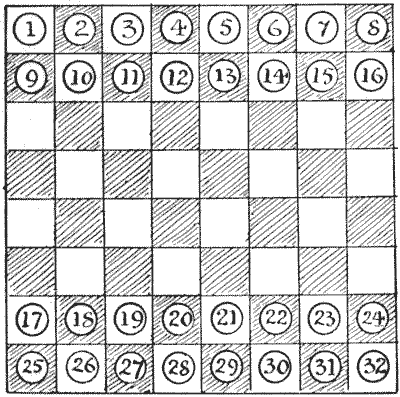 Here is an extension of the last game of solitaire. All you need is a chessboard and the thirty-two pieces, or the same number of draughts or counters. In the illustration numbered counters are used. The puzzle is to remove all the counters except two, and these two must have originally been on the same side of the board; that is, the two left must either belong to the group `1` to `16` or to the other group, `17` to `32`. You remove a counter by jumping over it with another counter to the next square beyond, if that square is vacant, but you cannot make a leap in a diagonal direction. The following moves will make the play quite clear: `3-11`, `4-12`, `3-4`, `13-3`. Here `3` jumps over `11`, and you remove `11`; `4` jumps over `12`, and you remove `12`; and so on. It will be found a fascinating little game of patience, and the solution requires the exercise of some ingenuity.
Sources:Topics:Combinatorics -> Game Theory Logic -> Reasoning / Logic Combinatorics -> Case Analysis / Checking Cases -> Processes / Procedures Puzzles and Rebuses
Here is an extension of the last game of solitaire. All you need is a chessboard and the thirty-two pieces, or the same number of draughts or counters. In the illustration numbered counters are used. The puzzle is to remove all the counters except two, and these two must have originally been on the same side of the board; that is, the two left must either belong to the group `1` to `16` or to the other group, `17` to `32`. You remove a counter by jumping over it with another counter to the next square beyond, if that square is vacant, but you cannot make a leap in a diagonal direction. The following moves will make the play quite clear: `3-11`, `4-12`, `3-4`, `13-3`. Here `3` jumps over `11`, and you remove `11`; `4` jumps over `12`, and you remove `12`; and so on. It will be found a fascinating little game of patience, and the solution requires the exercise of some ingenuity.
Sources:Topics:Combinatorics -> Game Theory Logic -> Reasoning / Logic Combinatorics -> Case Analysis / Checking Cases -> Processes / Procedures Puzzles and Rebuses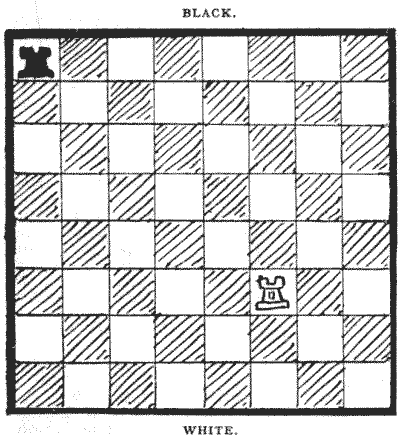 Sources:Topics:Combinatorics -> Combinatorial Geometry Combinatorics -> Invariants Combinatorics -> Game Theory Logic -> Reasoning / Logic Combinatorics -> Colorings -> Chessboard Coloring