Combinatorics, Colorings, Chessboard Coloring
Chessboard coloring uses the alternating black and white pattern of a standard chessboard (or similar grid colorings) as a tool to solve problems, particularly those involving tiling, covering, or movement on grids. It's a specific application of invariant or parity arguments.
-
Question
On the circle, there are blue and red points. It is allowed to add a red point and change the colors of its neighboring points or remove a red point and change the colors of its neighboring points (it is not allowed to leave fewer than 2 points on the circle). Prove that it is impossible to move, using only these operations, from a circle with two red points to a circle with two blue points.
K. KaznvoskySources:Topics:Combinatorics -> Combinatorial Geometry Combinatorics -> Invariants Algebra Logic -> Reasoning / Logic Number Theory -> Division -> Parity (Even/Odd) Set Theory Combinatorics -> Case Analysis / Checking Cases -> Processes / Procedures Combinatorics -> Colorings -> Chessboard Coloring- Tournament of Towns, 1979-1980, Main, Spring Question 1
-
Question
Is it possible to tile a `5xx5` board with dominoes?
Note: The size of a board square matches the size of a domino square.
Topics:Combinatorics -> Combinatorial Geometry Logic -> Reasoning / Logic Number Theory -> Division -> Parity (Even/Odd) Combinatorics -> Colorings -> Chessboard Coloring -
Question
A knight exited the square `a1` and, after several moves, returned to the same square.
Is it possible that the knight made an odd number of moves?
Topics:Combinatorics -> Invariants Logic -> Reasoning / Logic Number Theory -> Division -> Parity (Even/Odd) Combinatorics -> Colorings -> Chessboard Coloring -
Question
A knight moves from square `a1` to square `h8`. Is it possible that along the way it visited every square on the board exactly once?
-
Question
From a chessboard, two opposite corners are removed (the squares `a1` and `h8`, for example). Can you tile the remaining board with dominoes?
-
Question
Prove that the given shape cannot be cut into dominoes:

-
Question
Can you cut the shape on the left into six shapes like the shape on the right?
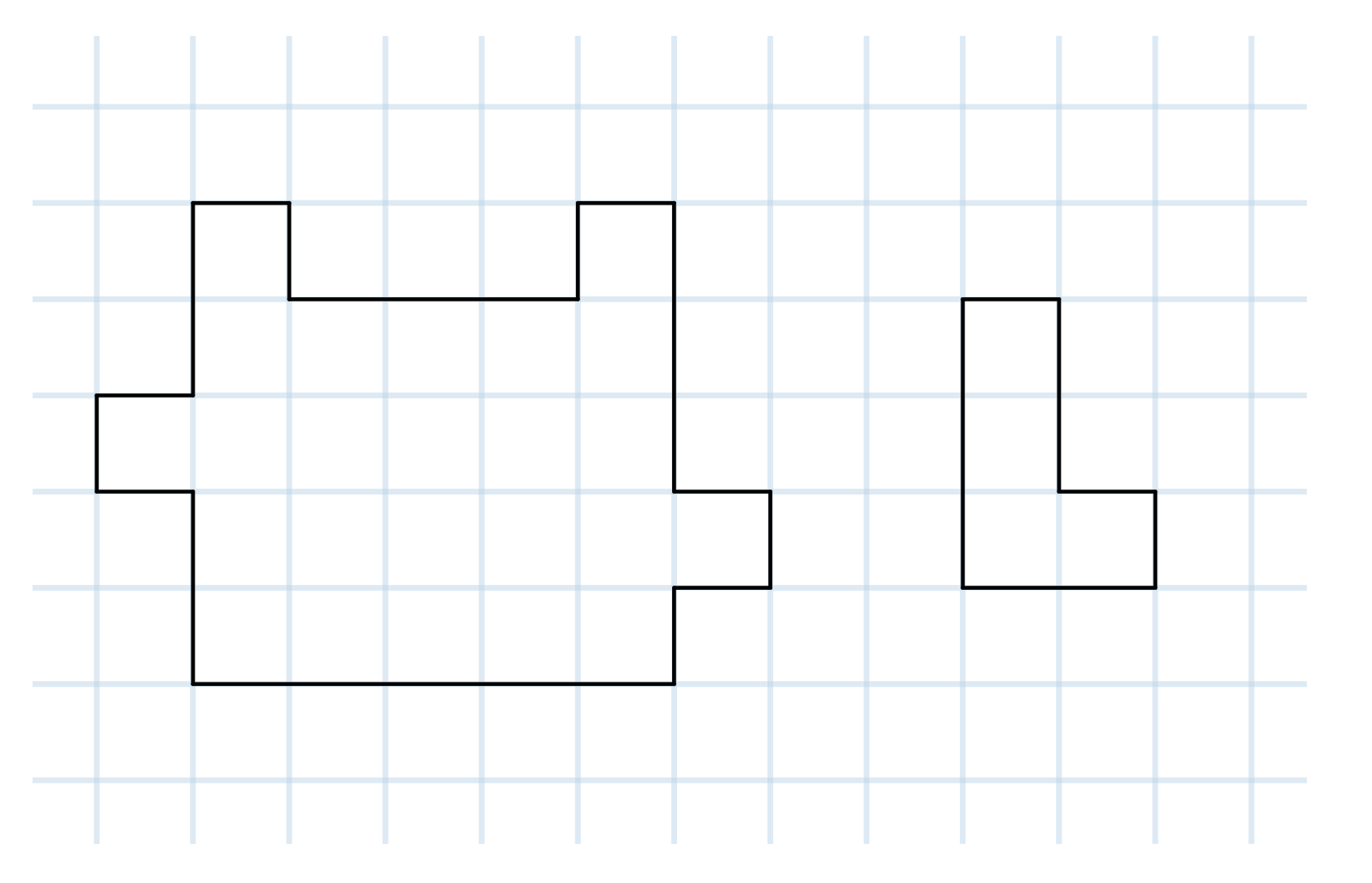
-
Question
Shlomi has a chessboard and a cube whose face size is the same as the size of a square on the board. Shlomi wants to paint the faces of the cube black and white, and then roll the cube across the board so that each time the face touching the board is the same color as the square it touches. The cube is supposed to pass through each square on the board exactly once. Can Shlomi do this? Justify or provide an example.
-
Differences in the Multiplication Table
Color the `10xx10` multiplication table with a black and white chessboard coloring, such that the cell of `1xx1` is colored black.
Find the difference between the sum of all the numbers in the black cells and the sum of all the numbers in the white cells.
1 2 3 4 5 6 7 8 9 10 1 1 2 3 4 5 6 7 8 9 10 2 2 4 6 8 10 12 14 16 18 20 3 3 6 9 12 15 18 21 24 27 30 4 4 8 12 16 20 24 28 32 36 40 5 5 10 15 20 25 30 35 40 45 50 6 6 12 18 24 30 36 42 48 54 60 7 7 14 21 28 35 42 49 56 63 70 8 8 16 24 32 40 48 56 64 72 80 9 9 18 27 36 45 54 63 72 81 90 10 10 20 30 40 50 60 70 80 90 100 Sources: -
The Grasshopper
Consider an infinite grid of squares. A grasshopper sits on one of the squares. The grasshopper can jump two squares in any horizontal or vertical direction, and it can jump to the adjacent square diagonally. Can the grasshopper ever reach a square that is adjacent to its starting square by a side?
Sources:Topics:Combinatorics -> Combinatorial Geometry Combinatorics -> Invariants Combinatorics -> Colorings -> Chessboard Coloring