Algebra, Equations
An equation is a statement that two mathematical expressions are equal. Solving an equation involves finding the values of variables that make the statement true. Questions cover various types: linear, quadratic, polynomial, rational, radical, and systems of equations.
Diophantine Equations-
THE WIDOW'S LEGACY
A gentleman who recently died left the sum of £`8,000` to be divided among his widow, five sons, and four daughters. He directed that every son should receive three times as much as a daughter, and that every daughter should have twice as much as their mother. What was the widow's share? Sources: -
INDISCRIMINATE CHARITY
A charitable gentleman, on his way home one night, was appealed to by three needy persons in succession for assistance. To the first person he gave one penny more than half the money he had in his pocket; to the second person he gave twopence more than half the money he then had in his pocket; and to the third person he handed over threepence more than half of what he had left. On entering his house he had only one penny in his pocket. Now, can you say exactly how much money that gentleman had on him when he started for home? Sources: -
BUYING PRESENTS
"Whom do you think I met in town last week, Brother William?" said Uncle Benjamin. "That old skinflint Jorkins. His family had been taking him around buying Christmas presents. He said to me, 'Why cannot the government abolish Christmas, and make the giving of presents punishable by law? I came out this morning with a certain amount of money in my pocket, and I find I have spent just half of it. In fact, if you will believe me, I take home just as many shillings as I had pounds, and half as many pounds as I had shillings. It is monstrous!'" Can you say exactly how much money Jorkins had spent on those presents? Sources:- Amusements in Mathematics, Henry Ernest Dudeney Question 10
-
THE CYCLISTS' FEAST
'Twas last Bank Holiday, so I've been told,
Some cyclists rode abroad in glorious weather.
Resting at noon within a tavern old,
They all agreed to have a feast together.
"Put it all in one bill, mine host," they said,
"For every man an equal share will pay."
The bill was promptly on the table laid,
And four pounds was the reckoning that day.
But, sad to state, when they prepared to square,
'Twas found that two had sneaked outside and fled.
So, for two shillings more than his due share
Each honest man who had remained was bled.
They settled later with those rogues, no doubt.
How many were they when they first set out?
Sources:- Amusements in Mathematics, Henry Ernest Dudeney Question 11
-
SQUARE MONEY
"This is queer," said McCrank to his friend. "Twopence added to twopence is fourpence, and twopence multiplied by twopence is also fourpence." Of course, he was wrong in thinking you can multiply money by money. The multiplier must be regarded as an abstract number. It is true that two feet multiplied by two feet will make four square feet. Similarly, two pence multiplied by two pence will produce four square pence! And it will perplex the reader to say what a "square penny" is. But we will assume for the purposes of our puzzle that twopence multiplied by twopence is fourpence. Now, what two amounts of money will produce the next smallest possible result, the same in both cases, when added or multiplied in this manner? The two amounts need not be alike, but they must be those that can be paid in current coins of the realm. Sources:- Amusements in Mathematics, Henry Ernest Dudeney Question 14
-
THE PUZZLING MONEY-BOXES
Four brothers—named John, William, Charles, and Thomas—had each a money-box. The boxes were all given to them on the same day, and they at once put what money they had into them; only, as the boxes were not very large, they first changed the money into as few coins as possible. After they had done this, they told one another how much money they had saved, and it was found that if John had had `2`s. more in his box than at present, if William had had `2`s. less, if Charles had had twice as much, and if Thomas had had half as much, they would all have had exactly the same amount.Now, when I add that all four boxes together contained `45`s., and that there were only six coins in all in them, it becomes an entertaining puzzle to discover just what coins were in each box. Sources:- Amusements in Mathematics, Henry Ernest Dudeney Question 17
-
THE NEW YEAR'S EVE SUPPERS
The proprietor of a small London café has given me some interesting figures. He says that the ladies who come alone to his place for refreshment spend each on an average eighteenpence, that the unaccompanied men spend half a crown each, and that when a gentleman brings in a lady he spends half a guinea. On New Year's Eve he supplied suppers to twenty-five persons, and took five pounds in all. Now, assuming his averages to have held good in every case, how was his company made up on that occasion? Of course, only single gentlemen, single ladies, and pairs (a lady and gentleman) can be supposed to have been present, as we are not considering larger parties. Sources:- Amusements in Mathematics, Henry Ernest Dudeney Question 19
-
BEEF AND SAUSAGES
"A neighbour of mine," said Aunt Jane, "bought a certain quantity of beef at two shillings a pound, and the same quantity of sausages at eighteenpence a pound. I pointed out to her that if she had divided the same money equally between beef and sausages she would have gained two pounds in the total weight. Can you tell me exactly how much she spent?"
"Of course, it is no business of mine," said Mrs. Sunniborne; "but a lady who could pay such prices must be somewhat inexperienced in domestic economy."
"I quite agree, my dear," Aunt Jane replied, "but you see that is not the precise point under discussion, any more than the name and morals of the tradesman."
Sources:- Amusements in Mathematics, Henry Ernest Dudeney Question 20
-
A DEAL IN EGGS
A man went recently into a dairyman's shop to buy eggs. He wanted them of various qualities. The salesman had new-laid eggs at the high price of fivepence each, fresh eggs at one penny each, eggs at a halfpenny each, and eggs for electioneering purposes at a greatly reduced figure, but as there was no election on at the time the buyer had no use for the last. However, he bought some of each of the three other kinds and obtained exactly one hundred eggs for eight and fourpence. Now, as he brought away exactly the same number of eggs of two of the three qualities, it is an interesting puzzle to determine just how many he bought at each price. Sources:- Amusements in Mathematics, Henry Ernest Dudeney Question 22
-
CHINESE MONEY
The Chinese are a curious people, and have strange inverted ways of doing things. It is said that they use a saw with an upward pressure instead of a downward one, that they plane a deal board by pulling the tool toward them instead of pushing it, and that in building a house they first construct the roof and, having raised that into position, proceed to work downwards. In money the currency of the country consists of taels of fluctuating value. The tael became thinner and thinner until `2,000` of them piled together made less than three inches in height. The common cash consists of brass coins of varying thicknesses, with a round, square, or triangular hole in the centre, as in our illustration.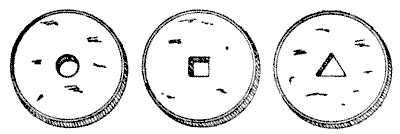 These are strung on wires like buttons. Supposing that eleven coins with round holes are worth fifteen ching-changs, that eleven with square holes are worth sixteen ching-changs, and that eleven with triangular holes are worth seventeen ching-changs, how can a Chinaman give me change for half a crown, using no coins other than the three mentioned? A ching-chang is worth exactly twopence and four-fifteenths of a ching-chang.
Sources:
These are strung on wires like buttons. Supposing that eleven coins with round holes are worth fifteen ching-changs, that eleven with square holes are worth sixteen ching-changs, and that eleven with triangular holes are worth seventeen ching-changs, how can a Chinaman give me change for half a crown, using no coins other than the three mentioned? A ching-chang is worth exactly twopence and four-fifteenths of a ching-chang.
Sources:
- Amusements in Mathematics, Henry Ernest Dudeney Question 25