Algebra, Equations
An equation is a statement that two mathematical expressions are equal. Solving an equation involves finding the values of variables that make the statement true. Questions cover various types: linear, quadratic, polynomial, rational, radical, and systems of equations.
Diophantine Equations-
ROVER'S AGE
"Now, then, Tommy, how old is Rover?" Mildred's young man asked her brother.
"Well, five years ago," was the youngster's reply, "sister was four times older than the dog, but now she is only three times as old."
Can you tell Rover's age?
Sources:- Amusements in Mathematics, Henry Ernest Dudeney Question 47
-
CONCERNING TOMMY'S AGE
Tommy Smart was recently sent to a new school. On the first day of his arrival the teacher asked him his age, and this was his curious reply: "Well, you see, it is like this. At the time I was born—I forget the year—my only sister, Ann, happened to be just one-quarter the age of mother, and she is now one-third the age of father." "That's all very well," said the teacher, "but what I want is not the age of your sister Ann, but your own age." "I was just coming to that," Tommy answered; "I am just a quarter of mother's present age, and in four years' time I shall be a quarter the age of father. Isn't that funny?"
This was all the information that the teacher could get out of Tommy Smart. Could you have told, from these facts, what was his precise age? It is certainly a little puzzling.
Sources:- Amusements in Mathematics, Henry Ernest Dudeney Question 48
-
NEXT-DOOR NEIGHBOURS
There were two families living next door to one another at Tooting Bec—the Jupps and the Simkins. The united ages of the four Jupps amounted to one hundred years, and the united ages of the Simkins also amounted to the same. It was found in the case of each family that the sum obtained by adding the squares of each of the children's ages to the square of the mother's age equalled the square of the father's age. In the case of the Jupps, however, Julia was one year older than her brother Joe, whereas Sophy Simkin was two years older than her brother Sammy. What was the age of each of the eight individuals? Sources:- Amusements in Mathematics, Henry Ernest Dudeney Question 49
-
HOW OLD WAS MARY?
Here is a funny little age problem, by the late Sam Loyd, which has been very popular in the United States. Can you unravel the mystery?The combined ages of Mary and Ann are forty-four years, and Mary is twice as old as Ann was when Mary was half as old as Ann will be when Ann is three times as old as Mary was when Mary was three times as old as Ann. How old is Mary? That is all, but can you work it out? If not, ask your friends to help you, and watch the shadow of bewilderment creep over their faces as they attempt to grip the intricacies of the question. Sources:- Amusements in Mathematics, Henry Ernest Dudeney Question 51
-
WHAT WAS THE TIME?
"I say, Rackbrane, what is the time?" an acquaintance asked our friend the professor the other day. The answer was certainly curious.
"If you add one quarter of the time from noon till now to half the time from now till noon to-morrow, you will get the time exactly."
What was the time of day when the professor spoke?
Sources:- Amusements in Mathematics, Henry Ernest Dudeney Question 57
-
A TIME PUZZLE
How many minutes is it until six o'clock if fifty minutes ago it was four times as many minutes past three o'clock? Sources:- Amusements in Mathematics, Henry Ernest Dudeney Question 58
-
THE TWO TRAINS
I put this little question to a stationmaster, and his correct answer was so prompt that I am convinced there is no necessity to seek talented railway officials in America or elsewhere.
Two trains start at the same time, one from London to Liverpool, the other from Liverpool to London. If they arrive at their destinations one hour and four hours respectively after passing one another, how much faster is one train running than the other?
Sources:- Amusements in Mathematics, Henry Ernest Dudeney Question 68
-
DRAWING HER PENSION
"Speaking of odd figures," said a gentleman who occupies some post in a Government office, "one of the queerest characters I know is an old lame widow who climbs up a hill every week to draw her pension at the village post office. She crawls up at the rate of a mile and a half an hour and comes down at the rate of four and a half miles an hour, so that it takes her just six hours to make the double journey. Can any of you tell me how far it is from the bottom of the hill to the top?" Sources:- Amusements in Mathematics, Henry Ernest Dudeney Question 70
-
SIR EDWYN DE TUDOR
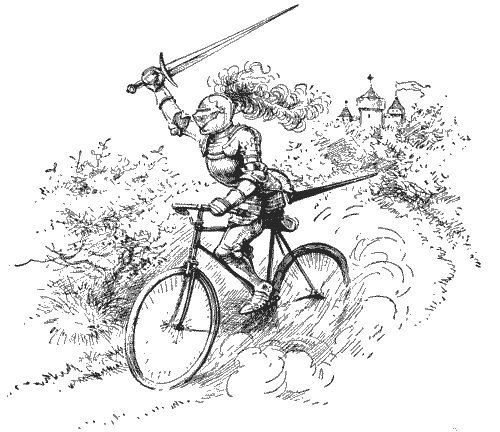 In the illustration we have a sketch of Sir Edwyn de Tudor going to rescue his lady-love, the fair Isabella, who was held a captive by a neighbouring wicked baron. Sir Edwyn calculated that if he rode fifteen miles an hour he would arrive at the castle an hour too soon, while if he rode ten miles an hour he would get there just an hour too late. Now, it was of the first importance that he should arrive at the exact time appointed, in order that the rescue that he had planned should be a success, and the time of the tryst was five o'clock, when the captive lady would be taking her afternoon tea. The puzzle is to discover exactly how far Sir Edwyn de Tudor had to ride.
Sources:
In the illustration we have a sketch of Sir Edwyn de Tudor going to rescue his lady-love, the fair Isabella, who was held a captive by a neighbouring wicked baron. Sir Edwyn calculated that if he rode fifteen miles an hour he would arrive at the castle an hour too soon, while if he rode ten miles an hour he would get there just an hour too late. Now, it was of the first importance that he should arrive at the exact time appointed, in order that the rescue that he had planned should be a success, and the time of the tryst was five o'clock, when the captive lady would be taking her afternoon tea. The puzzle is to discover exactly how far Sir Edwyn de Tudor had to ride.
Sources:
- Amusements in Mathematics, Henry Ernest Dudeney Question 71
-
THE HYDROPLANE QUESTION
The inhabitants of Slocomb-on-Sea were greatly excited over the visit of a certain flying man. All the town turned out to see the flight of the wonderful hydroplane, and, of course, Dobson and his family were there. Master Tommy was in good form, and informed his father that Englishmen made better airmen than Scotsmen and Irishmen because they are not so heavy. "How do you make that out?" asked Mr. Dobson. "Well, you see," Tommy replied, "it is true that in Ireland there are men of Cork and in Scotland men of Ayr, which is better still, but in England there are lightermen." Unfortunately it had to be explained to Mrs. Dobson, and this took the edge off the thing. The hydroplane flight was from Slocomb to the neighbouring watering-place Poodleville—five miles distant. But there was a strong wind, which so helped the airman that he made the outward journey in the short time of ten minutes, though it took him an hour to get back to the starting point at Slocomb, with the wind dead against him. Now, how long would the ten miles have taken him if there had been a perfect calm? Of course, the hydroplane's engine worked uniformly throughout. Sources:- Amusements in Mathematics, Henry Ernest Dudeney Question 72