Algebra, Word Problems
Word problems present mathematical challenges in a narrative or real-world context. Solving them requires translating the text into mathematical equations or expressions and then applying appropriate mathematical techniques. These can span arithmetic, algebra, geometry, etc.
Motion Problems Solving Word Problems "From the End" / Working Backwards-
Question
Seven wolves eat seven sheep in seven days. How long will it take `9` wolves to eat `9` sheep?
-
An Ancient Russian Riddle
Two woodcutters, Ivan and Prokhor, were working together in the forest. They settled down to eat lunch. Ivan had `4` pitas, and Prokhor had `8`. At that moment, a hunter passed by them and asked to join the meal, so they divided the `12` pitas equally among the three of them. After the meal, the hunter really wanted to thank the woodcutters and gave them `15` kopecks. After he left, Ivan and Prokhor began to discuss how to divide the money.
Prokhor suggested simply dividing it equally. But Ivan argued that this would not be fair, because he had twice as few pitas, therefore, in his opinion, Prokhor should receive `10` kopecks and Ivan himself - `5`. How do you think the money should be divided fairly?
-
Question
Three travelers need to cross a river. They have a boat that can hold a load of up to `100` kilograms. The travelers weigh `45`, `50`, and `80` kilograms. How should the travelers proceed to cross to the other side?
-
Question
The company "The Diligent Builder" is engaged in stockpiling trees in a magical forest in Canada. A nature protection association called "The Green Avenger" wants to protect the forest and opposes the company's activity. As a result, the company's CEO said the following sentence:
"`99%` of the trees in the forest are maple trees. In the coming year, we are going to cut down only maple trees, and as a result, the percentage of maple trees in the forest in a year will become `98%`."
What percentage of the trees in the forest do the Diligent Builders intend to cut down?
-
Where Did the Extra Thaler Come From?
A cobbler named Karl made boots and sent his young son Hans to the market to sell them for `25` thalers. When Hans arrived at the market, two disabled men approached him, one without a left leg, the other without a right leg, and asked to buy one boot each. Hans agreed and sold each of them a boot for `12.5` thalers.
When Hans returned home and told his father what had happened, Karl decided that these people should have been sold boots at a lower price - `10` thalers per boot. So he gave Hans `5` thalers and asked him to return `2.5` thalers to each of them.
On his way to the market, Hans saw a sweets stall, couldn't resist, and spent `3` thalers of what his father had given him there. After that, he found the two disabled men and gave each of them one thaler, because that's all he had left. When Hans returned home, he regretted what he had done and told his father everything. The cobbler Karl was very angry and locked his son in the pantry as punishment.
Thus, Hans sits in the pantry and analyzes what happened that day: "I returned one thaler to each of the disabled men, which means that each of them ultimately paid `12.5-1=11.5` thalers for his boot. So in total they paid `11.5*2=23` thalers. And I spent three thalers on sweets. That's a total of `26` thalers, but there were `25`! Where did one more thaler come from?"
-
Camel Division (Ancient Question)
An old Arab merchant had three sons. He bequeathed them 17 camels, and in his will, he requested that the eldest son receive half of the camels, the middle son receive a third, and the youngest a ninth. The sons could not divide the camels among themselves as stated in the will without slaughtering some of the camels – and they did not want to do that. So they turned to the Qadi for help.
The Qadi added one of his own camels to the 17 camels, and divided the 18 camels as follows: the eldest son received 9 camels, which is half of the amount, the middle son received 6 camels, which is a third of the amount, and the youngest son received 2 camels, which is a ninth of the amount, for a total of 17 camels divided, and the extra camel was returned to the Qadi.
The brothers were amazed by the wisdom of the Qadi and began to think: how did it happen that each received even more than he was supposed to receive according to the will?
-
Signs
A cyclist is riding on a straight road without turns and sees the following sign by the side of the road:
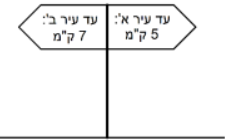
He continues moving and sees another sign:
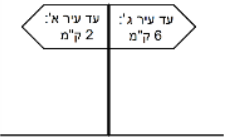
Find the distance between cities B and C.
Sources: -
Question
Grandma Hannah has many flowerpots with flowers in her house. One day, her three grandchildren, Avi, Beni, and Gili, came to visit and tried to guess how many flowerpots she has.
Sources:
Avi said: "Grandma has more than 8 flowerpots,"
Beni said: "More than 10, I think,"
And then Gili said: "Grandma Hannah has at least 12 flowerpots."
"Two of you are right, and one of you is wrong," answered the grandmother. So how many flowerpots does she have in the house? -
Sheep and Camels
Shmuel has a flock of 9 sheep and 5 camels. He wants to divide the flock between his two sons, Yossi and Danny, so that each of them receives an equal share of the value.
Sources:
It is known that 7 sheep cost as much as 3 camels. How can Shmuel divide the flock between his two sons equally, without selling any animals? -
Log of Wood
You have a very long log of wood. Can you measure exactly one meter from it, if you have for this purpose:
а. A stick with a length of one and a half meters and another stick with a length of 40 centimeters,
б. A stick with a length of one and a half meters and another stick with a length of 30 centimeters,Assuming you have no other measuring tools? Explain!
Sources:Topics:Combinatorics -> Invariants Algebra -> Word Problems Logic -> Reasoning / Logic Arithmetic -> Division with Remainder