Algebra, Word Problems
Word problems present mathematical challenges in a narrative or real-world context. Solving them requires translating the text into mathematical equations or expressions and then applying appropriate mathematical techniques. These can span arithmetic, algebra, geometry, etc.
Motion Problems Solving Word Problems "From the End" / Working Backwards-
THE CLUB CLOCK
One of the big clocks in the Cogitators' Club was found the other night to have stopped just when, as will be seen in the illustration, the second hand was exactly midway between the other two hands. One of the members proposed to some of his friends that they should tell him the exact time when (if the clock had not stopped) the second hand would next again have been midway between the minute hand and the hour hand. Can you find the correct time that it would happen?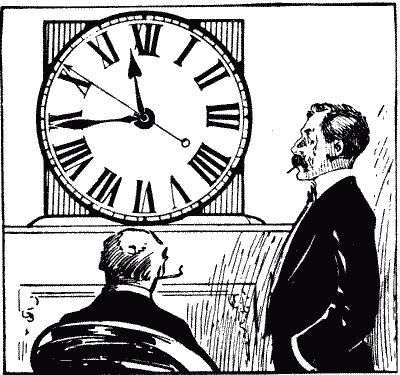 Sources:
- Amusements in Mathematics, Henry Ernest Dudeney Question 62
-
THE STOP-WATCH
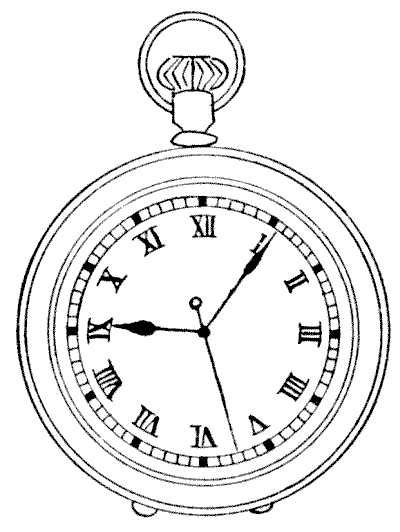 We have here a stop-watch with three hands. The second hand, which travels once round the face in a minute, is the one with the little ring at its end near the centre. Our dial indicates the exact time when its owner stopped the watch. You will notice that the three hands are nearly equidistant. The hour and minute hands point to spots that are exactly a third of the circumference apart, but the second hand is a little too advanced. An exact equidistance for the three hands is not possible. Now, we want to know what the time will be when the three hands are next at exactly the same distances as shown from one another. Can you state the time?
Sources:
We have here a stop-watch with three hands. The second hand, which travels once round the face in a minute, is the one with the little ring at its end near the centre. Our dial indicates the exact time when its owner stopped the watch. You will notice that the three hands are nearly equidistant. The hour and minute hands point to spots that are exactly a third of the circumference apart, but the second hand is a little too advanced. An exact equidistance for the three hands is not possible. Now, we want to know what the time will be when the three hands are next at exactly the same distances as shown from one another. Can you state the time?
Sources:
- Amusements in Mathematics, Henry Ernest Dudeney Question 63
-
AVERAGE SPEED
In a recent motor ride it was found that we had gone at the rate of ten miles an hour, but we did the return journey over the same route, owing to the roads being more clear of traffic, at fifteen miles an hour. What was our average speed? Do not be too hasty in your answer to this simple little question, or it is pretty certain that you will be wrong. Sources:- Amusements in Mathematics, Henry Ernest Dudeney Question 67
-
THE TWO TRAINS
I put this little question to a stationmaster, and his correct answer was so prompt that I am convinced there is no necessity to seek talented railway officials in America or elsewhere.
Two trains start at the same time, one from London to Liverpool, the other from Liverpool to London. If they arrive at their destinations one hour and four hours respectively after passing one another, how much faster is one train running than the other?
Sources:- Amusements in Mathematics, Henry Ernest Dudeney Question 68
-
DRAWING HER PENSION
"Speaking of odd figures," said a gentleman who occupies some post in a Government office, "one of the queerest characters I know is an old lame widow who climbs up a hill every week to draw her pension at the village post office. She crawls up at the rate of a mile and a half an hour and comes down at the rate of four and a half miles an hour, so that it takes her just six hours to make the double journey. Can any of you tell me how far it is from the bottom of the hill to the top?" Sources:- Amusements in Mathematics, Henry Ernest Dudeney Question 70
-
SIR EDWYN DE TUDOR
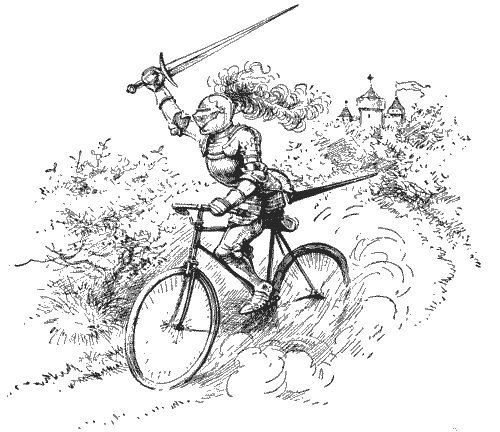 In the illustration we have a sketch of Sir Edwyn de Tudor going to rescue his lady-love, the fair Isabella, who was held a captive by a neighbouring wicked baron. Sir Edwyn calculated that if he rode fifteen miles an hour he would arrive at the castle an hour too soon, while if he rode ten miles an hour he would get there just an hour too late. Now, it was of the first importance that he should arrive at the exact time appointed, in order that the rescue that he had planned should be a success, and the time of the tryst was five o'clock, when the captive lady would be taking her afternoon tea. The puzzle is to discover exactly how far Sir Edwyn de Tudor had to ride.
Sources:
In the illustration we have a sketch of Sir Edwyn de Tudor going to rescue his lady-love, the fair Isabella, who was held a captive by a neighbouring wicked baron. Sir Edwyn calculated that if he rode fifteen miles an hour he would arrive at the castle an hour too soon, while if he rode ten miles an hour he would get there just an hour too late. Now, it was of the first importance that he should arrive at the exact time appointed, in order that the rescue that he had planned should be a success, and the time of the tryst was five o'clock, when the captive lady would be taking her afternoon tea. The puzzle is to discover exactly how far Sir Edwyn de Tudor had to ride.
Sources:
- Amusements in Mathematics, Henry Ernest Dudeney Question 71
-
THE HYDROPLANE QUESTION
The inhabitants of Slocomb-on-Sea were greatly excited over the visit of a certain flying man. All the town turned out to see the flight of the wonderful hydroplane, and, of course, Dobson and his family were there. Master Tommy was in good form, and informed his father that Englishmen made better airmen than Scotsmen and Irishmen because they are not so heavy. "How do you make that out?" asked Mr. Dobson. "Well, you see," Tommy replied, "it is true that in Ireland there are men of Cork and in Scotland men of Ayr, which is better still, but in England there are lightermen." Unfortunately it had to be explained to Mrs. Dobson, and this took the edge off the thing. The hydroplane flight was from Slocomb to the neighbouring watering-place Poodleville—five miles distant. But there was a strong wind, which so helped the airman that he made the outward journey in the short time of ten minutes, though it took him an hour to get back to the starting point at Slocomb, with the wind dead against him. Now, how long would the ten miles have taken him if there had been a perfect calm? Of course, the hydroplane's engine worked uniformly throughout. Sources:- Amusements in Mathematics, Henry Ernest Dudeney Question 72
-
DONKEY RIDING
During a visit to the seaside Tommy and Evangeline insisted on having a donkey race over the mile course on the sands. Mr. Dobson and some of his friends whom he had met on the beach acted as judges, but, as the donkeys were familiar acquaintances and declined to part company the whole way, a dead heat was unavoidable. However, the judges, being stationed at different points on the course, which was marked off in quarter-miles, noted the following results:—The first three-quarters were run in six and three-quarter minutes, the first half-mile took the same time as the second half, and the third quarter was run in exactly the same time as the last quarter. From these results Mr. Dobson amused himself in discovering just how long it took those two donkeys to run the whole mile. Can you give the answer? Sources:- Amusements in Mathematics, Henry Ernest Dudeney Question 73
-
CATCHING THE THIEF
"Now, constable," said the defendant's counsel in cross-examination," you say that the prisoner was exactly twenty-seven steps ahead of you when you started to run after him?"
"Yes, sir."
"And you swear that he takes eight steps to your five?"
"That is so."
"Then I ask you, constable, as an intelligent man, to explain how you ever caught him, if that is the case?"
"Well, you see, I have got a longer stride. In fact, two of my steps are equal in length to five of the prisoner's. If you work it out, you will find that the number of steps I required would bring me exactly to the spot where I captured him."
Here the foreman of the jury asked for a few minutes to figure out the number of steps the constable must have taken. Can you also say how many steps the officer needed to catch the thief?
Sources:- Amusements in Mathematics, Henry Ernest Dudeney Question 104
-
Question
I went to the market to buy vegetables. I paid for tomatoes half of the money I had plus one shekel. After that, I paid for cucumbers half of the remaining money plus one shekel, and then I paid for onions half of the remaining money plus one shekel, and that used up all the money I had.
What is the amount of money I came to the market with?
Sources: