Algebra, Word Problems
Word problems present mathematical challenges in a narrative or real-world context. Solving them requires translating the text into mathematical equations or expressions and then applying appropriate mathematical techniques. These can span arithmetic, algebra, geometry, etc.
Motion Problems Solving Word Problems "From the End" / Working Backwards-
The Cookies
Avi, Benny, and Danny's mother left a plate of cookies on the table in the morning. Avi woke up, ate one-third of the total number of cookies, and went to school. After that, Benny woke up, unaware that Avi had already eaten some, so he ate one-third of the remaining cookies and also went to school. After that, Danny woke up and ate one-third of the cookies that were left. When their mother returned home, she saw that there were `8` cookies left. How many cookies were there at the beginning?
Sources: -
Bacteria in a Test Tube
A scientist has a test tube containing bacteria. Every second, each bacterium splits into two. After two hours, the test tube was completely full of bacteria. How long before that was the test tube exactly half full?
-
A QUEER COINCIDENCE
Seven men, whose names were Adams, Baker, Carter, Dobson, Edwards, Francis, and Gudgeon, were recently engaged in play. The name of the particular game is of no consequence. They had agreed that whenever a player won a game he should double the money of each of the other players—that is, he was to give the players just as much money as they had already in their pockets. They played seven games, and, strange to say, each won a game in turn, in the order in which their names are given. But a more curious coincidence is this—that when they had finished play each of the seven men had exactly the same amount—two shillings and eightpence—in his pocket. The puzzle is to find out how much money each man had with him before he sat down to play. Sources: -
INDISCRIMINATE CHARITY
A charitable gentleman, on his way home one night, was appealed to by three needy persons in succession for assistance. To the first person he gave one penny more than half the money he had in his pocket; to the second person he gave twopence more than half the money he then had in his pocket; and to the third person he handed over threepence more than half of what he had left. On entering his house he had only one penny in his pocket. Now, can you say exactly how much money that gentleman had on him when he started for home? Sources: -
THE SPANISH DUNGEON
Not fifty miles from Cadiz stood in the middle ages a castle, all traces of which have for centuries disappeared. Among other interesting features, this castle contained a particularly unpleasant dungeon divided into sixteen cells, all communicating with one another, as shown in the illustration.
Now, the governor was a merry wight, and very fond of puzzles withal. One day he went to the dungeon and said to the prisoners, "By my halidame!" (or its equivalent in Spanish) "you shall all be set free if you can solve this puzzle. You must so arrange yourselves in the sixteen cells that the numbers on your backs shall form a magic square in which every column, every row, and each of the two diagonals shall add up the same. Only remember this: that in no case may two of you ever be together in the same cell."
One of the prisoners, after working at the problem for two or three days, with a piece of chalk, undertook to obtain the liberty of himself and his fellow-prisoners if they would follow his directions and move through the doorway from cell to cell in the order in which he should call out their numbers.
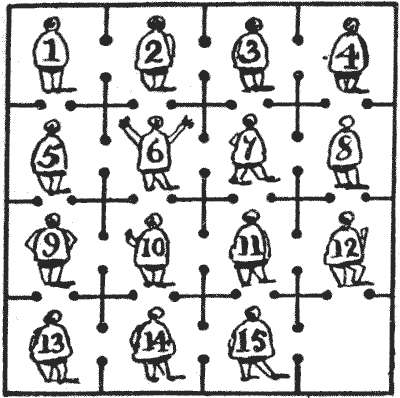
He succeeded in his attempt, and, what is more remarkable, it would seem from the account of his method recorded in the ancient manuscript lying before me, that he did so in the fewest possible moves. The reader is asked to show what these moves were.
Sources:Topics:Logic -> Reasoning / Logic Combinatorics -> Case Analysis / Checking Cases -> Processes / Procedures Combinatorics -> Number Tables Algebra -> Word Problems -> Solving Word Problems "From the End" / Working Backwards Puzzles and Rebuses -> Reconstruct the Exercise / Cryptarithmetic- Amusements in Mathematics, Henry Ernest Dudeney Question 403