Young Mathematician Olympiad, 2017-2018, Stage A, Grades 3-4
-
Question 1 - Signs
A cyclist is riding on a straight road without turns and sees the following sign by the side of the road:
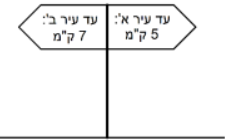
He continues moving and sees another sign:
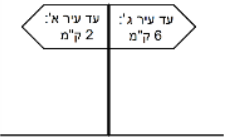
Find the distance between cities B and C.
Additional sources: -
Question 2 - What is the Smiley?
In the following exercise, one of the digits has been replaced by a smiley face. Find the digit.
`1☺xx6-☺=70`
-
Question 3 - Triangles in a Hexagon
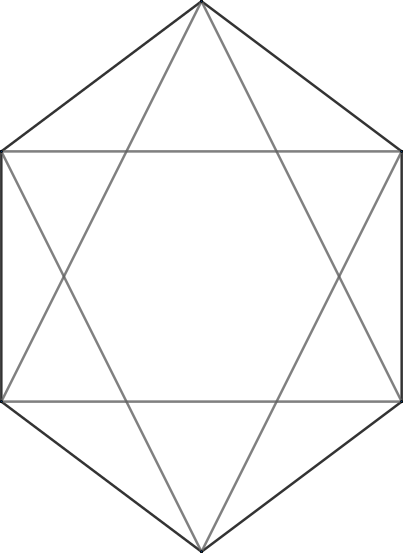
How many triangles are in the picture? Count all the triangles formed by the lines.
-
Question 4 - Cats for Grandma
Grandma Hannah has a number of cats. One day, her three grandchildren, Avi, Benny, and Gili, came to visit and tried to guess how many cats she has.
Avi said: "Grandma has at least 7 cats",
Benny said: "But less than 10, I think",
Then Gili said: "Grandma Hannah has either 9, or 10, or 11 cats".
"You are all correct!" replied the grandma
So how many cats does she have?
-
Question 5 - Palindromic Number
Find a four-digit palindromic number that is divisible by 25 and not divisible by 3.
Note: A palindromic number is a number that does not change if its digits are read in reverse order. For example, the number 5775 is a palindromic number, and the number 5778 is not a palindromic number.
Topics:Number Theory -> Modular Arithmetic / Remainder Arithmetic -> Divisibility Rules -> Divisibility Rules by 3 and 9 Number Theory -> Division -> Parity (Even/Odd) Number Theory -> Modular Arithmetic / Remainder Arithmetic -> Divisibility Rules -> Divisibility Rules by 5 and 25 Combinatorics -> Case Analysis / Checking Cases -> Processes / Procedures -
Question 6 - 5 but not 7
How many numbers from 1 to 100 (inclusive) are divisible by 5 but not divisible by 7?
-
Question 7 - Area of the Shape
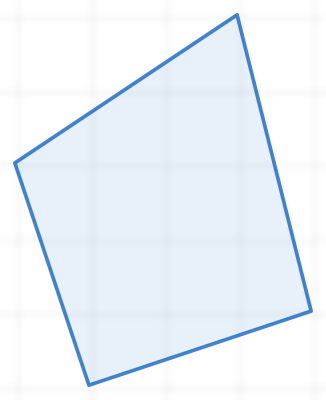
Given a grid paper where the area of each square is one unit area. Find the area of the shape (in unit areas)
-
Question 8 - Differences in the Multiplication Table
Color the `10xx10` multiplication table with a black and white chessboard coloring, such that the cell of `1xx1` is colored black.
Find the difference between the sum of all the numbers in the black cells and the sum of all the numbers in the white cells.
1 2 3 4 5 6 7 8 9 10 1 1 2 3 4 5 6 7 8 9 10 2 2 4 6 8 10 12 14 16 18 20 3 3 6 9 12 15 18 21 24 27 30 4 4 8 12 16 20 24 28 32 36 40 5 5 10 15 20 25 30 35 40 45 50 6 6 12 18 24 30 36 42 48 54 60 7 7 14 21 28 35 42 49 56 63 70 8 8 16 24 32 40 48 56 64 72 80 9 9 18 27 36 45 54 63 72 81 90 10 10 20 30 40 50 60 70 80 90 100 Additional sources: