Young Mathematician Olympiad, 2017-2018, Final
Grades 3-4 Grades 5-6-
Question from sources: Grades 3-4(1) - Toys
Jonathan has a collection of wooden toys. Some are cubes and some are spheres, some are red and some are blue.
It is known that there are more spheres than cubes, and it is known that there are more blue toys than red toys.
Prove that Jonathan has a blue sphere.
Sources: -
Question from sources: Grades 3-4(2) - The Grasshopper
Consider an infinite grid of squares. A grasshopper sits on one of the squares. The grasshopper can jump two squares in any horizontal or vertical direction, and it can jump to the adjacent square diagonally. Can the grasshopper ever reach a square that is adjacent to its starting square by a side?
Sources:Topics:Combinatorics -> Combinatorial Geometry Combinatorics -> Invariants Combinatorics -> Colorings -> Chessboard Coloring -
Question from sources: Grades 3-4(3) - Digits in a circle
The digits from 1 to 5 are written in a circle in some order. Danny summed five two-digit numbers formed from pairs
of adjacent digits on the circle (clockwise). Find all the possible values for this sum.Sources:Topics:Arithmetic -
Question from sources: Grades 3-4(4) - Products of Areas
In the figure, there is a rectangle and a point inside it. Two segments are drawn through the point, parallel to the sides of the rectangle, dividing the rectangle into 4 smaller rectangles.
Prove that the product of the areas of the shaded rectangles inside the rectangle is equal to the product of the areas of the unshaded rectangles inside the rectangle.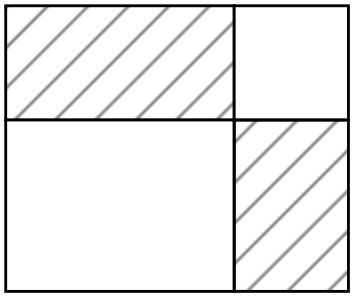 Sources:
 -
Question from sources: Grades 3-4(5), Grades 5-6(5) - Sheep and Camels
Shmuel has a flock of 9 sheep and 5 camels. He wants to divide the flock between his two sons, Yossi and Danny, so that each of them receives an equal share of the value.
Sources:
It is known that 7 sheep cost as much as 3 camels. How can Shmuel divide the flock between his two sons equally, without selling any animals? -
Question from sources: Grades 3-4(6), Grades 5-6(6) - The Magic Octopuses
In the magic sea live octopuses who can talk. Each octopus either always tells the truth or always lies. One day
the following conversation took place between four octopuses, Avi, Benny, Gidi, and Danny:
Avi: I am a green octopus
Benny: I am not green
Gidi: All green octopuses are liars
Danny: Only a green octopus can be a liar
Sources:
It is known that only one of these four is a liar, and the rest are truthful.
a. Who is the liar among the four friends? Explain!
b. Is it possible to know what his color is? -
Question from sources: Grades 3-4(7), Grades 5-6(7) - Log of Wood
You have a very long log of wood. Can you measure exactly one meter from it, if you have for this purpose:
а. A stick with a length of one and a half meters and another stick with a length of 40 centimeters,
б. A stick with a length of one and a half meters and another stick with a length of 30 centimeters,Assuming you have no other measuring tools? Explain!
Sources:Topics:Combinatorics -> Invariants Algebra -> Word Problems Logic -> Reasoning / Logic Arithmetic -> Division with Remainder -
Question from sources: Grades 3-4(1), Grades 5-6(1) - Sheep and Camels
Shmuel has a flock of 9 sheep and 5 camels. He wants to divide the flock between his two sons, Yossi and Danny, so that each of them receives an equal share of the value.
Sources:
It is known that 7 sheep cost as much as 3 camels. How can Shmuel divide the flock between his two sons equally, without selling any animals? -
Question from sources: Grades 3-4(2), Grades 5-6(2) - Log of Wood
You have a very long log of wood. Can you measure exactly one meter from it, if you have for this purpose:
а. A stick with a length of one and a half meters and another stick with a length of 40 centimeters,
б. A stick with a length of one and a half meters and another stick with a length of 30 centimeters,Assuming you have no other measuring tools? Explain!
Sources:Topics:Combinatorics -> Invariants Algebra -> Word Problems Logic -> Reasoning / Logic Arithmetic -> Division with Remainder -
Question from sources: Grades 5-6(3) - Product of Areas
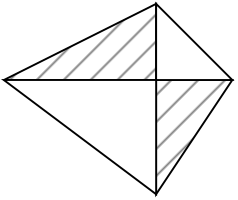
In the diagram, there is a quadrilateral with perpendicular diagonals. Prove that the product of the areas of the shaded regions within the quadrilateral is equal to the product of the areas of the unshaded regions within the quadrilateral.
 Sources: