Algebra
Algebra is a broad branch of mathematics that uses symbols (usually letters) to represent numbers and to state rules and relationships. It involves manipulating expressions, solving equations and inequalities, and studying functions and structures. Questions cover a wide range of these topics.
Algebraic Techniques Equations Inequalities Word Problems Sequences-
THE FARMER AND HIS SHEEP
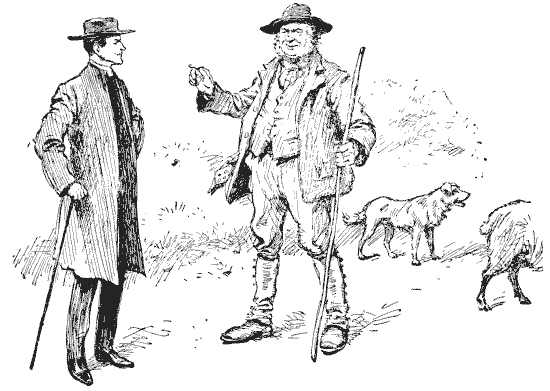
Farmer Longmore had a curious aptitude for arithmetic, and was known in his district as the "mathematical farmer." The new vicar was not aware of this fact when, meeting his worthy parishioner one day in the lane, he asked him in the course of a short conversation, "Now, how many sheep have you altogether?" He was therefore rather surprised at Longmore's answer, which was as follows: "You can divide my sheep into two different parts, so that the difference between the two numbers is the same as the difference between their squares. Maybe, Mr. Parson, you will like to work out the little sum for yourself."
Can the reader say just how many sheep the farmer had? Supposing he had possessed only twenty sheep, and he divided them into the two parts `12` and `8`. Now, the difference between their squares, `144` and `64`, is `80`. So that will not do, for `4` and `80` are certainly not the same. If you can find numbers that work out correctly, you will know exactly how many sheep Farmer Longmore owned.
Sources:- Amusements in Mathematics, Henry Ernest Dudeney Question 120
-
HEADS OR TAILS
Crooks, an inveterate gambler, at Goodwood recently said to a friend, "I'll bet you half the money in my pocket on the toss of a coin—heads I win, tails I lose." The coin was tossed and the money handed over. He repeated the offer again and again, each time betting half the money then in his possession. We are not told how long the game went on, or how many times the coin was tossed, but this we know, that the number of times that Crooks lost was exactly equal to the number of times that he won. Now, did he gain or lose by this little venture?Sources:Topics:Algebra -> Word Problems- Amusements in Mathematics, Henry Ernest Dudeney Question 121
-
THE SEE-SAW PUZZLE
Necessity is, indeed, the mother of invention. I was amused the other day in watching a boy who wanted to play see-saw and, in his failure to find another child to share the sport with him, had been driven back upon the ingenious resort of tying a number of bricks to one end of the plank to balance his weight at the other.
As a matter of fact, he just balanced against sixteen bricks, when these were fixed to the short end of plank, but if he fixed them to the long end of plank he only needed eleven as balance.
Now, what was that boy's weight, if a brick weighs equal to a three-quarter brick and three-quarters of a pound?
Sources:- Amusements in Mathematics, Henry Ernest Dudeney Question 122
-
A LEGAL DIFFICULTY
"A client of mine," said a lawyer, "was on the point of death when his wife was about to present him with a child. I drew up his will, in which he settled two-thirds of his estate upon his son (if it should happen to be a boy) and one-third on the mother. But if the child should be a girl, then two-thirds of the estate should go to the mother and one-third to the daughter. As a matter of fact, after his death twins were born—a boy and a girl. A very nice point then arose. How was the estate to be equitably divided among the three in the closest possible accordance with the spirit of the dead man's will?" Sources:- Amusements in Mathematics, Henry Ernest Dudeney Question 123
-
THE MINERS' HOLIDAY
Seven coal-miners took a holiday at the seaside during a big strike. Six of the party spent exactly half a sovereign each, but Bill Harris was more extravagant. Bill spent three shillings more than the average of the party. What was the actual amount of Bill's expenditure? Sources:- Amusements in Mathematics, Henry Ernest Dudeney Question 125
-
A PROBLEM IN SQUARES
We possess three square boards. The surface of the first contains five square feet more than the second, and the second contains five square feet more than the third. Can you give exact measurements for the sides of the boards? If you can solve this little puzzle, then try to find three squares in arithmetical progression, with a common difference of `7` and also of `13`.Sources:Topics:Number Theory Algebra -> Sequences -> Arithmetic Progression / Arithmetic Sequence Algebra -> Equations -> Diophantine Equations- Amusements in Mathematics, Henry Ernest Dudeney Question 128
-
THE BATTLE OF HASTINGS
All historians know that there is a great deal of mystery and uncertainty concerning the details of the ever-memorable battle on that fatal day, October `14, 1066`. My puzzle deals with a curious passage in an ancient monkish chronicle that may never receive the attention that it deserves, and if I am unable to vouch for the authenticity of the document it will none the less serve to furnish us with a problem that can hardly fail to interest those of my readers who have arithmetical predilections. Here is the passage in question.
"The men of Harold stood well together, as their wont was, and formed sixty and one squares, with a like number of men in every square thereof, and woe to the hardy Norman who ventured to enter their redoubts; for a single blow of a Saxon war-hatchet would break his lance and cut through his coat of mail.... When Harold threw himself into the fray the Saxons were one mighty square of men, shouting the battle-cries, 'Ut!' 'Olicrosse!' 'Godemitè!'"
Now, I find that all the contemporary authorities agree that the Saxons did actually fight in this solid order. For example, in the "Carmen de Bello Hastingensi," a poem attributed to Guy, Bishop of Amiens, living at the time of the battle, we are told that "the Saxons stood fixed in a dense mass," and Henry of Huntingdon records that "they were like unto a castle, impenetrable to the Normans;" while Robert Wace, a century after, tells us the same thing. So in this respect my newly-discovered chronicle may not be greatly in error. But I have reason to believe that there is something wrong with the actual figures. Let the reader see what he can make of them.
The number of men would be sixty-one times a square number; but when Harold himself joined in the fray they were then able to form one large square. What is the smallest possible number of men there could have been?
In order to make clear to the reader the simplicity of the question, I will give the lowest solutions in the case of `60` and `62`, the numbers immediately preceding and following `61`. They are `60xx4^2+1 = 31^2`, and `62xx8^2+1=63^2`. That is, `60` squares of `16` men each would be `960` men, and when Harold joined them they would be `961` in number, and so form a square with `31` men on every side. Similarly in the case of the figures I have given for `62`. Now, find the lowest answer for `61`.
Sources:- Amusements in Mathematics, Henry Ernest Dudeney Question 129
-
THE SCULPTOR'S PROBLEM
An ancient sculptor was commissioned to supply two statues, each on a cubical pedestal. It is with these pedestals that we are concerned. They were of unequal sizes, as will be seen in the illustration, and when the time arrived for payment a dispute arose as to whether the agreement was based on lineal or cubical measurement. But as soon as they came to measure the two pedestals the matter was at once settled, because, curiously enough, the number of lineal feet was exactly the same as the number of cubical feet. The puzzle is to find the dimensions for two pedestals having this peculiarity, in the smallest possible figures. You see, if the two pedestals, for example, measure respectively `3` ft. and `1` ft. on every side, then the lineal measurement would be `4` ft. and the cubical contents `28` ft., which are not the same, so these measurements will not do.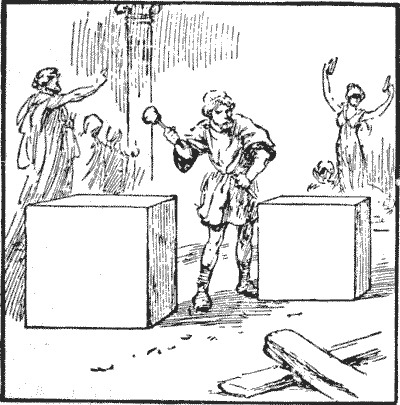 Sources:Topics:Number Theory Geometry -> Solid Geometry / Geometry in Space Arithmetic -> Fractions Algebra -> Equations -> Diophantine Equations
- Amusements in Mathematics, Henry Ernest Dudeney Question 130
-
THE SPANISH MISER
There once lived in a small town in New Castile a noted miser named Don Manuel Rodriguez. His love of money was only equalled by a strong passion for arithmetical problems. These puzzles usually dealt in some way or other with his accumulated treasure, and were propounded by him solely in order that he might have the pleasure of solving them himself. Unfortunately very few of them have survived, and when travelling through Spain, collecting material for a proposed work on "The Spanish Onion as a Cause of National Decadence," I only discovered a very few. One of these concerns the three boxes that appear in the accompanying authentic portrait.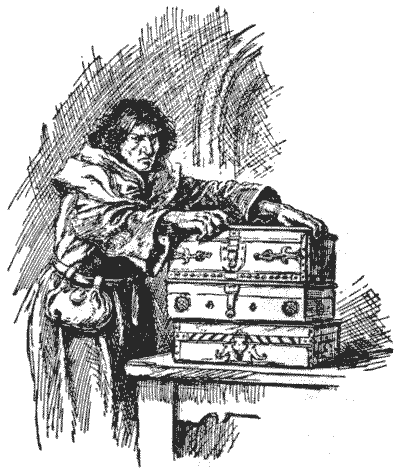 Each box contained a different number of golden doubloons. The difference between the number of doubloons in the upper box and the number in the middle box was the same as the difference between the number in the middle box and the number in the bottom box. And if the contents of any two of the boxes were united they would form a square number. What is the smallest number of doubloons that there could have been in any one of the boxes?
Sources:
Each box contained a different number of golden doubloons. The difference between the number of doubloons in the upper box and the number in the middle box was the same as the difference between the number in the middle box and the number in the bottom box. And if the contents of any two of the boxes were united they would form a square number. What is the smallest number of doubloons that there could have been in any one of the boxes?
Sources:
- Amusements in Mathematics, Henry Ernest Dudeney Question 131
-
THE NINE TREASURE BOXES
The following puzzle will illustrate the importance on occasions of being able to fix the minimum and maximum limits of a required number. This can very frequently be done. For example, it has not yet been ascertained in how many different ways the knight's tour can be performed on the chess board; but we know that it is fewer than the number of combinations of `168` things taken `63` at a time and is greater than `31,054,144`—for the latter is the number of routes of a particular type. Or, to take a more familiar case, if you ask a man how many coins he has in his pocket, he may tell you that he has not the slightest idea. But on further questioning you will get out of him some such statement as the following: "Yes, I am positive that I have more than three coins, and equally certain that there are not so many as twenty-five." Now, the knowledge that a certain number lies between `2` and `12` in my puzzle will enable the solver to find the exact answer; without that information there would be an infinite number of answers, from which it would be impossible to select the correct one.
This is another puzzle received from my friend Don Manuel Rodriguez, the cranky miser of New Castile. On New Year's Eve in `1879` he showed me nine treasure boxes, and after informing me that every box contained a square number of golden doubloons, and that the difference between the contents of A and B was the same as between B and C, D and E, E and F, G and H, or H and I, he requested me to tell him the number of coins in every one of the boxes. At first I thought this was impossible, as there would be an infinite number of different answers, but on consideration I found that this was not the case. I discovered that while every box contained coins, the contents of A, B, C increased in weight in alphabetical order; so did D, E, F; and so did G, H, I; but D or E need not be heavier than C, nor G or H heavier than F. It was also perfectly certain that box A could not contain more than a dozen coins at the outside; there might not be half that number, but I was positive that there were not more than twelve. With this knowledge I was able to arrive at the correct answer.
In short, we have to discover nine square numbers such that A, B, C; and D, E, F; and G, H, I are three groups in arithmetical progression, the common difference being the same in each group, and A being less than `12`. How many doubloons were there in every one of the nine boxes?
Sources:Topics:Number Theory Algebra -> Sequences -> Arithmetic Progression / Arithmetic Sequence Algebra -> Equations -> Diophantine Equations- Amusements in Mathematics, Henry Ernest Dudeney Question 132