Algebra
Algebra is a broad branch of mathematics that uses symbols (usually letters) to represent numbers and to state rules and relationships. It involves manipulating expressions, solving equations and inequalities, and studying functions and structures. Questions cover a wide range of these topics.
Algebraic Techniques Equations Inequalities Word Problems Sequences-
THE THREE RAILWAY STATIONS
As I sat in a railway carriage I noticed at the other end of the compartment a worthy squire, whom I knew by sight, engaged in conversation with another passenger, who was evidently a friend of his.
"How far have you to drive to your place from the railway station?" asked the stranger.
"Well," replied the squire, "if I get out at Appleford, it is just the same distance as if I go to Bridgefield, another fifteen miles farther on; and if I changed at Appleford and went thirteen miles from there to Carterton, it would still be the same distance. You see, I am equidistant from the three stations, so I get a good choice of trains."
Now I happened to know that Bridgefield is just fourteen miles from Carterton, so I amused myself in working out the exact distance that the squire had to drive home whichever station he got out at. What was the distance?
Sources:Topics:Geometry -> Area Calculation Geometry -> Plane Geometry -> Triangles Algebra -> Word Problems- Amusements in Mathematics, Henry Ernest Dudeney Question 181
-
THE GARDEN PUZZLE
Professor Rackbrain tells me that he was recently smoking a friendly pipe under a tree in the garden of a country acquaintance. The garden was enclosed by four straight walls, and his friend informed him that he had measured these and found the lengths to be `80, 45, 100`, and `63` yards respectively. "Then," said the professor, "we can calculate the exact area of the garden." "Impossible," his host replied, "because you can get an infinite number of different shapes with those four sides." "But you forget," Rackbrane said, with a twinkle in his eye, "that you told me once you had planted this tree equidistant from all the four corners of the garden." Can you work out the garden's area?Sources:Topics:Geometry -> Area Calculation Geometry -> Plane Geometry -> Circles Algebra -> Equations Algebra -> Word Problems- Amusements in Mathematics, Henry Ernest Dudeney Question 182
-
ST. GEORGE'S BANNER
At a celebration of the national festival of St. George's Day I was contemplating the familiar banner of the patron saint of our country. We all know the red cross on a white ground, shown in our illustration. This is the banner of St. George. The banner of St. Andrew (Scotland) is a white "St. Andrew's Cross" on a blue ground. That of St. Patrick (Ireland) is a similar cross in red on a white ground. These three are united in one to form our Union Jack.
Now on looking at St. George's banner it occurred to me that the following question would make a simple but pretty little puzzle. Supposing the flag measures four feet by three feet, how wide must the arm of the cross be if it is required that there shall be used just the same quantity of red and of white bunting?
Sources: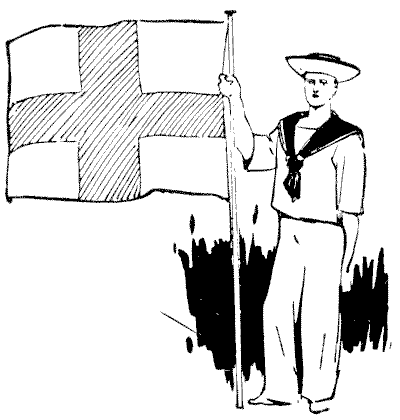
- Amusements in Mathematics, Henry Ernest Dudeney Question 185
-
THE CLOTHES LINE PUZZLE
A boy tied a clothes line from the top of each of two poles to the base of the other. He then proposed to his father the following question. As one pole was exactly seven feet above the ground and the other exactly five feet, what was the height from the ground where the two cords crossed one another? Sources:- Amusements in Mathematics, Henry Ernest Dudeney Question 186
-
THE CRESCENT PUZZLE
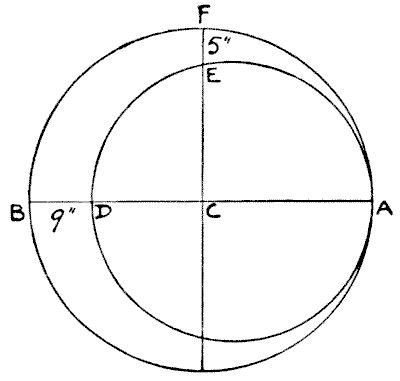 Here is an easy geometrical puzzle. The crescent is formed by two circles, and C is the centre of the larger circle. The width of the crescent between B and D is `9` inches, and between E and F `5` inches. What are the diameters of the two circles?
Sources:
Here is an easy geometrical puzzle. The crescent is formed by two circles, and C is the centre of the larger circle. The width of the crescent between B and D is `9` inches, and between E and F `5` inches. What are the diameters of the two circles?
Sources:
- Amusements in Mathematics, Henry Ernest Dudeney Question 191
-
LADY BELINDA'S GARDEN
Lady Belinda is an enthusiastic gardener. In the illustration she is depicted in the act of worrying out a pleasant little problem which I will relate. One of her gardens is oblong in shape, enclosed by a high holly hedge, and she is turning it into a rosary for the cultivation of some of her choicest roses. She wants to devote exactly half of the area of the garden to the flowers, in one large bed, and the other half to be a path going all round it of equal breadth throughout. Such a garden is shown in the diagram at the foot of the picture. How is she to mark out the garden under these simple conditions? She has only a tape, the length of the garden, to do it with, and, as the holly hedge is so thick and dense, she must make all her measurements inside. Lady Belinda did not know the exact dimensions of the garden, and, as it was not necessary for her to know, I also give no dimensions. It is quite a simple task no matter what the size or proportions of the garden may be. Yet how many lady gardeners would know just how to proceed? The tape may be quite plain—that is, it need not be a graduated measure.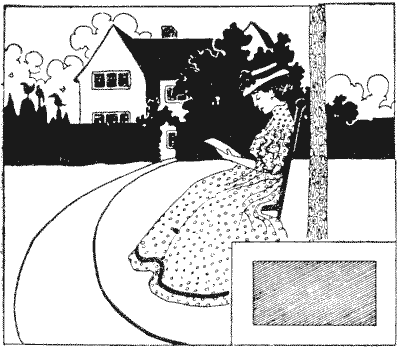 Sources:Topics:Geometry -> Plane Geometry Geometry -> Area Calculation Algebra -> Algebraic Techniques Algebra -> Equations
- Amusements in Mathematics, Henry Ernest Dudeney Question 195
-
A KITE-FLYING PUZZLE
While accompanying my friend Professor Highflite during a scientific kite-flying competition on the South Downs of Sussex I was led into a little calculation that ought to interest my readers. The Professor was paying out the wire to which his kite was attached from a winch on which it had been rolled into a perfectly spherical form. This ball of wire was just two feet in diameter, and the wire had a diameter of one-hundredth of an inch. What was the length of the wire?
Now, a simple little question like this that everybody can perfectly understand will puzzle many people to answer in any way. Let us see whether, without going into any profound mathematical calculations, we can get the answer roughly—say, within a mile of what is correct! We will assume that when the wire is all wound up the ball is perfectly solid throughout, and that no allowance has to be made for the axle that passes through it. With that simplification, I wonder how many readers can state within even a mile of the correct answer the length of that wire.
Sources:Topics:Geometry -> Solid Geometry / Geometry in Space Arithmetic Geometry -> Area Calculation Algebra -> Word Problems Units of Measurement- Amusements in Mathematics, Henry Ernest Dudeney Question 200
-
HOW TO MAKE CISTERNS
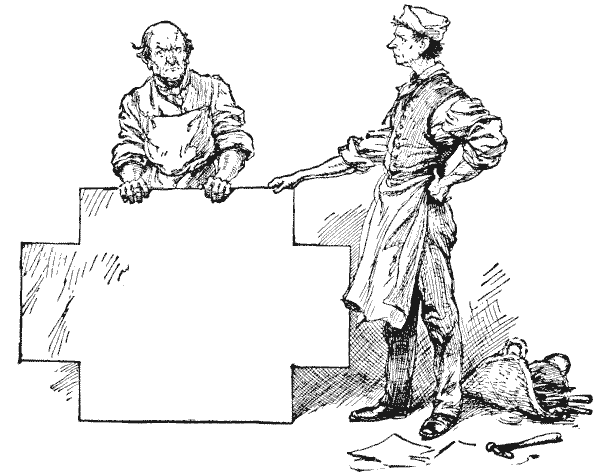 Our friend in the illustration has a large sheet of zinc, measuring (before cutting) eight feet by three feet, and he has cut out square pieces (all of the same size) from the four corners and now proposes to fold up the sides, solder the edges, and make a cistern. But the point that puzzles him is this: Has he cut out those square pieces of the correct size in order that the cistern may hold the greatest possible quantity of water? You see, if you cut them very small you get a very shallow cistern; if you cut them large you get a tall and slender one. It is all a question of finding a way of cutting put these four square pieces exactly the right size. How are we to avoid making them too small or too large?
Sources:
Our friend in the illustration has a large sheet of zinc, measuring (before cutting) eight feet by three feet, and he has cut out square pieces (all of the same size) from the four corners and now proposes to fold up the sides, solder the edges, and make a cistern. But the point that puzzles him is this: Has he cut out those square pieces of the correct size in order that the cistern may hold the greatest possible quantity of water? You see, if you cut them very small you get a very shallow cistern; if you cut them large you get a tall and slender one. It is all a question of finding a way of cutting put these four square pieces exactly the right size. How are we to avoid making them too small or too large?
Sources:
- Amusements in Mathematics, Henry Ernest Dudeney Question 201
-
THE SIX FROGS
 The six educated frogs in the illustration are trained to reverse their order, so that their numbers shall read `6, 5, 4, 3, 2, 1`, with the blank square in its present position. They can jump to the next square (if vacant) or leap over one frog to the next square beyond (if vacant), just as we move in the game of draughts, and can go backwards or forwards at pleasure. Can you show how they perform their feat in the fewest possible moves? It is quite easy, so when you have done it add a seventh frog to the right and try again. Then add more frogs until you are able to give the shortest solution for any number. For it can always be done, with that single vacant square, no matter how many frogs there are.
Sources:Topics:Algebra -> Sequences -> Arithmetic Progression / Arithmetic Sequence
The six educated frogs in the illustration are trained to reverse their order, so that their numbers shall read `6, 5, 4, 3, 2, 1`, with the blank square in its present position. They can jump to the next square (if vacant) or leap over one frog to the next square beyond (if vacant), just as we move in the game of draughts, and can go backwards or forwards at pleasure. Can you show how they perform their feat in the fewest possible moves? It is quite easy, so when you have done it add a seventh frog to the right and try again. Then add more frogs until you are able to give the shortest solution for any number. For it can always be done, with that single vacant square, no matter how many frogs there are.
Sources:Topics:Algebra -> Sequences -> Arithmetic Progression / Arithmetic Sequence- Amusements in Mathematics, Henry Ernest Dudeney Question 214
-
THOSE FIFTEEN SHEEP
A certain cyclopædia has the following curious problem, I am told: "Place fifteen sheep in four pens so that there shall be the same number of sheep in each pen." No answer whatever is vouchsafed, so I thought I would investigate the matter. I saw that in dealing with apples or bricks the thing would appear to be quite impossible, since four times any number must be an even number, while fifteen is an odd number. I thought, therefore, that there must be some quality peculiar to the sheep that was not generally known. So I decided to interview some farmers on the subject. The first one pointed out that if we put one pen inside another, like the rings of a target, and placed all sheep in the smallest pen, it would be all right. But I objected to this, because you admittedly place all the sheep in one pen, not in four pens. The second man said that if I placed four sheep in each of three pens and three sheep in the last pen (that is fifteen sheep in all), and one of the ewes in the last pen had a lamb during the night, there would be the same number in each pen in the morning. This also failed to satisfy me.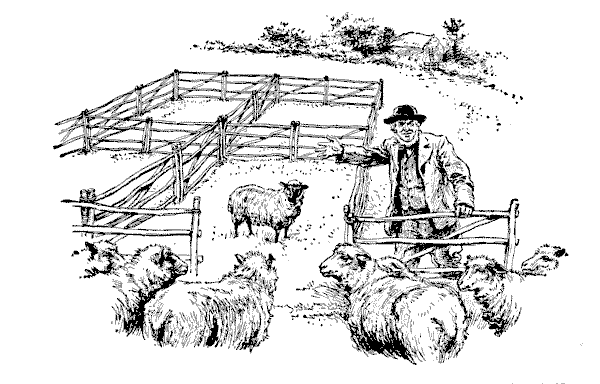 The third farmer said, "I've got four hurdle pens down in one of my fields, and a small flock of wethers, so if you will just step down with me I will show you how it is done." The illustration depicts my friend as he is about to demonstrate the matter to me. His lucid explanation was evidently that which was in the mind of the writer of the article in the cyclopædia. What was it? Can you place those fifteen sheep?
Sources:Topics:Algebra -> Word Problems Logic -> Reasoning / Logic Combinatorics -> Case Analysis / Checking Cases -> Processes / Procedures Puzzles and Rebuses
The third farmer said, "I've got four hurdle pens down in one of my fields, and a small flock of wethers, so if you will just step down with me I will show you how it is done." The illustration depicts my friend as he is about to demonstrate the matter to me. His lucid explanation was evidently that which was in the mind of the writer of the article in the cyclopædia. What was it? Can you place those fifteen sheep?
Sources:Topics:Algebra -> Word Problems Logic -> Reasoning / Logic Combinatorics -> Case Analysis / Checking Cases -> Processes / Procedures Puzzles and Rebuses- Amusements in Mathematics, Henry Ernest Dudeney Question 262