Logic, Reasoning / Logic
This category emphasizes general logical reasoning skills, often applied to puzzles or scenarios not strictly formal. It involves deduction, inference, identifying patterns, and drawing sound conclusions from given information. It overlaps with formal logic but can be broader.
Paradoxes-
Question
There are 5778 extinguished lamps arranged at equal distances on a circle. Below each lamp is a button. Pressing a button changes the state of 4 lamps: the lamp next to the button, the next two lamps in the circle clockwise, and the lamp opposite the button (an extinguished lamp lights up when its state is changed, and a lit lamp is extinguished). What is the maximum number of lamps that can be lit simultaneously?
 Sources:Topics:Combinatorics -> Combinatorial Geometry Combinatorics -> Invariants Logic -> Reasoning / Logic Number Theory -> Division -> Parity (Even/Odd) Combinatorics -> Case Analysis / Checking Cases -> Processes / Procedures Combinatorics -> Colorings
- Beno Arbel Olympiad, 2017, Grade 8 Question 8
-
HEARD ON THE TUBE RAILWAY
First Lady: "And was he related to you, dear?"
Second Lady: "Oh, yes. You see, that gentleman's mother was my mother's mother-in-law, but he is not on speaking terms with my papa."
First Lady: "Oh, indeed!" (But you could see that she was not much wiser.)
How was the gentleman related to the Second Lady?
Sources:Topics:Logic -> Reasoning / Logic- Amusements in Mathematics, Henry Ernest Dudeney Question 53
-
A FAMILY PARTY
A certain family party consisted of `1` grandfather, `1` grandmother, `2` fathers, `2` mothers, `4` children, `3` grandchildren, `1` brother, `2` sisters, `2` sons, `2` daughters, `1` father-in-law, `1` mother-in-law, and `1` daughter-in-law. Twenty-three people, you will say. No; there were only seven persons present. Can you show how this might be? Sources:- Amusements in Mathematics, Henry Ernest Dudeney Question 54
-
A MIXED PEDIGREE
Joseph Bloggs: "I can't follow it, my dear boy. It makes me dizzy!"
John Snoggs: "It's very simple. Listen again! You happen to be my father's brother-in-law, my brother's father-in-law, and also my father-in-law's brother. You see, my father was——"
But Mr. Bloggs refused to hear any more. Can the reader show how this extraordinary triple relationship might have come about?
Sources:- Amusements in Mathematics, Henry Ernest Dudeney Question 55
-
WILSON'S POSER
"Speaking of perplexities——" said Mr. Wilson, throwing down a magazine on the table in the commercial room of the Railway Hotel.
"Who was speaking of perplexities?" inquired Mr. Stubbs.
"Well, then, reading about them, if you want to be exact—it just occurred to me that perhaps you three men may be interested in a little matter connected with myself."
It was Christmas Eve, and the four commercial travellers were spending the holiday at Grassminster. Probably each suspected that the others had no homes, and perhaps each was conscious of the fact that he was in that predicament himself. In any case they seemed to be perfectly comfortable, and as they drew round the cheerful fire the conversation became general.
"What is the difficulty?" asked Mr. Packhurst.
"There's no difficulty in the matter, when you rightly understand it. It is like this. A man named Parker had a flying-machine that would carry two. He was a venturesome sort of chap—reckless, I should call him—and he had some bother in finding a man willing to risk his life in making an ascent with him. However, an uncle of mine thought he would chance it, and one fine morning he took his seat in the machine and she started off well. When they were up about a thousand feet, my nephew suddenly——"
"Here, stop, Wilson! What was your nephew doing there? You said your uncle," interrupted Mr. Stubbs.
"Did I? Well, it does not matter. My nephew suddenly turned to Parker and said that the engine wasn't running well, so Parker called out to my uncle——"
"Look here," broke in Mr. Waterson, "we are getting mixed. Was it your uncle or your nephew? Let's have it one way or the other."
"What I said is quite right. Parker called out to my uncle to do something or other, when my nephew——"
"There you are again, Wilson," cried Mr. Stubbs; "once for all, are we to understand that both your uncle and your nephew were on the machine?"
"Certainly. I thought I made that clear. Where was I? Well, my nephew shouted back to Parker——"
"Phew! I'm sorry to interrupt you again, Wilson, but we can't get on like this. Is it true that the machine would only carry two?"
"Of course. I said at the start that it only carried two."
"Then what in the name of aerostation do you mean by saying that there were three persons on board?" shouted Mr. Stubbs.
"Who said there were three?"
"You have told us that Parker, your uncle, and your nephew went up on this blessed flying-machine."
"That's right."
"And the thing would only carry two!"
"Right again."
"Wilson, I have known you for some time as a truthful man and a temperate man," said Mr. Stubbs, solemnly. "But I am afraid since you took up that new line of goods you have overworked yourself."
"Half a minute, Stubbs," interposed Mr. Waterson. "I see clearly where we all slipped a cog. Of course, Wilson, you meant us to understand that Parker is either your uncle or your nephew. Now we shall be all right if you will just tell us whether Parker is your uncle or nephew."
"He is no relation to me whatever."
The three men sighed and looked anxiously at one another. Mr. Stubbs got up from his chair to reach the matches, Mr. Packhurst proceeded to wind up his watch, and Mr. Waterson took up the poker to attend to the fire. It was an awkward moment, for at the season of goodwill nobody wished to tell Mr. Wilson exactly what was in his mind.
"It's curious," said Mr. Wilson, very deliberately, "and it's rather sad, how thick-headed some people are. You don't seem to grip the facts. It never seems to have occurred to either of you that my uncle and my nephew are one and the same man."
"What!" exclaimed all three together.
"Yes; David George Linklater is my uncle, and he is also my nephew. Consequently, I am both his uncle and nephew. Queer, isn't it? I'll explain how it comes about.
"Mr. Wilson put the case so very simply that the three men saw how it might happen without any marriage within the prohibited degrees. Perhaps the reader can work it out for himself.
Sources:- Amusements in Mathematics, Henry Ernest Dudeney Question 56
-
THE WAPSHAW'S WHARF MYSTERY
There was a great commotion in Lower Thames Street on the morning of January `12, 1887`. When the early members of the staff arrived at Wapshaw's Wharf they found that the safe had been broken open, a considerable sum of money removed, and the offices left in great disorder. The night watchman was nowhere to be found, but nobody who had been acquainted with him for one moment suspected him to be guilty of the robbery. In this belief the proprietors were confirmed when, later in the day, they were informed that the poor fellow's body had been picked up by the River Police. Certain marks of violence pointed to the fact that he had been brutally attacked and thrown into the river. A watch found in his pocket had stopped, as is invariably the case in such circumstances, and this was a valuable clue to the time of the outrage. But a very stupid officer (and we invariably find one or two stupid individuals in the most intelligent bodies of men) had actually amused himself by turning the hands round and round, trying to set the watch going again. After he had been severely reprimanded for this serious indiscretion, he was asked whether he could remember the time that was indicated by the watch when found. He replied that he could not, but he recollected that the hour hand and minute hand were exactly together, one above the other, and the second hand had just passed the forty-ninth second. More than this he could not remember.
What was the exact time at which the watchman's watch stopped? The watch is, of course, assumed to have been an accurate one.
Sources:- Amusements in Mathematics, Henry Ernest Dudeney Question 60
-
THE VILLAGE SIMPLETON
A facetious individual who was taking a long walk in the country came upon a yokel sitting on a stile. As the gentleman was not quite sure of his road, he thought he would make inquiries of the local inhabitant; but at the first glance he jumped too hastily to the conclusion that he had dropped on the village idiot. He therefore decided to test the fellow's intelligence by first putting to him the simplest question he could think of, which was, "What day of the week is this, my good man?" The following is the smart answer that he received:—
"When the day after to-morrow is yesterday, to-day will be as far from Sunday as to-day was from Sunday when the day before yesterday was to-morrow."
Can the reader say what day of the week it was? It is pretty evident that the countryman was not such a fool as he looked. The gentleman went on his road a puzzled but a wiser man.
Sources:- Amusements in Mathematics, Henry Ernest Dudeney Question 66
-
THE BARREL OF BEER
A man bought an odd lot of wine in barrels and one barrel containing beer. These are shown in the illustration, marked with the number of gallons that each barrel contained. He sold a quantity of the wine to one man and twice the quantity to another, but kept the beer to himself. The puzzle is to point out which barrel contains beer. Can you say which one it is? Of course, the man sold the barrels just as he bought them, without manipulating in any way the contents.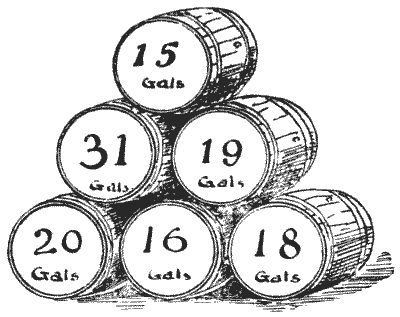 Sources:Topics:Arithmetic Number Theory -> Modular Arithmetic / Remainder Arithmetic -> Divisibility Rules -> Divisibility Rules by 3 and 9 Algebra -> Word Problems Logic -> Reasoning / Logic
- Amusements in Mathematics, Henry Ernest Dudeney Question 76
-
THE LOCKERS PUZZLE
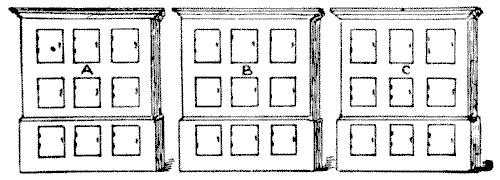
A man had in his office three cupboards, each containing nine lockers, as shown in the diagram. He told his clerk to place a different one-figure number on each locker of cupboard A, and to do the same in the case of B, and of C. As we are here allowed to call nought a digit, and he was not prohibited from using nought as a number, he clearly had the option of omitting any one of ten digits from each cupboard.
Now, the employer did not say the lockers were to be numbered in any numerical order, and he was surprised to find, when the work was done, that the figures had apparently been mixed up indiscriminately. Calling upon his clerk for an explanation, the eccentric lad stated that the notion had occurred to him so to arrange the figures that in each case they formed a simple addition sum, the two upper rows of figures producing the sum in the lowest row. But the most surprising point was this: that he had so arranged them that the addition in A gave the smallest possible sum, that the addition in C gave the largest possible sum, and that all the nine digits in the three totals were different. The puzzle is to show how this could be done. No decimals are allowed and the nought may not appear in the hundreds place.
Sources:Topics:Number Theory Arithmetic Logic -> Reasoning / Logic Combinatorics -> Case Analysis / Checking Cases -> Processes / Procedures- Amusements in Mathematics, Henry Ernest Dudeney Question 79
-
THE CENTURY PUZZLE
Can you write `100` in the form of a mixed number, using all the nine digits once, and only once? The late distinguished French mathematician, Edouard Lucas, found seven different ways of doing it, and expressed his doubts as to there being any other ways. As a matter of fact there are just eleven ways and no more. Here is one of them, `91 5742/638`. Nine of the other ways have similarly two figures in the integral part of the number, but the eleventh expression has only one figure there. Can the reader find this last form?
Sources:Topics:Number Theory -> Modular Arithmetic / Remainder Arithmetic -> Divisibility Rules Logic -> Reasoning / Logic Arithmetic -> Fractions Combinatorics -> Case Analysis / Checking Cases -> Processes / Procedures- Amusements in Mathematics, Henry Ernest Dudeney Question 90