Logic, Reasoning / Logic
This category emphasizes general logical reasoning skills, often applied to puzzles or scenarios not strictly formal. It involves deduction, inference, identifying patterns, and drawing sound conclusions from given information. It overlaps with formal logic but can be broader.
Paradoxes-
THE TWO ROOKS
This is a puzzle game for two players. Each player has a single rook. The first player places his rook on any square of the board that he may choose to select, and then the second player does the same. They now play in turn, the point of each play being to capture the opponent's rook. But in this game you cannot play through a line of attack without being captured. That is to say, if in the diagram it is Black's turn to play, he cannot move his rook to his king's knight's square, or to his king's rook's square, because he would enter the "line of fire" when passing his king's bishop's square. For the same reason he cannot move to his queen's rook's seventh or eighth squares. Now, the game can never end in a draw. Sooner or later one of the rooks must fall, unless, of course, both players commit the absurdity of not trying to win. The trick of winning is ridiculously simple when you know it. Can you solve the puzzle?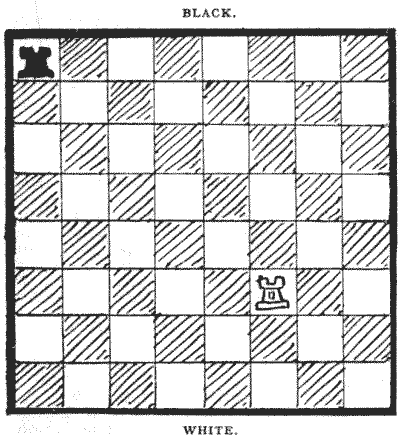 Sources:Topics:Combinatorics -> Combinatorial Geometry Combinatorics -> Invariants Combinatorics -> Game Theory Logic -> Reasoning / Logic Combinatorics -> Colorings -> Chessboard Coloring
- Amusements in Mathematics, Henry Ernest Dudeney Question 393
-
THE CIGAR PUZZLE
I once propounded the following puzzle in a London club, and for a considerable period it absorbed the attention of the members. They could make nothing of it, and considered it quite impossible of solution. And yet, as I shall show, the answer is remarkably simple.
Two men are seated at a square-topped table. One places an ordinary cigar (flat at one end, pointed at the other) on the table, then the other does the same, and so on alternately, a condition being that no cigar shall touch another. Which player should succeed in placing the last cigar, assuming that they each will play in the best possible manner? The size of the table top and the size of the cigar are not given, but in order to exclude the ridiculous answer that the table might be so diminutive as only to take one cigar, we will say that the table must not be less than `2` feet square and the cigar not more than `4`½ inches long. With those restrictions you may take any dimensions you like. Of course we assume that all the cigars are exactly alike in every respect. Should the first player, or the second player, win?
Sources:Topics:Combinatorics -> Game Theory Logic -> Reasoning / Logic Geometry -> Plane Geometry -> Symmetry- Amusements in Mathematics, Henry Ernest Dudeney Question 398
-
EIGHT JOLLY GAOL BIRDS
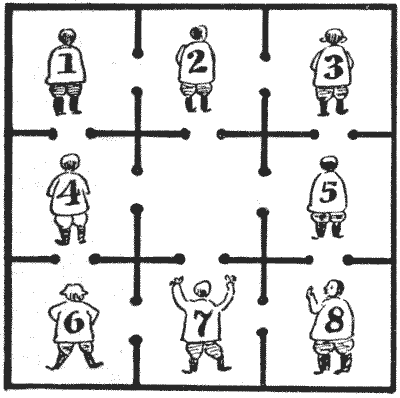
The illustration shows the plan of a prison of nine cells all communicating with one another by doorways. The eight prisoners have their numbers on their backs, and any one of them is allowed to exercise himself in whichever cell may happen to be vacant, subject to the rule that at no time shall two prisoners be in the same cell. The merry monarch in whose dominions the prison was situated offered them special comforts one Christmas Eve if, without breaking that rule, they could so place themselves that their numbers should form a magic square.
Now, prisoner No. `7` happened to know a good deal about magic squares, so he worked out a scheme and naturally selected the method that was most expeditious—that is, one involving the fewest possible moves from cell to cell. But one man was a surly, obstinate fellow (quite unfit for the society of his jovial companions), and he refused to move out of his cell or take any part in the proceedings. But No. `7` was quite equal to the emergency, and found that he could still do what was required in the fewest possible moves without troubling the brute to leave his cell. The puzzle is to show how he did it and, incidentally, to discover which prisoner was so stupidly obstinate. Can you find the fellow?
Sources:- Amusements in Mathematics, Henry Ernest Dudeney Question 401
-
THE SPANISH DUNGEON
Not fifty miles from Cadiz stood in the middle ages a castle, all traces of which have for centuries disappeared. Among other interesting features, this castle contained a particularly unpleasant dungeon divided into sixteen cells, all communicating with one another, as shown in the illustration.
Now, the governor was a merry wight, and very fond of puzzles withal. One day he went to the dungeon and said to the prisoners, "By my halidame!" (or its equivalent in Spanish) "you shall all be set free if you can solve this puzzle. You must so arrange yourselves in the sixteen cells that the numbers on your backs shall form a magic square in which every column, every row, and each of the two diagonals shall add up the same. Only remember this: that in no case may two of you ever be together in the same cell."
One of the prisoners, after working at the problem for two or three days, with a piece of chalk, undertook to obtain the liberty of himself and his fellow-prisoners if they would follow his directions and move through the doorway from cell to cell in the order in which he should call out their numbers.
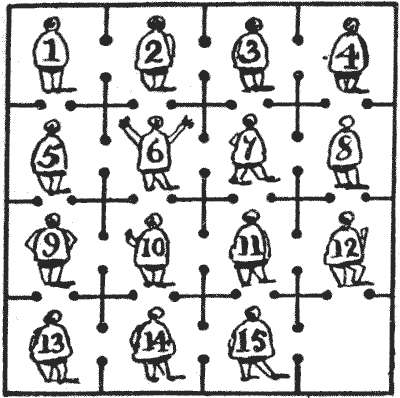
He succeeded in his attempt, and, what is more remarkable, it would seem from the account of his method recorded in the ancient manuscript lying before me, that he did so in the fewest possible moves. The reader is asked to show what these moves were.
Sources:Topics:Logic -> Reasoning / Logic Combinatorics -> Case Analysis / Checking Cases -> Processes / Procedures Combinatorics -> Number Tables Algebra -> Word Problems -> Solving Word Problems "From the End" / Working Backwards Puzzles and Rebuses -> Reconstruct the Exercise / Cryptarithmetic- Amusements in Mathematics, Henry Ernest Dudeney Question 403
-
WHO WAS FIRST?
Anderson, Biggs, and Carpenter were staying together at a place by the seaside. One day they went out in a boat and were a mile at sea when a rifle was fired on shore in their direction. Why or by whom the shot was fired fortunately does not concern us, as no information on these points is obtainable, but from the facts I picked up we can get material for a curious little puzzle for the novice.
It seems that Anderson only heard the report of the gun, Biggs only saw the smoke, and Carpenter merely saw the bullet strike the water near them. Now, the question arises: Which of them first knew of the discharge of the rifle?
Sources:Topics:Logic -> Reasoning / Logic- Amusements in Mathematics, Henry Ernest Dudeney Question 414
-
THE SABBATH PUZZLE
I have come across the following little poser in an old book. I wonder how many readers will see the author's intended solution to the riddle.
Christians the week's first day for Sabbath hold;
Sources:
The Jews the seventh, as they did of old;
The Turks the sixth, as we have oft been told.
How can these three, in the same place and day,
Have each his own true Sabbath? tell, I pray.- Amusements in Mathematics, Henry Ernest Dudeney Question 422
-
THE RUBY BROOCH
The annals of Scotland Yard contain some remarkable cases of jewel robberies, but one of the most perplexing was the theft of Lady Littlewood's rubies. There have, of course, been many greater robberies in point of value, but few so artfully conceived. Lady Littlewood, of Romley Manor, had a beautiful but rather eccentric heirloom in the form of a ruby brooch. While staying at her town house early in the eighties she took the jewel to a shop in Brompton for some slight repairs.
"A fine collection of rubies, madam," said the shopkeeper, to whom her ladyship was a stranger.
"Yes," she replied; "but curiously enough I have never actually counted them. My mother once pointed out to me that if you start from the centre and count up one line, along the outside and down the next line, there are always eight rubies. So I should always know if a stone were missing."
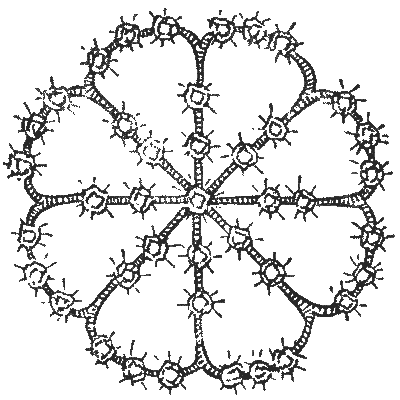
Six months later a brother of Lady Littlewood's, who had returned from his regiment in India, noticed that his sister was wearing the ruby brooch one night at a county ball, and on their return home asked to look at it more closely. He immediately detected the fact that four of the stones were gone.
"How can that possibly be?" said Lady Littlewood. "If you count up one line from the centre, along the edge, and down the next line, in any direction, there are always eight stones. This was always so and is so now. How, therefore, would it be possible to remove a stone without my detecting it?"
"Nothing could be simpler," replied the brother. "I know the brooch well. It originally contained forty-five stones, and there are now only forty-one. Somebody has stolen four rubies, and then reset as small a number of the others as possible in such a way that there shall always be eight in any of the directions you have mentioned."
There was not the slightest doubt that the Brompton jeweller was the thief, and the matter was placed in the hands of the police. But the man was wanted for other robberies, and had left the neighbourhood some time before. To this day he has never been found.
The interesting little point that at first baffled the police, and which forms the subject of our puzzle, is this: How were the forty-five rubies originally arranged on the brooch? The illustration shows exactly how the forty-one were arranged after it came back from the jeweller; but although they count eight correctly in any of the directions mentioned, there are four stones missing.
Sources:- Amusements in Mathematics, Henry Ernest Dudeney Question 423
-
THE GARDENER AND THE COOK
A correspondent, signing himself "Simple Simon," suggested that I should give a special catch puzzle in the issue of The Weekly Dispatch for All Fools' Day, `1900`. So I gave the following, and it caused considerable amusement; for out of a very large body of competitors, many quite expert, not a single person solved it, though it ran for nearly a month.
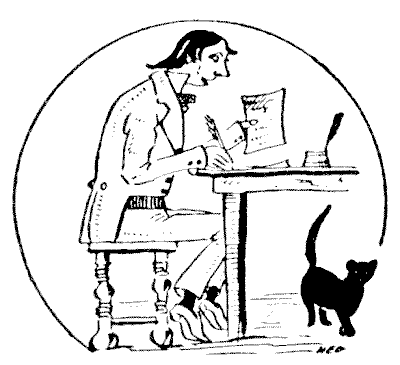
"The illustration is a fancy sketch of my correspondent, 'Simple Simon,' in the act of trying to solve the following innocent little arithmetical puzzle. A race between a man and a woman that I happened to witness one All Fools' Day has fixed itself indelibly on my memory. It happened at a country-house, where the gardener and the cook decided to run a race to a point `100` feet straight away and return. I found that the gardener ran `3` feet at every bound and the cook only `2` feet, but then she made three bounds to his two. Now, what was the result of the race?"
A fortnight after publication I added the following note: "It has been suggested that perhaps there is a catch in the 'return,' but there is not. The race is to a point `100` feet away and home again—that is, a distance of `200` feet. One correspondent asks whether they take exactly the same time in turning, to which I reply that they do. Another seems to suspect that it is really a conundrum, and that the answer is that 'the result of the race was a (matrimonial) tie.' But I had no such intention. The puzzle is an arithmetical one, as it purports to be."
Sources:Topics:Arithmetic Algebra -> Word Problems Logic -> Reasoning / Logic Combinatorics -> Case Analysis / Checking Cases -> Processes / Procedures- Amusements in Mathematics, Henry Ernest Dudeney Question 428
-
FIND THE MAN'S WIFE
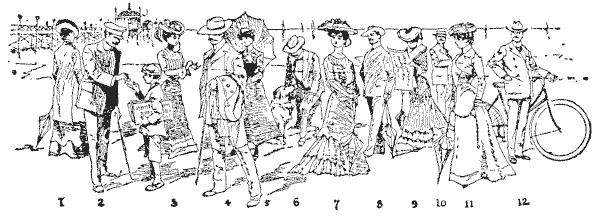
One summer day in `1903` I was loitering on the Brighton front, watching the people strolling about on the beach, when the friend who was with me suddenly drew my attention to an individual who was standing alone, and said, "Can you point out that man's wife? They are stopping at the same hotel as I am, and the lady is one of those in view." After a few minutes' observation, I was successful in indicating the lady correctly. My friend was curious to know by what method of reasoning I had arrived at the result. This was my answer:—
"We may at once exclude that Sister of Mercy and the girl in the short frock; also the woman selling oranges. It cannot be the lady in widows' weeds. It is not the lady in the bath chair, because she is not staying at your hotel, for I happened to see her come out of a private house this morning assisted by her maid. The two ladies in red breakfasted at my hotel this morning, and as they were not wearing outdoor dress I conclude they are staying there. It therefore rests between the lady in blue and the one with the green parasol. But the left hand that holds the parasol is, you see, ungloved and bears no wedding-ring. Consequently I am driven to the conclusion that the lady in blue is the man's wife—and you say this is correct."
Now, as my friend was an artist, and as I thought an amusing puzzle might be devised on the lines of his question, I asked him to make me a drawing according to some directions that I gave him, and I have pleasure in presenting his production to my readers. It will be seen that the picture shows six men and six ladies: Nos. `1, 3, 5, 7, 9`, and `11` are ladies, and Nos. `2, 4, 6, 8, 10`, and `12` are men. These twelve individuals represent six married couples, all strangers to one another, who, in walking aimlessly about, have got mixed up. But we are only concerned with the man that is wearing a straw hat—Number `10`. The puzzle is to find this man's wife. Examine the six ladies carefully, and see if you can determine which one of them it is.
I showed the picture at the time to a few friends, and they expressed very different opinions on the matter. One said, "I don't believe he would marry a girl like Number `7`." Another said, "I am sure a nice girl like Number `3` would not marry such a fellow!" Another said, "It must be Number `1`, because she has got as far away as possible from the brute!" It was suggested, again, that it must be Number `11`, because "he seems to be looking towards her;" but a cynic retorted, "For that very reason, if he is really looking at her, I should say that she is not his wife!"
I now leave the question in the hands of my readers. Which is really Number `10`'s wife?
The illustration is of necessity considerably reduced from the large scale on which it originally appeared in The Weekly Dispatch (24th May `1903`), but it is hoped that the details will be sufficiently clear to allow the reader to derive entertainment from its examination. In any case the solution given will enable him to follow the points with interest.
Sources:
- Amusements in Mathematics, Henry Ernest Dudeney Question 430
-
Question
One day, Harry Potter found a strange notebook in which the following one hundred sentences were written:
"In this notebook, there is exactly one sentence that is false."
"In this notebook, there are exactly two sentences that are false."
"In this notebook, there are exactly three sentences that are false."
...
"In this notebook, there are exactly one hundred sentences that are false."
Are there any true sentences in this notebook, and if so, how many? Justify your answer!