Logic, Reasoning / Logic
This category emphasizes general logical reasoning skills, often applied to puzzles or scenarios not strictly formal. It involves deduction, inference, identifying patterns, and drawing sound conclusions from given information. It overlaps with formal logic but can be broader.
Paradoxes-
CROSSING THE STREAM
During a country ramble Mr. and Mrs. Softleigh found themselves in a pretty little dilemma. They had to cross a stream in a small boat which was capable of carrying only `150` lbs. weight. But Mr. Softleigh and his wife each weighed exactly `150` lbs., and each of their sons weighed `75` lbs. And then there was the dog, who could not be induced on any terms to swim. On the principle of "ladies first," they at once sent Mrs. Softleigh over; but this was a stupid oversight, because she had to come back again with the boat, so nothing was gained by that operation. How did they all succeed in getting across? The reader will find it much easier than the Softleigh family did, for their greatest enemy could not have truthfully called them a brilliant quartette—while the dog was a perfect fool.Sources:Topics:Algebra -> Word Problems Logic -> Reasoning / Logic Combinatorics -> Case Analysis / Checking Cases -> Processes / Procedures- Amusements in Mathematics, Henry Ernest Dudeney Question 373
-
CROSSING THE RIVER AXE
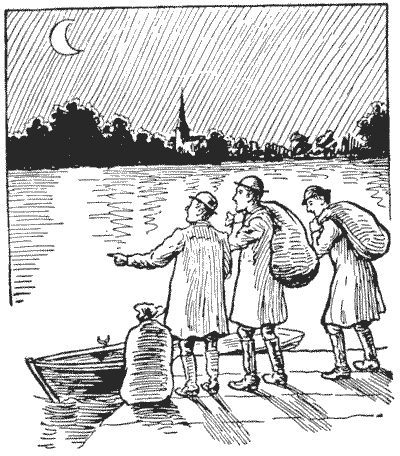 Many years ago, in the days of the smuggler known as "Rob Roy of the West," a piratical band buried on the coast of South Devon a quantity of treasure which was, of course, abandoned by them in the usual inexplicable way. Some time afterwards its whereabouts was discovered by three countrymen, who visited the spot one night and divided the spoil between them, Giles taking treasure to the value of £`800`, Jasper £`500` worth, and Timothy £`300` worth. In returning they had to cross the river Axe at a point where they had left a small boat in readiness. Here, however, was a difficulty they had not anticipated. The boat would only carry two men, or one man and a sack, and they had so little confidence in one another that no person could be left alone on the land or in the boat with more than his share of the spoil, though two persons (being a check on each other) might be left with more than their shares. The puzzle is to show how they got over the river in the fewest possible crossings, taking their treasure with them. No tricks, such as ropes, "flying bridges," currents, swimming, or similar dodges, may be employed.
Sources:Topics:Algebra -> Word Problems Logic -> Reasoning / Logic Combinatorics -> Case Analysis / Checking Cases -> Processes / Procedures
Many years ago, in the days of the smuggler known as "Rob Roy of the West," a piratical band buried on the coast of South Devon a quantity of treasure which was, of course, abandoned by them in the usual inexplicable way. Some time afterwards its whereabouts was discovered by three countrymen, who visited the spot one night and divided the spoil between them, Giles taking treasure to the value of £`800`, Jasper £`500` worth, and Timothy £`300` worth. In returning they had to cross the river Axe at a point where they had left a small boat in readiness. Here, however, was a difficulty they had not anticipated. The boat would only carry two men, or one man and a sack, and they had so little confidence in one another that no person could be left alone on the land or in the boat with more than his share of the spoil, though two persons (being a check on each other) might be left with more than their shares. The puzzle is to show how they got over the river in the fewest possible crossings, taking their treasure with them. No tricks, such as ropes, "flying bridges," currents, swimming, or similar dodges, may be employed.
Sources:Topics:Algebra -> Word Problems Logic -> Reasoning / Logic Combinatorics -> Case Analysis / Checking Cases -> Processes / Procedures- Amusements in Mathematics, Henry Ernest Dudeney Question 374
-
FIVE JEALOUS HUSBANDS
During certain local floods five married couples found themselves surrounded by water, and had to escape from their unpleasant position in a boat that would only hold three persons at a time. Every husband was so jealous that he would not allow his wife to be in the boat or on either bank with another man (or with other men) unless he was himself present. Show the quickest way of getting these five men and their wives across into safety.
Call the men A, B, C, D, E, and their respective wives a, b, c, d, e. To go over and return counts as two crossings. No tricks such as ropes, swimming, currents, etc., are permitted.
Sources:Topics:Logic -> Reasoning / Logic Combinatorics -> Case Analysis / Checking Cases -> Processes / Procedures Combinatorics -> Case Analysis / Checking Cases -> Processes / Procedures- Amusements in Mathematics, Henry Ernest Dudeney Question 375
-
THE FOUR ELOPEMENTS
Colonel B—— was a widower of a very taciturn disposition. His treatment of his four daughters was unusually severe, almost cruel, and they not unnaturally felt disposed to resent it. Being charming girls with every virtue and many accomplishments, it is not surprising that each had a fond admirer. But the father forbade the young men to call at his house, intercepted all letters, and placed his daughters under stricter supervision than ever. But love, which scorns locks and keys and garden walls, was equal to the occasion, and the four youths conspired together and planned a general elopement.
At the foot of the tennis lawn at the bottom of the garden ran the silver Thames, and one night, after the four girls had been safely conducted from a dormitory window to terra firma, they all crept softly down to the bank of the river, where a small boat belonging to the Colonel was moored. With this they proposed to cross to the opposite side and make their way to a lane where conveyances were waiting to carry them in their flight. Alas! here at the water's brink their difficulties already began.
The young men were so extremely jealous that not one of them would allow his prospective bride to remain at any time in the company of another man, or men, unless he himself were present also. Now, the boat would only hold two persons, though it could, of course, be rowed by one, and it seemed impossible that the four couples would ever get across. But midway in the stream was a small island, and this seemed to present a way out of the difficulty, because a person or persons could be left there while the boat was rowed back or to the opposite shore. If they had been prepared for their difficulty they could have easily worked out a solution to the little poser at any other time. But they were now so hurried and excited in their flight that the confusion they soon got into was exceedingly amusing—or would have been to any one except themselves.
As a consequence they took twice as long and crossed the river twice as often as was really necessary. Meanwhile, the Colonel, who was a very light sleeper, thought he heard a splash of oars. He quickly raised the alarm among his household, and the young ladies were found to be missing. Somebody was sent to the police-station, and a number of officers soon aided in the pursuit of the fugitives, who, in consequence of that delay in crossing the river, were quickly overtaken. The four girls returned sadly to their homes, and afterwards broke off their engagements in disgust.
For a considerable time it was a mystery how the party of eight managed to cross the river in that little boat without any girl being ever left with a man, unless her betrothed was also present. The favourite method is to take eight counters or pieces of cardboard and mark them A, B, C, D, a, b, c, d, to represent the four men and their prospective brides, and carry them from one side of a table to the other in a matchbox (to represent the boat), a penny being placed in the middle of the table as the island.
Readers are now asked to find the quickest method of getting the party across the river. How many passages are necessary from land to land? By "land" is understood either shore or island. Though the boat would not necessarily call at the island every time of crossing, the possibility of its doing so must be provided for. For example, it would not do for a man to be alone in the boat (though it were understood that he intended merely to cross from one bank to the opposite one) if there happened to be a girl alone on the island other than the one to whom he was engaged.
Sources:Topics:Logic -> Reasoning / Logic Combinatorics -> Case Analysis / Checking Cases -> Processes / Procedures Combinatorics -> Case Analysis / Checking Cases -> Processes / Procedures Puzzles and Rebuses- Amusements in Mathematics, Henry Ernest Dudeney Question 376
-
THE CARD FRAME PUZZLE
In the illustration we have a frame constructed from the ten playing cards, ace to ten of diamonds. The children who made it wanted the pips on all four sides to add up alike, but they failed in their attempt and gave it up as impossible. It will be seen that the pips in the top row, the bottom row, and the left-hand side all add up `14`, but the right-hand side sums to `23`. Now, what they were trying to do is quite possible. Can you rearrange the ten cards in the same formation so that all four sides shall add up alike? Of course they need not add up `14`, but any number you choose to select.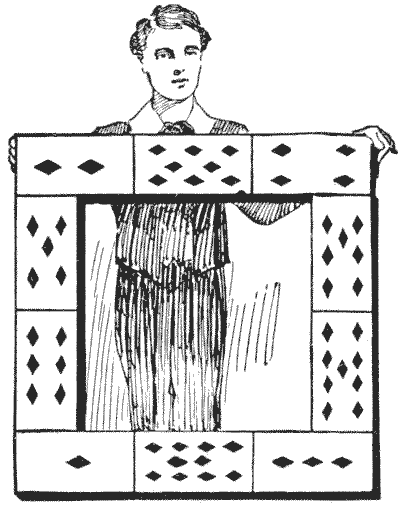 Sources:Topics:Arithmetic Algebra -> Equations Logic -> Reasoning / Logic Combinatorics -> Case Analysis / Checking Cases -> Processes / Procedures
- Amusements in Mathematics, Henry Ernest Dudeney Question 381
-
"STRAND" PATIENCE
The idea for this came to me when considering the game of Patience that I gave in the Strand Magazine for December, `1910`, which has been reprinted in Ernest Bergholt's Second Book of Patience Games, under the new name of "King Albert."
Make two piles of cards as follows: `9` D, `8` S, `7` D, `6` S, `5` D, `4` S, `3` D, `2` S, `1` D, and `9` H, `8` C, `7` H, `6` C, `5` H, `4` C, `3` H, `2` C, `1` H, with the `9` of diamonds at the bottom of one pile and the `9` of hearts at the bottom of the other. The point is to exchange the spades with the clubs, so that the diamonds and clubs are still in numerical order in one pile and the hearts and spades in the other. There are four vacant spaces in addition to the two spaces occupied by the piles, and any card may be laid on a space, but a card can only be laid on another of the next higher value—an ace on a two, a two on a three, and so on. Patience is required to discover the shortest way of doing this. When there are four vacant spaces you can pile four cards in seven moves, with only three spaces you can pile them in nine moves, and with two spaces you cannot pile more than two cards. When you have a grasp of these and similar facts you will be able to remove a number of cards bodily and write down `7, 9`, or whatever the number of moves may be. The gradual shortening of play is fascinating, and first attempts are surprisingly lengthy.
Sources:Topics:Logic -> Reasoning / Logic Combinatorics -> Case Analysis / Checking Cases -> Processes / Procedures Combinatorics -> Case Analysis / Checking Cases -> Processes / Procedures Puzzles and Rebuses- Amusements in Mathematics, Henry Ernest Dudeney Question 385
-
A TRICK WITH DICE
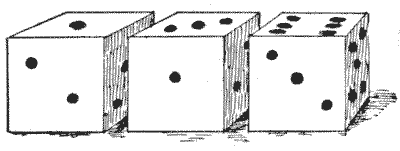 Here is a neat little trick with three dice. I ask you to throw the dice without my seeing them. Then I tell you to multiply the points of the first die by `2` and add `5`; then multiply the result by `5` and add the points of the second die; then multiply the result by `10` and add the points of the third die. You then give me the total, and I can at once tell you the points thrown with the three dice. How do I do it? As an example, if you threw `1, 3`, and `6`, as in the illustration, the result you would give me would be `386`, from which I could at once say what you had thrown.
Sources:
Here is a neat little trick with three dice. I ask you to throw the dice without my seeing them. Then I tell you to multiply the points of the first die by `2` and add `5`; then multiply the result by `5` and add the points of the second die; then multiply the result by `10` and add the points of the third die. You then give me the total, and I can at once tell you the points thrown with the three dice. How do I do it? As an example, if you threw `1, 3`, and `6`, as in the illustration, the result you would give me would be `386`, from which I could at once say what you had thrown.
Sources:
- Amusements in Mathematics, Henry Ernest Dudeney Question 386
-
THE VILLAGE CRICKET MATCH
In a cricket match, Dingley Dell v. All Muggleton, the latter had the first innings. Mr. Dumkins and Mr. Podder were at the wickets, when the wary Dumkins made a splendid late cut, and Mr. Podder called on him to run. Four runs were apparently completed, but the vigilant umpires at each end called, "three short," making six short runs in all. What number did Mr. Dumkins score? When Dingley Dell took their turn at the wickets their champions were Mr. Luffey and Mr. Struggles. The latter made a magnificent off-drive, and invited his colleague to "come along," with the result that the observant spectators applauded them for what was supposed to have been three sharp runs. But the umpires declared that there had been two short runs at each end—four in all. To what extent, if any, did this manœuvre increase Mr. Struggles's total? Sources:- Amusements in Mathematics, Henry Ernest Dudeney Question 387
-
THE FOOTBALL PLAYERS
"It is a glorious game!" an enthusiast was heard to exclaim. "At the close of last season, of the footballers of my acquaintance four had broken their left arm, five had broken their right arm, two had the right arm sound, and three had sound left arms." Can you discover from that statement what is the smallest number of players that the speaker could be acquainted with?
It does not at all follow that there were as many as fourteen men, because, for example, two of the men who had broken the left arm might also be the two who had sound right arms.
Sources:Topics:Logic -> Reasoning / Logic Combinatorics -> Case Analysis / Checking Cases -> Processes / Procedures Minimum and Maximum Problems / Optimization Problems- Amusements in Mathematics, Henry Ernest Dudeney Question 389
-
THE PEBBLE GAME
Here is an interesting little puzzle game that I used to play with an acquaintance on the beach at Slocomb-on-Sea. Two players place an odd number of pebbles, we will say fifteen, between them. Then each takes in turn one, two, or three pebbles (as he chooses), and the winner is the one who gets the odd number. Thus, if you get seven and your opponent eight, you win. If you get six and he gets nine, he wins. Ought the first or second player to win, and how? When you have settled the question with fifteen pebbles try again with, say, thirteen.Sources:Topics:Combinatorics -> Game Theory Logic -> Reasoning / Logic Combinatorics -> Case Analysis / Checking Cases -> Processes / Procedures- Amusements in Mathematics, Henry Ernest Dudeney Question 392