Arithmetic
Arithmetic is the fundamental branch of mathematics dealing with numbers and the basic operations: addition, subtraction, multiplication, and division. Questions involve performing these operations, understanding number properties (like integers, fractions, decimals), and solving related word problems.
Fractions Percentages Division with Remainder-
Question
Find the sum of all natural numbers from `1` to `100`.
-
The Clubs
In the grade, there are `70` children. Of these, `27` go to theater club, `32` sing in the choir, and `22` do Judo. In the theater club, there are `10` children from the choir, in the choir there are `6` children from Judo, and in Judo there are `8` children who also study theater. Three children also go to theater club, Judo, and sing in the choir. How many children from the grade do not participate in any of these three clubs?
-
Question
How many numbers between `1` and `100` are not divisible by `2` or `5`?
Topics:Arithmetic Number Theory -> Modular Arithmetic / Remainder Arithmetic -> Divisibility Rules -> Divisibility Rules by 2, 4, and 8 Number Theory -> Modular Arithmetic / Remainder Arithmetic -> Divisibility Rules -> Divisibility Rules by 5 and 25 Number Theory -> Greatest Common Divisor (GCD) and Least Common Multiple (LCM) Set Theory Number Theory -> Division -
Question
Calculate the value of the expression (without a calculator):
`(1+1/(2^2-1))(1+1/(3^2-1))(1+1/(4^2-1))*...*(1+1/(99^2-1))`
-
Question
Given a sheet of paper of size `10×10` cm. Can you cut out a number of circles from this sheet such that the sum of their diameters is greater than `5` meters?
-
Question
The following numbers are written on the board: `1, 2, 3, …, 2016, 2017`. In one move, it is allowed to choose a pair of numbers written on the board, erase them, and write their (positive) difference in their place. After several such operations, a single number remains on the board. Is it possible that this is zero?
Topics:Arithmetic Combinatorics -> Invariants Combinatorics -> Induction (Mathematical Induction) Number Theory -> Division -> Parity (Even/Odd) Algebra -> Sequences -> Arithmetic Progression / Arithmetic Sequence Combinatorics -> Case Analysis / Checking Cases -> Processes / Procedures Proof and Example -> Proof by Contradiction -
Question
By how much is the sum of all even numbers not exceeding `100` greater than the sum of all odd numbers not exceeding `100`?
-
Cherries and Blueberries
`175` kg of cherries cost more than `125` kg of blueberries, but less than `126` kg of blueberries. In addition, it is known that a kilogram of cherries costs a whole number of shekels, and a kilogram of blueberries also costs a whole number of shekels.
Prove that `80` shekels is not enough to buy one kilogram of blueberries and three kilograms of cherries.
S. Fomin
Sources:- Tournament of Towns, 1983-1984, Fall, Practice Version, Grades 9-10 Question 1 Points 3
-
Frame
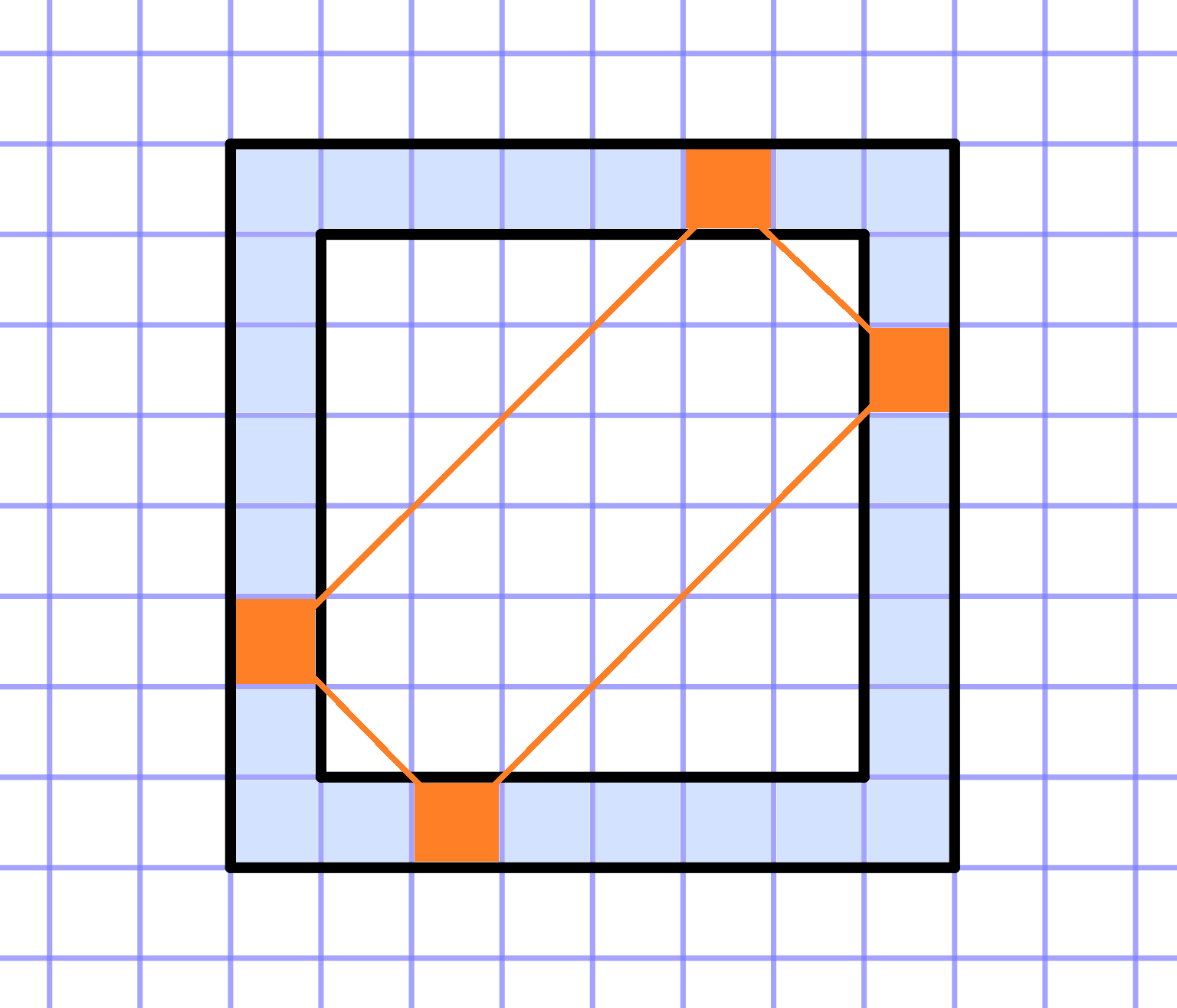
On a grid paper, a square of size `NxxN` is given. Consider its frame with a width of one square. It consists of `4*(N-1)` squares.
Can you write `4*(N-1)` consecutive integers (not necessarily positive) in the squares of the frame, such that the following condition holds:
For every rectangle whose vertices are on the frame and whose sides are parallel to the diagonals of the original square, the sum of the numbers at the vertices is equal to a constant value. This also includes the "degenerate" rectangles of zero width that coincide with the diagonals of the square - in this case, simply sum the two numbers at the opposite vertices of the square.
For:
a. `N=3`
b. `N=4`
c. `N=5`
 Sources:Topics:Arithmetic Number Theory -> Division -> Parity (Even/Odd) Proof and Example -> Constructing an Example / Counterexample Algebra -> Sequences -> Arithmetic Progression / Arithmetic Sequence Combinatorics -> Case Analysis / Checking Cases -> Processes / Procedures
- Tournament of Towns, 1983-1984, Fall, Practice Version, Grades 9-10 Question 3 Points 2+3+4
-
Question
`120` identical spheres are arranged in the shape of a triangular pyramid. How many layers are there in the pyramid?
Note: This is a pyramid, which is a three-dimensional shape, and not a triangle in a plane.
Topics:Geometry -> Solid Geometry / Geometry in Space Arithmetic Logic -> Reasoning / Logic Proof and Example -> Constructing an Example / Counterexample Algebra -> Sequences -> Arithmetic Progression / Arithmetic Sequence Algebra -> Sequences -> Complete/Continue the Sequence Number Theory -> Triangular Numbers