Arithmetic
Arithmetic is the fundamental branch of mathematics dealing with numbers and the basic operations: addition, subtraction, multiplication, and division. Questions involve performing these operations, understanding number properties (like integers, fractions, decimals), and solving related word problems.
Fractions Percentages Division with Remainder-
Question
In the magical land, there are only coins of `5`, `6`, and `15` liras. Shlomi currently only has coins of `6` and `15` liras. Shlomi wants to buy a book that costs `38` liras. Will he be able to pay for the book without change?
-
Question
A cube with a side of one meter is cut into cubes with a side of one centimeter. If we put all the resulting cubes in a row, what will be the length of the row (in kilometers)?
-
Question
Seven wolves eat seven sheep in seven days. How long will it take `9` wolves to eat `9` sheep?
-
Question
Consider the integers from `1` to `700`.
a. How many of these numbers are even?
b. How many of these numbers are divisible by `7`?
c. How many of these numbers are not divisible by `2` nor by `7`?
Answer question c.
-
Question
Can you divide `44` balls into `9` piles, each containing a different number of balls?
-
Question
In the following arithmetic puzzle, different digits have been replaced by different letters, and identical digits – by identical letters. Reconstruct the puzzle:
`BAOxxBAxxB=2002`
-
Question
Given `50` distinct natural numbers between `1` and `100`. It is known that no two of these numbers sum to `100`. Is it necessarily true that one of these numbers must be a perfect square?
Topics:Number Theory -> Prime Numbers Arithmetic Combinatorics -> Pigeonhole Principle Combinatorics -> Matchings Logic -> Reasoning / Logic Proof and Example -> Constructing an Example / Counterexample Set Theory Combinatorics -> Case Analysis / Checking Cases -> Processes / Procedures Proof and Example -> Proof by Contradiction -
Where Did the Extra Thaler Come From?
A cobbler named Karl made boots and sent his young son Hans to the market to sell them for `25` thalers. When Hans arrived at the market, two disabled men approached him, one without a left leg, the other without a right leg, and asked to buy one boot each. Hans agreed and sold each of them a boot for `12.5` thalers.
When Hans returned home and told his father what had happened, Karl decided that these people should have been sold boots at a lower price - `10` thalers per boot. So he gave Hans `5` thalers and asked him to return `2.5` thalers to each of them.
On his way to the market, Hans saw a sweets stall, couldn't resist, and spent `3` thalers of what his father had given him there. After that, he found the two disabled men and gave each of them one thaler, because that's all he had left. When Hans returned home, he regretted what he had done and told his father everything. The cobbler Karl was very angry and locked his son in the pantry as punishment.
Thus, Hans sits in the pantry and analyzes what happened that day: "I returned one thaler to each of the disabled men, which means that each of them ultimately paid `12.5-1=11.5` thalers for his boot. So in total they paid `11.5*2=23` thalers. And I spent three thalers on sweets. That's a total of `26` thalers, but there were `25`! Where did one more thaler come from?"
-
Question
Move one matchstick to make a valid equation.
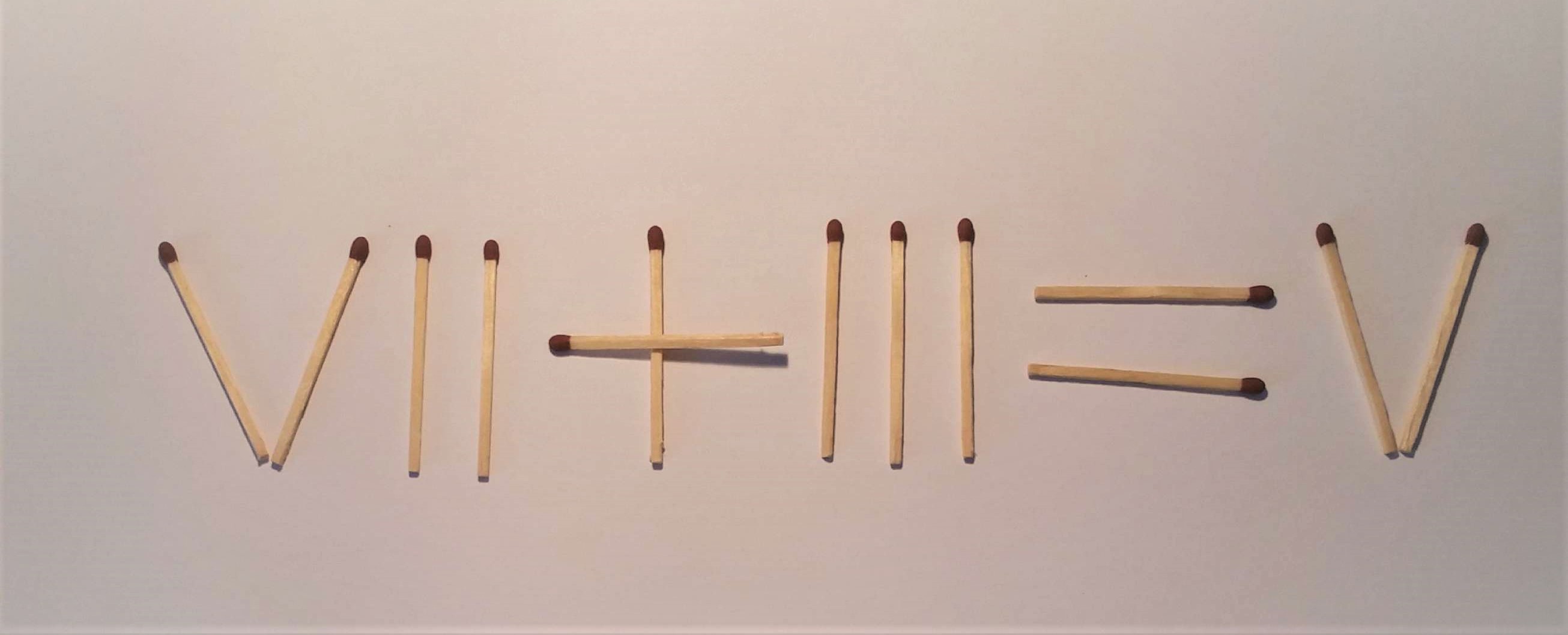
Note: There may be multiple solutions.
Sources:- Tournament of Towns, 1983-1984, Fall, Practice Version, Grades 9-10 Question 4 Points 8
-
Reconstruct the Exercise
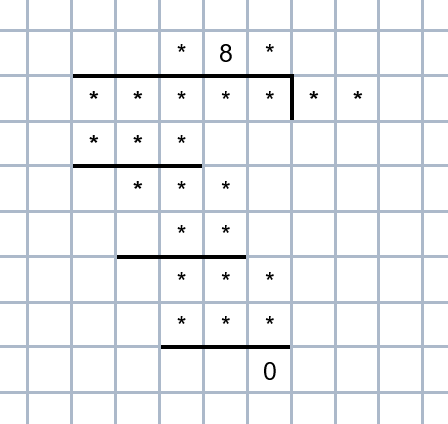
Reconstruct the digits in the following exercise: