Combinatorics, Matchings
In graph theory, a matching is a set of edges where no two edges share a common vertex. This topic explores finding maximum matchings, perfect matchings, or stable matchings in graphs, often in bipartite graphs (e.g., Hall's Marriage Theorem). Questions involve assignment or pairing problems.
-
Question
On a circle, `2016` blue points and one red point are marked. Consider all possible polygons whose vertices are at these points. Which polygons are more numerous – those that contain the red point or those whose vertices are all blue?
Sources: -
Question
From a chessboard, two opposite corners are removed (the squares `a1` and `h8`, for example). Can you tile the remaining board with dominoes?
-
Question
`101` points are located on a circle. Which polygons with vertices at these points are more numerous – polygons with `51` sides or polygons with `50` sides?
-
Question
Prove that the given shape cannot be cut into dominoes:

-
Question
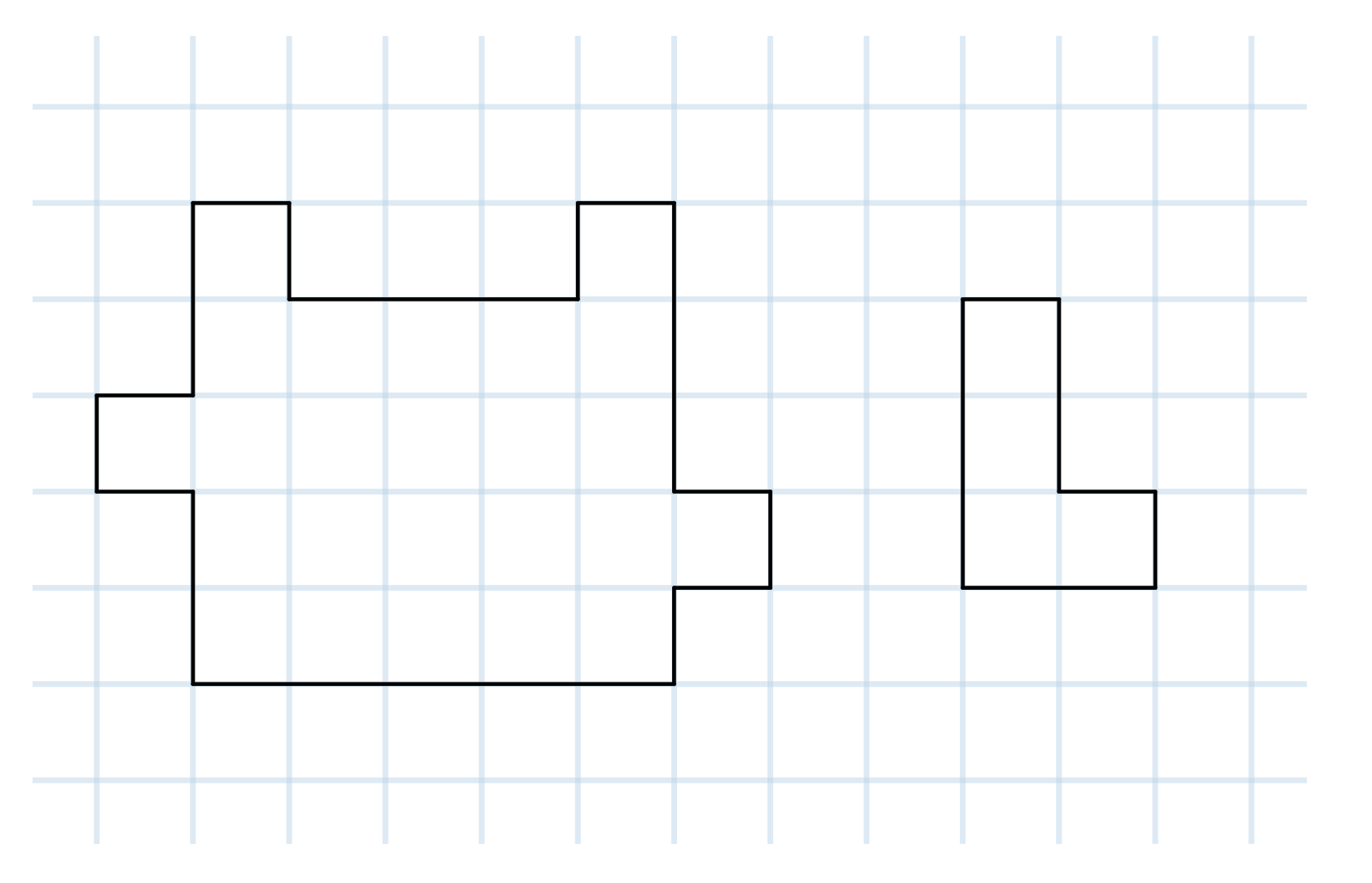
Can you cut the shape on the left into six shapes like the shape on the right?
-
Question
Consider the integers from `1` to `700`.
a. How many of these numbers are even?
b. How many of these numbers are divisible by `7`?
c. How many of these numbers are not divisible by `2` nor by `7`?
Answer question c.
-
Question
Given `50` distinct natural numbers between `1` and `100`. It is known that no two of these numbers sum to `100`. Is it necessarily true that one of these numbers must be a perfect square?
Topics:Number Theory -> Prime Numbers Arithmetic Combinatorics -> Pigeonhole Principle Combinatorics -> Matchings Logic -> Reasoning / Logic Proof and Example -> Constructing an Example / Counterexample Set Theory Combinatorics -> Case Analysis / Checking Cases -> Processes / Procedures Proof and Example -> Proof by Contradiction