Combinatorics
Combinatorics is the art of counting. It deals with selections, arrangements, and combinations of objects. Questions involve determining the number of ways to perform tasks, arrange items (permutations), or choose subsets (combinations), often using principles like the product rule and sum rule.
Pigeonhole Principle Double Counting Binomial Coefficients and Pascal's Triangle Product Rule / Rule of Product Graph Theory Matchings Induction (Mathematical Induction) Game Theory Combinatorial Geometry Invariants Case Analysis / Checking Cases Processes / Procedures Number Tables Colorings-
THE GARDENER AND THE COOK
A correspondent, signing himself "Simple Simon," suggested that I should give a special catch puzzle in the issue of The Weekly Dispatch for All Fools' Day, `1900`. So I gave the following, and it caused considerable amusement; for out of a very large body of competitors, many quite expert, not a single person solved it, though it ran for nearly a month.
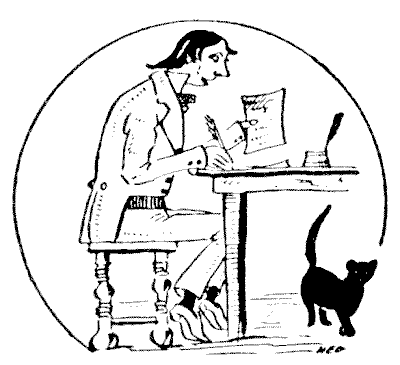
"The illustration is a fancy sketch of my correspondent, 'Simple Simon,' in the act of trying to solve the following innocent little arithmetical puzzle. A race between a man and a woman that I happened to witness one All Fools' Day has fixed itself indelibly on my memory. It happened at a country-house, where the gardener and the cook decided to run a race to a point `100` feet straight away and return. I found that the gardener ran `3` feet at every bound and the cook only `2` feet, but then she made three bounds to his two. Now, what was the result of the race?"
A fortnight after publication I added the following note: "It has been suggested that perhaps there is a catch in the 'return,' but there is not. The race is to a point `100` feet away and home again—that is, a distance of `200` feet. One correspondent asks whether they take exactly the same time in turning, to which I reply that they do. Another seems to suspect that it is really a conundrum, and that the answer is that 'the result of the race was a (matrimonial) tie.' But I had no such intention. The puzzle is an arithmetical one, as it purports to be."
Sources:Topics:Arithmetic Algebra -> Word Problems Logic -> Reasoning / Logic Combinatorics -> Case Analysis / Checking Cases -> Processes / Procedures- Amusements in Mathematics, Henry Ernest Dudeney Question 428