Logic
Logic is the study of reasoning and valid inference. It involves analyzing statements, arguments, and deductive processes. Questions may include solving logic puzzles, evaluating the truth of compound statements, using truth tables, and identifying logical fallacies.
Reasoning / Logic Truth-tellers and Liars Problems-
THE MOTOR-GARAGE PUZZLE
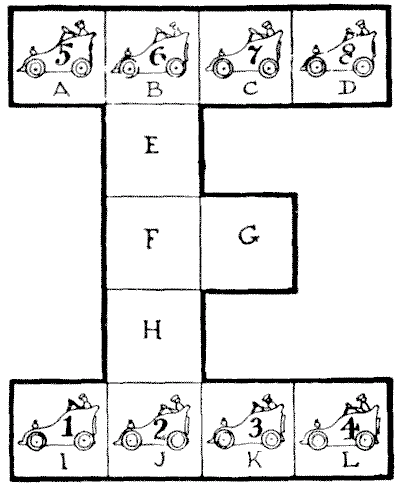
The difficulties of the proprietor of a motor garage are converted into a little pastime of a kind that has a peculiar fascination. All you need is to make a simple plan or diagram on a sheet of paper or cardboard and number eight counters, `1` to `8`. Then a whole family can enter into an amusing competition to find the best possible solution of the difficulty.
The illustration represents the plan of a motor garage, with accommodation for twelve cars. But the premises are so inconveniently restricted that the proprietor is often caused considerable perplexity. Suppose, for example, that the eight cars numbered `1` to `8` are in the positions shown, how are they to be shifted in the quickest possible way so that `1, 2, 3`, and `4` shall change places with `5, 6, 7`, and `8`—that is, with the numbers still running from left to right, as at present, but the top row exchanged with the bottom row? What are the fewest possible moves?
One car moves at a time, and any distance counts as one move. To prevent misunderstanding, the stopping-places are marked in squares, and only one car can be in a square at the same time.
Sources:Topics:Logic -> Reasoning / Logic Combinatorics -> Case Analysis / Checking Cases -> Processes / Procedures Combinatorics -> Case Analysis / Checking Cases -> Processes / Procedures Puzzles and Rebuses- Amusements in Mathematics, Henry Ernest Dudeney Question 224
-
ROUND THE COAST
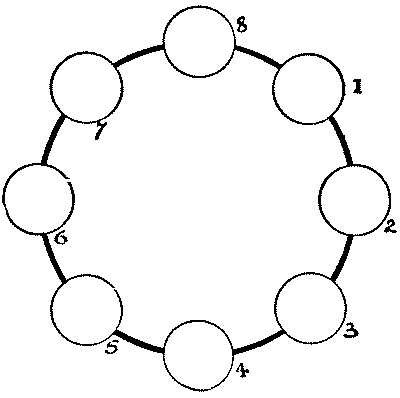 Here is a puzzle that will, I think, be found as amusing as instructive. We are given a ring of eight circles. Leaving circle `8` blank, we are required to write in the name of a seven-lettered port in the United Kingdom in this manner. Touch a blank circle with your pencil, then jump over two circles in either direction round the ring, and write down the first letter. Then touch another vacant circle, jump over two circles, and write down your second letter. Proceed similarly with the other letters in their proper order until you have completed the word. Thus, suppose we select "Glasgow," and proceed as follows: `6`—`1, 7`—`2, 8`—`3, 7`—`4, 8`—`5`, which means that we touch `6`, jump over `7` and and write down "G" on `1`; then touch `7`, jump over `8` and `1`, and write down "l" on `2`; and so on. It will be found that after we have written down the first five letters—"Glasg"—as above, we cannot go any further. Either there is something wrong with "Glasgow," or we have not managed our jumps properly. Can you get to the bottom of the mystery?
Sources:
Here is a puzzle that will, I think, be found as amusing as instructive. We are given a ring of eight circles. Leaving circle `8` blank, we are required to write in the name of a seven-lettered port in the United Kingdom in this manner. Touch a blank circle with your pencil, then jump over two circles in either direction round the ring, and write down the first letter. Then touch another vacant circle, jump over two circles, and write down your second letter. Proceed similarly with the other letters in their proper order until you have completed the word. Thus, suppose we select "Glasgow," and proceed as follows: `6`—`1, 7`—`2, 8`—`3, 7`—`4, 8`—`5`, which means that we touch `6`, jump over `7` and and write down "G" on `1`; then touch `7`, jump over `8` and `1`, and write down "l" on `2`; and so on. It will be found that after we have written down the first five letters—"Glasg"—as above, we cannot go any further. Either there is something wrong with "Glasgow," or we have not managed our jumps properly. Can you get to the bottom of the mystery?
Sources:
- Amusements in Mathematics, Henry Ernest Dudeney Question 226
-
THE EXCHANGE PUZZLE
Here is a rather entertaining little puzzle with moving counters. You only need twelve counters—six of one colour, marked A, C, E, G, I, and K, and the other six marked B, D, F, H, J, and L. You first place them on the diagram, as shown in the illustration, and the puzzle is to get them into regular alphabetical order, as follows:—
A B C D E F G H I J K L The moves are made by exchanges of opposite colours standing on the same line. Thus, G and J may exchange places, or F and A, but you cannot exchange G and C, or F and D, because in one case they are both white and in the other case both black. Can you bring about the required arrangement in seventeen exchanges?
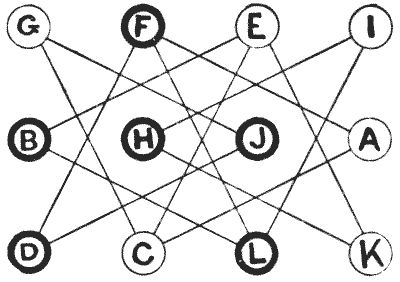
It cannot be done in fewer moves. The puzzle is really much easier than it looks, if properly attacked.
Sources:Topics:Combinatorics -> Invariants Logic -> Reasoning / Logic Combinatorics -> Case Analysis / Checking Cases -> Processes / Procedures Combinatorics -> Case Analysis / Checking Cases -> Processes / Procedures Puzzles and Rebuses- Amusements in Mathematics, Henry Ernest Dudeney Question 234
-
BOYS AND GIRLS
If you mark off ten divisions on a sheet of paper to represent the chairs, and use eight numbered counters for the children, you will have a fascinating pastime. Let the odd numbers represent boys and even numbers girls, or you can use counters of two colours, or coins.
The puzzle is to remove two children who are occupying adjoining chairs and place them in two empty chairs, making them first change sides; then remove a second pair of children from adjoining chairs and place them in the two now vacant, making them change sides; and so on, until all the boys are together and all the girls together, with the two vacant chairs at one end as at present. To solve the puzzle you must do this in five moves. The two children must always be taken from chairs that are next to one another; and remember the important point of making the two children change sides, as this latter is the distinctive feature of the puzzle. By "change sides" I simply mean that if, for example, you first move `1` and `2` to the vacant chairs, then the first (the outside) chair will be occupied by `2` and the second one by `1`.
Sources: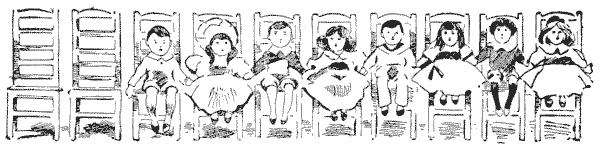
- Amusements in Mathematics, Henry Ernest Dudeney Question 237
-
ARRANGING THE JAMPOTS
I happened to see a little girl sorting out some jam in a cupboard for her mother. She was putting each different kind of preserve apart on the shelves. I noticed that she took a pot of damson in one hand and a pot of gooseberry in the other and made them change places; then she changed a strawberry with a raspberry, and so on. It was interesting to observe what a lot of unnecessary trouble she gave herself by making more interchanges than there was any need for, and I thought it would work into a good puzzle.
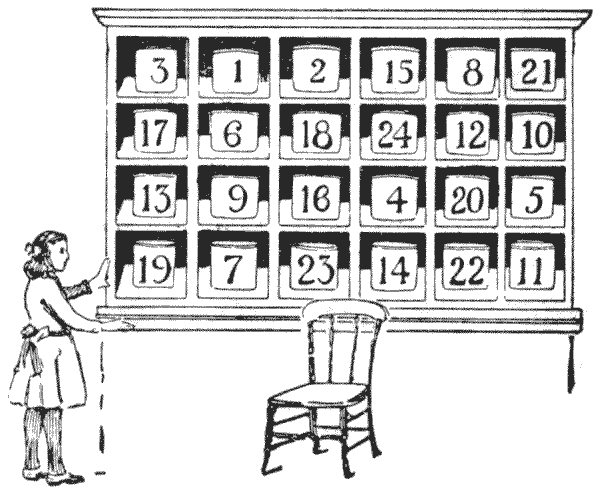
It will be seen in the illustration that little Dorothy has to manipulate twenty-four large jampots in as many pigeon-holes. She wants to get them in correct numerical order—that is, `1, 2, 3, 4, 5, 6` on the top shelf, `7, 8, 9, 10, 11, 12` on the next shelf, and so on. Now, if she always takes one pot in the right hand and another in the left and makes them change places, how many of these interchanges will be necessary to get all the jampots in proper order? She would naturally first change the `1` and the `3`, then the `2` and the `3`, when she would have the first three pots in their places. How would you advise her to go on then? Place some numbered counters on a sheet of paper divided into squares for the pigeon-holes, and you will find it an amusing puzzle.
Sources:- Amusements in Mathematics, Henry Ernest Dudeney Question 238
-
THE CYCLISTS' TOUR
Two cyclists were consulting a road map in preparation for a little tour together. The circles represent towns, and all the good roads are represented by lines. They are starting from the town with a star, and must complete their tour at E. But before arriving there they want to visit every other town once, and only once. That is the difficulty. Mr. Spicer said, "I am certain we can find a way of doing it;" but Mr. Maggs replied, "No way, I'm sure." Now, which of them was correct? Take your pencil and see if you can find any way of doing it. Of course you must keep to the roads indicated.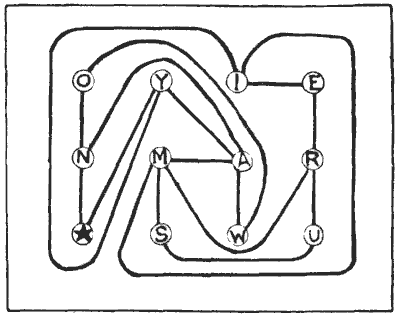 Sources:
- Amusements in Mathematics, Henry Ernest Dudeney Question 248
-
THE GRAND TOUR
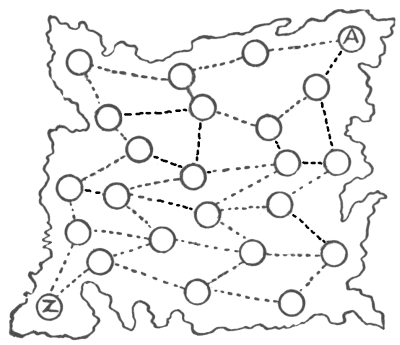
One of the everyday puzzles of life is the working out of routes. If you are taking a holiday on your bicycle, or a motor tour, there always arises the question of how you are to make the best of your time and other resources. You have determined to get as far as some particular place, to include visits to such-and-such a town, to try to see something of special interest elsewhere, and perhaps to try to look up an old friend at a spot that will not take you much out of your way. Then you have to plan your route so as to avoid bad roads, uninteresting country, and, if possible, the necessity of a return by the same way that you went. With a map before you, the interesting puzzle is attacked and solved. I will present a little poser based on these lines.
I give a rough map of a country—it is not necessary to say what particular country—the circles representing towns and the dotted lines the railways connecting them. Now there lived in the town marked A a man who was born there, and during the whole of his life had never once left his native place. From his youth upwards he had been very industrious, sticking incessantly to his trade, and had no desire whatever to roam abroad. However, on attaining his fiftieth birthday he decided to see something of his country, and especially to pay a visit to a very old friend living at the town marked Z. What he proposed was this: that he would start from his home, enter every town once and only once, and finish his journey at Z. As he made up his mind to perform this grand tour by rail only, he found it rather a puzzle to work out his route, but he at length succeeded in doing so. How did he manage it? Do not forget that every town has to be visited once, and not more than once.
 Sources:Topics:Combinatorics -> Combinatorial Geometry Combinatorics -> Graph Theory Logic -> Reasoning / Logic Combinatorics -> Case Analysis / Checking Cases -> Processes / Procedures Puzzles and Rebuses
- Amusements in Mathematics, Henry Ernest Dudeney Question 250
-
WATER, GAS, AND ELECTRICITY
There are some half-dozen puzzles, as old as the hills, that are perpetually cropping up, and there is hardly a month in the year that does not bring inquiries as to their solution. Occasionally one of these, that one had thought was an extinct volcano, bursts into eruption in a surprising manner. I have received an extraordinary number of letters respecting the ancient puzzle that I have called "Water, Gas, and Electricity." It is much older than electric lighting, or even gas, but the new dress brings it up to date. The puzzle is to lay on water, gas, and electricity, from W, G, and E, to each of the three houses, A, B, and C, without any pipe crossing another. Take your pencil and draw lines showing how this should be done. You will soon find yourself landed in difficulties.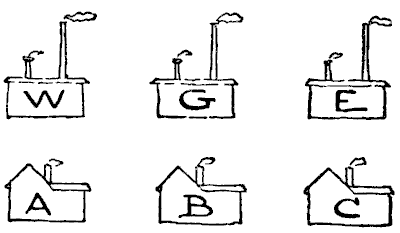 Sources:
- Amusements in Mathematics, Henry Ernest Dudeney Question 251
-
THOSE FIFTEEN SHEEP
A certain cyclopædia has the following curious problem, I am told: "Place fifteen sheep in four pens so that there shall be the same number of sheep in each pen." No answer whatever is vouchsafed, so I thought I would investigate the matter. I saw that in dealing with apples or bricks the thing would appear to be quite impossible, since four times any number must be an even number, while fifteen is an odd number. I thought, therefore, that there must be some quality peculiar to the sheep that was not generally known. So I decided to interview some farmers on the subject. The first one pointed out that if we put one pen inside another, like the rings of a target, and placed all sheep in the smallest pen, it would be all right. But I objected to this, because you admittedly place all the sheep in one pen, not in four pens. The second man said that if I placed four sheep in each of three pens and three sheep in the last pen (that is fifteen sheep in all), and one of the ewes in the last pen had a lamb during the night, there would be the same number in each pen in the morning. This also failed to satisfy me.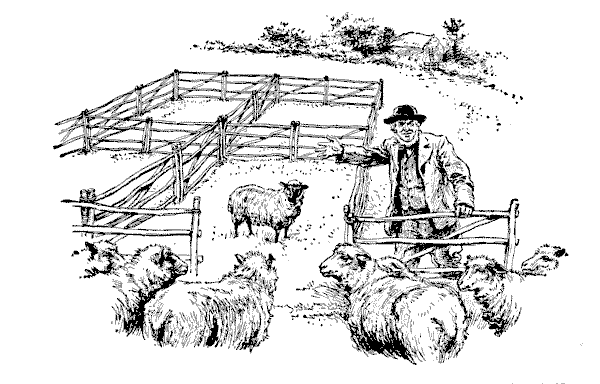 The third farmer said, "I've got four hurdle pens down in one of my fields, and a small flock of wethers, so if you will just step down with me I will show you how it is done." The illustration depicts my friend as he is about to demonstrate the matter to me. His lucid explanation was evidently that which was in the mind of the writer of the article in the cyclopædia. What was it? Can you place those fifteen sheep?
Sources:Topics:Algebra -> Word Problems Logic -> Reasoning / Logic Combinatorics -> Case Analysis / Checking Cases -> Processes / Procedures Puzzles and Rebuses
The third farmer said, "I've got four hurdle pens down in one of my fields, and a small flock of wethers, so if you will just step down with me I will show you how it is done." The illustration depicts my friend as he is about to demonstrate the matter to me. His lucid explanation was evidently that which was in the mind of the writer of the article in the cyclopædia. What was it? Can you place those fifteen sheep?
Sources:Topics:Algebra -> Word Problems Logic -> Reasoning / Logic Combinatorics -> Case Analysis / Checking Cases -> Processes / Procedures Puzzles and Rebuses- Amusements in Mathematics, Henry Ernest Dudeney Question 262
-
THE ABBOT'S WINDOW
Once upon a time the Lord Abbot of St. Edmondsbury, in consequence of "devotions too strong for his head," fell sick and was unable to leave his bed. As he lay awake, tossing his head restlessly from side to side, the attentive monks noticed that something was disturbing his mind; but nobody dared ask what it might be, for the abbot was of a stern disposition, and never would brook inquisitiveness. Suddenly he called for Father John, and that venerable monk was soon at the bedside.
"Father John," said the Abbot, "dost thou know that I came into this wicked world on a Christmas Even?
"The monk nodded assent.
"And have I not often told thee that, having been born on Christmas Even, I have no love for the things that are odd? Look there!"
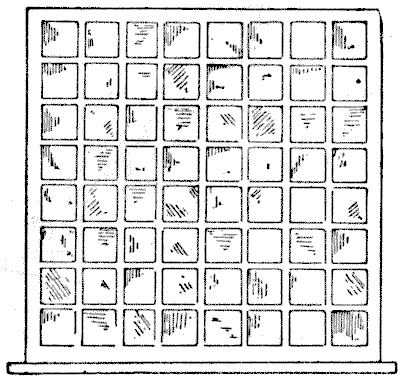
The Abbot pointed to the large dormitory window, of which I give a sketch. The monk looked, and was perplexed.
"Dost thou not see that the sixty-four lights add up an even number vertically and horizontally, but that all the diagonal lines, except fourteen are of a number that is odd? Why is this?"
"Of a truth, my Lord Abbot, it is of the very nature of things, and cannot be changed."
"Nay, but it shall be changed. I command thee that certain of the lights be closed this day, so that every line shall have an even number of lights. See thou that this be done without delay, lest the cellars be locked up for a month and other grievous troubles befall thee."
Father John was at his wits' end, but after consultation with one who was learned in strange mysteries, a way was found to satisfy the whim of the Lord Abbot. Which lights were blocked up, so that those which remained added up an even number in every line horizontally, vertically, and diagonally, while the least possible obstruction of light was caused?
Sources:Topics:Logic -> Reasoning / Logic Combinatorics -> Case Analysis / Checking Cases -> Processes / Procedures- Amusements in Mathematics, Henry Ernest Dudeney Question 292