Algebra, Word Problems
Word problems present mathematical challenges in a narrative or real-world context. Solving them requires translating the text into mathematical equations or expressions and then applying appropriate mathematical techniques. These can span arithmetic, algebra, geometry, etc.
Motion Problems Solving Word Problems "From the End" / Working Backwards-
THE WASSAIL BOWL
One Christmas Eve three Weary Willies came into possession of what was to them a veritable wassail bowl, in the form of a small barrel, containing exactly six quarts of fine ale. One of the men possessed a five-pint jug and another a three-pint jug, and the problem for them was to divide the liquor equally amongst them without waste. Of course, they are not to use any other vessels or measures. If you can show how it was to be done at all, then try to find the way that requires the fewest possible manipulations, every separate pouring from one vessel to another, or down a man's throat, counting as a manipulation.
Sources:Topics:Algebra -> Word Problems Logic -> Reasoning / Logic Combinatorics -> Case Analysis / Checking Cases -> Processes / Procedures Combinatorics -> Case Analysis / Checking Cases -> Processes / Procedures- Amusements in Mathematics, Henry Ernest Dudeney Question 362
-
THE DOCTOR'S QUERY
"A curious little point occurred to me in my dispensary this morning," said a doctor. "I had a bottle containing ten ounces of spirits of wine, and another bottle containing ten ounces of water. I poured a quarter of an ounce of spirits into the water and shook them up together. The mixture was then clearly forty to one. Then I poured back a quarter-ounce of the mixture, so that the two bottles should again each contain the same quantity of fluid. What proportion of spirits to water did the spirits of wine bottle then contain?" Sources:- Amusements in Mathematics, Henry Ernest Dudeney Question 363
-
NEW MEASURING PUZZLE
Here is a new poser in measuring liquids that will be found interesting. A man has two ten-quart vessels full of wine, and a five-quart and a four-quart measure. He wants to put exactly three quarts into each of the two measures. How is he to do it? And how many manipulations (pourings from one vessel to another) do you require? Of course, waste of wine, tilting, and other tricks are not allowed.Sources:Topics:Algebra -> Word Problems Combinatorics -> Case Analysis / Checking Cases -> Processes / Procedures- Amusements in Mathematics, Henry Ernest Dudeney Question 365
-
THE HONEST DAIRYMAN
An honest dairyman in preparing his milk for public consumption employed a can marked B, containing milk, and a can marked A, containing water. From can A he poured enough to double the contents of can B. Then he poured from can B into can A enough to double its contents. Then he finally poured from can A into can B until their contents were exactly equal. After these operations he would send the can A to London, and the puzzle is to discover what are the relative proportions of milk and water that he provides for the Londoners' breakfast-tables. Do they get equal proportions of milk and water—or two parts of milk and one of water—or what? It is an interesting question, though, curiously enough, we are not told how much milk or water he puts into the cans at the start of his operations.Sources:Topics:Algebra -> Word Problems- Amusements in Mathematics, Henry Ernest Dudeney Question 366
-
WINE AND WATER
Mr. Goodfellow has adopted a capital idea of late. When he gives a little dinner party and the time arrives to smoke, after the departure of the ladies, he sometimes finds that the conversation is apt to become too political, too personal, too slow, or too scandalous. Then he always manages to introduce to the company some new poser that he has secreted up his sleeve for the occasion. This invariably results in no end of interesting discussion and debate, and puts everybody in a good humour.
Here is a little puzzle that he propounded the other night, and it is extraordinary how the company differed in their answers. He filled a wine-glass half full of wine, and another glass twice the size one-third full of wine. Then he filled up each glass with water and emptied the contents of both into a tumbler. "Now," he said, "what part of the mixture is wine and what part water?" Can you give the correct answer?
Sources:- Amusements in Mathematics, Henry Ernest Dudeney Question 367
-
THE KEG OF WINE
Here is a curious little problem. A man had a ten-gallon keg full of wine and a jug. One day he drew off a jugful of wine and filled up the keg with water. Later on, when the wine and water had got thoroughly mixed, he drew off another jugful and again filled up the keg with water. It was then found that the keg contained equal proportions of wine and water. Can you find from these facts the capacity of the jug? Sources:- Amusements in Mathematics, Henry Ernest Dudeney Question 368
-
MIXING THE TEA
"Mrs. Spooner called this morning," said the honest grocer to his assistant. "She wants twenty pounds of tea at `2`s. `4`½d. per lb. Of course we have a good `2`s. `6`d. tea, a slightly inferior at `2`s. `3`d., and a cheap Indian at `1`s. `9`d., but she is very particular always about her prices."
"What do you propose to do?" asked the innocent assistant.
"Do?" exclaimed the grocer. "Why, just mix up the three teas in different proportions so that the twenty pounds will work out fairly at the lady's price. Only don't put in more of the best tea than you can help, as we make less profit on that, and of course you will use only our complete pound packets. Don't do any weighing."
How was the poor fellow to mix the three teas? Could you have shown him how to do it?
Sources:- Amusements in Mathematics, Henry Ernest Dudeney Question 369
-
GOLD PACKING IN RUSSIA
The editor of the Times newspaper was invited by a high Russian official to inspect the gold stored in reserve at St. Petersburg, in order that he might satisfy himself that it was not another "Humbert safe." He replied that it would be of no use whatever, for although the gold might appear to be there, he would be quite unable from a mere inspection to declare that what he saw was really gold. A correspondent of the Daily Mail thereupon took up the challenge, but, although he was greatly impressed by what he saw, he was compelled to confess his incompetence (without emptying and counting the contents of every box and sack, and assaying every piece of gold) to give any assurance on the subject. In presenting the following little puzzle, I wish it to be also understood that I do not guarantee the real existence of the gold, and the point is not at all material to our purpose. Moreover, if the reader says that gold is not usually "put up" in slabs of the dimensions that I give, I can only claim problematic licence.
Russian officials were engaged in packing `800` gold slabs, each measuring `12`½ inches long, `11` inches wide, and `1` inch deep. What are the interior dimensions of a box of equal length and width, and necessary depth, that will exactly contain them without any space being left over? Not more than twelve slabs may be laid on edge, according to the rules of the government. It is an interesting little problem in packing, and not at all difficult.
Sources:- Amusements in Mathematics, Henry Ernest Dudeney Question 371
-
THE BARRELS OF HONEY
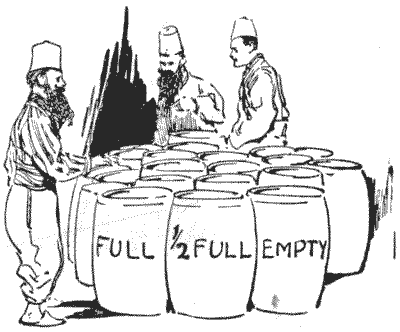
Once upon a time there was an aged merchant of Bagdad who was much respected by all who knew him. He had three sons, and it was a rule of his life to treat them all exactly alike. Whenever one received a present, the other two were each given one of equal value. One day this worthy man fell sick and died, bequeathing all his possessions to his three sons in equal shares.
The only difficulty that arose was over the stock of honey. There were exactly twenty-one barrels. The old man had left instructions that not only should every son receive an equal quantity of honey, but should receive exactly the same number of barrels, and that no honey should be transferred from barrel to barrel on account of the waste involved. Now, as seven of these barrels were full of honey, seven were half-full, and seven were empty, this was found to be quite a puzzle, especially as each brother objected to taking more than four barrels of, the same description—full, half-full, or empty. Can you show how they succeeded in making a correct division of the property?
Sources:Topics:Algebra -> Word Problems Arithmetic -> Fractions Combinatorics -> Case Analysis / Checking Cases -> Processes / Procedures Number Theory -> Division- Amusements in Mathematics, Henry Ernest Dudeney Question 372
-
CROSSING THE STREAM
During a country ramble Mr. and Mrs. Softleigh found themselves in a pretty little dilemma. They had to cross a stream in a small boat which was capable of carrying only `150` lbs. weight. But Mr. Softleigh and his wife each weighed exactly `150` lbs., and each of their sons weighed `75` lbs. And then there was the dog, who could not be induced on any terms to swim. On the principle of "ladies first," they at once sent Mrs. Softleigh over; but this was a stupid oversight, because she had to come back again with the boat, so nothing was gained by that operation. How did they all succeed in getting across? The reader will find it much easier than the Softleigh family did, for their greatest enemy could not have truthfully called them a brilliant quartette—while the dog was a perfect fool.Sources:Topics:Algebra -> Word Problems Logic -> Reasoning / Logic Combinatorics -> Case Analysis / Checking Cases -> Processes / Procedures- Amusements in Mathematics, Henry Ernest Dudeney Question 373