Algebra, Word Problems
Word problems present mathematical challenges in a narrative or real-world context. Solving them requires translating the text into mathematical equations or expressions and then applying appropriate mathematical techniques. These can span arithmetic, algebra, geometry, etc.
Motion Problems Solving Word Problems "From the End" / Working Backwards-
CONCERNING TOMMY'S AGE
Tommy Smart was recently sent to a new school. On the first day of his arrival the teacher asked him his age, and this was his curious reply: "Well, you see, it is like this. At the time I was born—I forget the year—my only sister, Ann, happened to be just one-quarter the age of mother, and she is now one-third the age of father." "That's all very well," said the teacher, "but what I want is not the age of your sister Ann, but your own age." "I was just coming to that," Tommy answered; "I am just a quarter of mother's present age, and in four years' time I shall be a quarter the age of father. Isn't that funny?"
This was all the information that the teacher could get out of Tommy Smart. Could you have told, from these facts, what was his precise age? It is certainly a little puzzling.
Sources:- Amusements in Mathematics, Henry Ernest Dudeney Question 48
-
NEXT-DOOR NEIGHBOURS
There were two families living next door to one another at Tooting Bec—the Jupps and the Simkins. The united ages of the four Jupps amounted to one hundred years, and the united ages of the Simkins also amounted to the same. It was found in the case of each family that the sum obtained by adding the squares of each of the children's ages to the square of the mother's age equalled the square of the father's age. In the case of the Jupps, however, Julia was one year older than her brother Joe, whereas Sophy Simkin was two years older than her brother Sammy. What was the age of each of the eight individuals? Sources:- Amusements in Mathematics, Henry Ernest Dudeney Question 49
-
THE BAG OF NUTS
Three boys were given a bag of nuts as a Christmas present, and it was agreed that they should be divided in proportion to their ages, which together amounted to `17 1/2` years. Now the bag contained `770` nuts, and as often as Herbert took four Robert took three, and as often as Herbert took six Christopher took seven. The puzzle is to find out how many nuts each had, and what were the boys' respective ages.
Sources:Topics:Algebra -> Word Problems Arithmetic -> Fractions Algebra -> Inequalities -> Averages / Means Number Theory -> Division- Amusements in Mathematics, Henry Ernest Dudeney Question 50
-
HOW OLD WAS MARY?
Here is a funny little age problem, by the late Sam Loyd, which has been very popular in the United States. Can you unravel the mystery?The combined ages of Mary and Ann are forty-four years, and Mary is twice as old as Ann was when Mary was half as old as Ann will be when Ann is three times as old as Mary was when Mary was three times as old as Ann. How old is Mary? That is all, but can you work it out? If not, ask your friends to help you, and watch the shadow of bewilderment creep over their faces as they attempt to grip the intricacies of the question. Sources:- Amusements in Mathematics, Henry Ernest Dudeney Question 51
-
WHAT WAS THE TIME?
"I say, Rackbrane, what is the time?" an acquaintance asked our friend the professor the other day. The answer was certainly curious.
"If you add one quarter of the time from noon till now to half the time from now till noon to-morrow, you will get the time exactly."
What was the time of day when the professor spoke?
Sources:- Amusements in Mathematics, Henry Ernest Dudeney Question 57
-
A TIME PUZZLE
How many minutes is it until six o'clock if fifty minutes ago it was four times as many minutes past three o'clock? Sources:- Amusements in Mathematics, Henry Ernest Dudeney Question 58
-
CHANGING PLACES
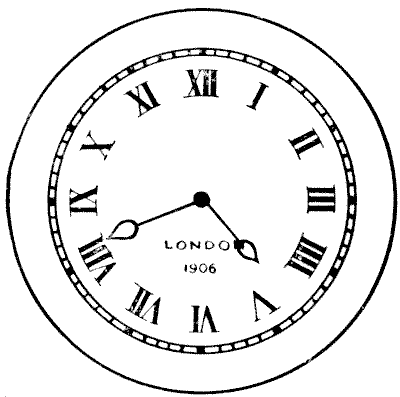 The above clock face indicates a little before `42` minutes past `4`. The hands will again point at exactly the same spots a little after `23` minutes past `8`. In fact, the hands will have changed places. How many times do the hands of a clock change places between three o'clock p.m. and midnight? And out of all the pairs of times indicated by these changes, what is the exact time when the minute hand will be nearest to the point IX?
Sources:
The above clock face indicates a little before `42` minutes past `4`. The hands will again point at exactly the same spots a little after `23` minutes past `8`. In fact, the hands will have changed places. How many times do the hands of a clock change places between three o'clock p.m. and midnight? And out of all the pairs of times indicated by these changes, what is the exact time when the minute hand will be nearest to the point IX?
Sources:
- Amusements in Mathematics, Henry Ernest Dudeney Question 61
-
THE THREE CLOCKS
On Friday, April `1, 1898`, three new clocks were all set going precisely at the same time—twelve noon. At noon on the following day it was found that clock A had kept perfect time, that clock B had gained exactly one minute, and that clock C had lost exactly one minute. Now, supposing that the clocks B and C had not been regulated, but all three allowed to go on as they had begun, and that they maintained the same rates of progress without stopping, on what date and at what time of day would all three pairs of hands again point at the same moment at twelve o'clock? Sources:- Amusements in Mathematics, Henry Ernest Dudeney Question 64
-
THE RAILWAY STATION CLOCK
A clock hangs on the wall of a railway station, `71` ft. `9` in. long and `10` ft. `4` in. high. Those are the dimensions of the wall, not of the clock! While waiting for a train we noticed that the hands of the clock were pointing in opposite directions, and were parallel to one of the diagonals of the wall. What was the exact time?Sources:Topics:Algebra -> Word Problems Arithmetic -> Fractions Geometry -> Plane Geometry -> Angle Calculation- Amusements in Mathematics, Henry Ernest Dudeney Question 65
-
THE VILLAGE SIMPLETON
A facetious individual who was taking a long walk in the country came upon a yokel sitting on a stile. As the gentleman was not quite sure of his road, he thought he would make inquiries of the local inhabitant; but at the first glance he jumped too hastily to the conclusion that he had dropped on the village idiot. He therefore decided to test the fellow's intelligence by first putting to him the simplest question he could think of, which was, "What day of the week is this, my good man?" The following is the smart answer that he received:—
"When the day after to-morrow is yesterday, to-day will be as far from Sunday as to-day was from Sunday when the day before yesterday was to-morrow."
Can the reader say what day of the week it was? It is pretty evident that the countryman was not such a fool as he looked. The gentleman went on his road a puzzled but a wiser man.
Sources:- Amusements in Mathematics, Henry Ernest Dudeney Question 66