Algebra, Word Problems
Word problems present mathematical challenges in a narrative or real-world context. Solving them requires translating the text into mathematical equations or expressions and then applying appropriate mathematical techniques. These can span arithmetic, algebra, geometry, etc.
Motion Problems Solving Word Problems "From the End" / Working Backwards-
MR. GUBBINS IN A FOG
Mr. Gubbins, a diligent man of business, was much inconvenienced by a London fog. The electric light happened to be out of order and he had to manage as best he could with two candles. His clerk assured him that though both were of the same length one candle would burn for four hours and the other for five hours. After he had been working some time he put the candles out as the fog had lifted, and he then noticed that what remained of one candle was exactly four times the length of what was left of the other.
When he got home that night Mr. Gubbins, who liked a good puzzle, said to himself, "Of course it is possible to work out just how long those two candles were burning to-day. I'll have a shot at it." But he soon found himself in a worse fog than the atmospheric one. Could you have assisted him in his dilemma? How long were the candles burning?
Sources:- Amusements in Mathematics, Henry Ernest Dudeney Question 102
-
PAINTING THE LAMP-POSTS
Tim Murphy and Pat Donovan were engaged by the local authorities to paint the lamp-posts in a certain street. Tim, who was an early riser, arrived first on the job, and had painted three on the south side when Pat turned up and pointed out that Tim's contract was for the north side. So Tim started afresh on the north side and Pat continued on the south. When Pat had finished his side he went across the street and painted six posts for Tim, and then the job was finished. As there was an equal number of lamp-posts on each side of the street, the simple question is: Which man painted the more lamp-posts, and just how many more? Sources:- Amusements in Mathematics, Henry Ernest Dudeney Question 103
-
THE MUDDLETOWN ELECTION
At the last Parliamentary election at Muddletown `5,473` votes were polled. The Liberal was elected by a majority of `18` over the Conservative, by `146` over the Independent, and by `575` over the Socialist. Can you give a simple rule for figuring out how many votes were polled for each candidate? Sources:- Amusements in Mathematics, Henry Ernest Dudeney Question 106
-
THE SUFFRAGISTS' MEETING
At a recent secret meeting of Suffragists a serious difference of opinion arose. This led to a split, and a certain number left the meeting. "I had half a mind to go myself," said the chair-woman, "and if I had done so, two-thirds of us would have retired." "True," said another member; "but if I had persuaded my friends Mrs. Wild and Christine Armstrong to remain we should only have lost half our number." Can you tell how many were present at the meeting at the start? Sources:- Amusements in Mathematics, Henry Ernest Dudeney Question 107
-
THE LEAP-YEAR LADIES
Last leap-year ladies lost no time in exercising the privilege of making proposals of marriage. If the figures that reached me from an occult source are correct, the following represents the state of affairs in this country.
A number of women proposed once each, of whom one-eighth were widows. In consequence, a number of men were to be married of whom one-eleventh were widowers. Of the proposals made to widowers, one-fifth were declined. All the widows were accepted. Thirty-five forty-fourths of the widows married bachelors. One thousand two hundred and twenty-one spinsters were declined by bachelors. The number of spinsters accepted by bachelors was seven times the number of widows accepted by bachelors. Those are all the particulars that I was able to obtain. Now, how many women proposed?
Sources:- Amusements in Mathematics, Henry Ernest Dudeney Question 108
-
THE GREAT SCRAMBLE
After dinner, the five boys of a household happened to find a parcel of sugar-plums. It was quite unexpected loot, and an exciting scramble ensued, the full details of which I will recount with accuracy, as it forms an interesting puzzle.
You see, Andrew managed to get possession of just two-thirds of the parcel of sugar-plums. Bob at once grabbed three-eighths of these, and Charlie managed to seize three-tenths also. Then young David dashed upon the scene, and captured all that Andrew had left, except one-seventh, which Edgar artfully secured for himself by a cunning trick. Now the fun began in real earnest, for Andrew and Charlie jointly set upon Bob, who stumbled against the fender and dropped half of all that he had, which were equally picked up by David and Edgar, who had crawled under a table and were waiting. Next, Bob sprang on Charlie from a chair, and upset all the latter's collection on to the floor. Of this prize Andrew got just a quarter, Bob gathered up one-third, David got two-sevenths, while Charlie and Edgar divided equally what was left of that stock.
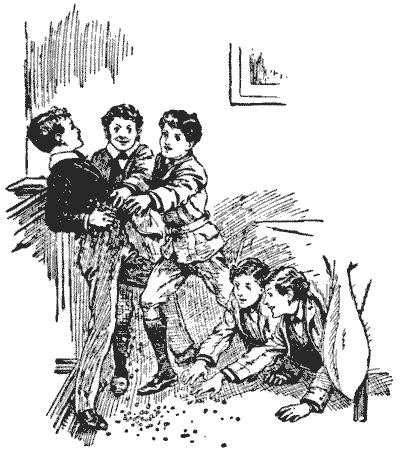
They were just thinking the fray was over when David suddenly struck out in two directions at once, upsetting three-quarters of what Bob and Andrew had last acquired. The two latter, with the greatest difficulty, recovered five-eighths of it in equal shares, but the three others each carried off one-fifth of the same. Every sugar-plum was now accounted for, and they called a truce, and divided equally amongst them the remainder of the parcel. What is the smallest number of sugar-plums there could have been at the start, and what proportion did each boy obtain?
Sources:- Amusements in Mathematics, Henry Ernest Dudeney Question 109
-
THE ABBOT'S PUZZLE
The first English puzzlist whose name has come down to us was a Yorkshireman—no other than Alcuin, Abbot of Canterbury (A.D. `735-804`). Here is a little puzzle from his works, which is at least interesting on account of its antiquity. "If `100` bushels of corn were distributed among `100` people in such a manner that each man received three bushels, each woman two, and each child half a bushel, how many men, women, and children were there?"
Now, there are six different correct answers, if we exclude a case where there would be no women. But let us say that there were just five times as many women as men, then what is the correct solution?
Sources:- Amusements in Mathematics, Henry Ernest Dudeney Question 110
-
REAPING THE CORN
A farmer had a square cornfield. The corn was all ripe for reaping, and, as he was short of men, it was arranged that he and his son should share the work between them. The farmer first cut one rod wide all round the square, thus leaving a smaller square of standing corn in the middle of the field. "Now," he said to his son, "I have cut my half of the field, and you can do your share." The son was not quite satisfied as to the proposed division of labour, and as the village schoolmaster happened to be passing, he appealed to that person to decide the matter. He found the farmer was quite correct, provided there was no dispute as to the size of the field, and on this point they were agreed. Can you tell the area of the field, as that ingenious schoolmaster succeeded in doing? Sources:- Amusements in Mathematics, Henry Ernest Dudeney Question 111
-
A PUZZLING LEGACY
A man left a hundred acres of land to be divided among his three sons—Alfred, Benjamin, and Charles—in the proportion of one-third, one-fourth, and one-fifth respectively. But Charles died. How was the land to be divided fairly between Alfred and Benjamin? Sources:- Amusements in Mathematics, Henry Ernest Dudeney Question 112
-
THE CONVERTED MISER
Mr. Jasper Bullyon was one of the very few misers who have ever been converted to a sense of their duty towards their less fortunate fellow-men. One eventful night he counted out his accumulated wealth, and resolved to distribute it amongst the deserving poor.
He found that if he gave away the same number of pounds every day in the year, he could exactly spread it over a twelvemonth without there being anything left over; but if he rested on the Sundays, and only gave away a fixed number of pounds every weekday, there would be one sovereign left over on New Year's Eve. Now, putting it at the lowest possible, what was the exact number of pounds that he had to distribute?
Could any question be simpler? A sum of pounds divided by one number of days leaves no remainder, but divided by another number of days leaves a sovereign over. That is all; and yet, when you come to tackle this little question, you will be surprised that it can become so puzzling.
Sources:- Amusements in Mathematics, Henry Ernest Dudeney Question 116