Arithmetic, Fractions
Fractions represent parts of a whole or ratios between numbers. This topic covers understanding, comparing, simplifying, and performing arithmetic operations (addition, subtraction, multiplication, division) with fractions and mixed numbers. Questions often involve practical applications.
-
Camel Division (Ancient Question)
An old Arab merchant had three sons. He bequeathed them 17 camels, and in his will, he requested that the eldest son receive half of the camels, the middle son receive a third, and the youngest a ninth. The sons could not divide the camels among themselves as stated in the will without slaughtering some of the camels – and they did not want to do that. So they turned to the Qadi for help.
The Qadi added one of his own camels to the 17 camels, and divided the 18 camels as follows: the eldest son received 9 camels, which is half of the amount, the middle son received 6 camels, which is a third of the amount, and the youngest son received 2 camels, which is a ninth of the amount, for a total of 17 camels divided, and the extra camel was returned to the Qadi.
The brothers were amazed by the wisdom of the Qadi and began to think: how did it happen that each received even more than he was supposed to receive according to the will?
-
Question
Given the sequence `1 , 1/2 ,1/3 ,1/4 ,1/5,...`, does there exist an arithmetic sequence composed of terms from the aforementioned sequence?
-
Of length 5
-
Of any length
Sources:Topics:Number Theory -> Modular Arithmetic / Remainder Arithmetic -> Divisibility Rules Proof and Example -> Constructing an Example / Counterexample Algebra -> Sequences -> Arithmetic Progression / Arithmetic Sequence Arithmetic -> Fractions Number Theory -> Greatest Common Divisor (GCD) and Least Common Multiple (LCM) -
-
Question
Consider all the numbers from 1 to 4242. Find the difference between the number of odd numbers divisible by 3
Sources:
and the number of numbers divisible by 7 in this range. -
Long Division
Calculate the value of the expression and write it as a decimal fraction:
`1/(1+1/(1+1/(1+1/(1+1/(1))))`
Sources: -
Sheep and Camels
Shmuel has a flock of 9 sheep and 5 camels. He wants to divide the flock between his two sons, Yossi and Danny, so that each of them receives an equal share of the value.
Sources:
It is known that 7 sheep cost as much as 3 camels. How can Shmuel divide the flock between his two sons equally, without selling any animals? -
Numbers on the Board
The following numbers are written on the board:`1/3,1/2,1,2,3`. In each step, you are allowed to choose any two numbers written on the board and replace each of them with their product.
Sources:
Can you reach a quintet of numbers in this way whose sum is `4 1/4`? -
Magic Fractions
Let's call a fraction magic if both its numerator and denominator are less than 10. For example, the fraction `1/9` is considered magic, the fraction `6/8` is also magic, but the fraction `3/14` is not magic.
How many magic fractions are there that are greater than one-half and less than 1?Note: For the purpose of this question, `2/3` and `4/6` are considered different fractions.
Sources:Topics:Arithmetic -> Fractions Combinatorics -> Case Analysis / Checking Cases -> Processes / Procedures -
Children's Clubs
In a kindergarten, there are three clubs: Judo, Agriculture, and Mathematics. Each child participates in exactly one club, and each club has at least one participant. The total number of children in the kindergarten is 32. On Friday, the kindergarten teacher gathered 6 children to tidy up the classroom. The teacher counted and found that exactly half of the Judo club members, a quarter of the Agriculture club members, and an eighth of the Mathematics club members volunteered for the task. How many students are in each club?
Sources:Topics:Algebra -> Word Problems Logic -> Reasoning / Logic Arithmetic -> Fractions Combinatorics -> Case Analysis / Checking Cases -> Processes / Procedures Number Theory -> Division- Gillis Mathematical Olympiad, 2018-2019 Question 1
-
CHINESE MONEY
The Chinese are a curious people, and have strange inverted ways of doing things. It is said that they use a saw with an upward pressure instead of a downward one, that they plane a deal board by pulling the tool toward them instead of pushing it, and that in building a house they first construct the roof and, having raised that into position, proceed to work downwards. In money the currency of the country consists of taels of fluctuating value. The tael became thinner and thinner until `2,000` of them piled together made less than three inches in height. The common cash consists of brass coins of varying thicknesses, with a round, square, or triangular hole in the centre, as in our illustration.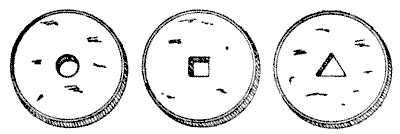 These are strung on wires like buttons. Supposing that eleven coins with round holes are worth fifteen ching-changs, that eleven with square holes are worth sixteen ching-changs, and that eleven with triangular holes are worth seventeen ching-changs, how can a Chinaman give me change for half a crown, using no coins other than the three mentioned? A ching-chang is worth exactly twopence and four-fifteenths of a ching-chang.
Sources:
These are strung on wires like buttons. Supposing that eleven coins with round holes are worth fifteen ching-changs, that eleven with square holes are worth sixteen ching-changs, and that eleven with triangular holes are worth seventeen ching-changs, how can a Chinaman give me change for half a crown, using no coins other than the three mentioned? A ching-chang is worth exactly twopence and four-fifteenths of a ching-chang.
Sources:
- Amusements in Mathematics, Henry Ernest Dudeney Question 25
-
THE BROKEN COINS
A man had three coins—a sovereign, a shilling, and a penny—and he found that exactly the same fraction of each coin had been broken away. Now, assuming that the original intrinsic value of these coins was the same as their nominal value—that is, that the sovereign was worth a pound, the shilling worth a shilling, and the penny worth a penny—what proportion of each coin has been lost if the value of the three remaining fragments is exactly one pound? Sources:- Amusements in Mathematics, Henry Ernest Dudeney Question 29