Young Mathematician Olympiad, 2017-2018
Stage A Final-
Question from sources: Stage A, Grades 5-6(3)
Grandma Hannah has many flowerpots with flowers in her house. One day, her three grandchildren, Avi, Beni, and Gili, came to visit and tried to guess how many flowerpots she has.
Sources:
Avi said: "Grandma has more than 8 flowerpots,"
Beni said: "More than 10, I think,"
And then Gili said: "Grandma Hannah has at least 12 flowerpots."
"Two of you are right, and one of you is wrong," answered the grandmother. So how many flowerpots does she have in the house? -
Question from sources: Stage A, Grades 5-6(4) - What's the Number?
Find a three-digit number that, when we add 1 to it, is divisible by 7; when we add 2 to it, is divisible by 8; and when we add 3 to it, is divisible by 9.
Sources: -
Question from sources: Stage A, Grades 5-6(5)
Consider all the numbers from 1 to 4242. Find the difference between the number of odd numbers divisible by 3
Sources:
and the number of numbers divisible by 7 in this range. -
Question from sources: Stage A, Grades 5-6(6) - Hexagon
In the diagram, there is a regular hexagon. By what factor is the area of the white region larger than the area of the shaded region?
(A regular hexagon is a hexagon where all sides are equal and all angles are equal.)
Sources: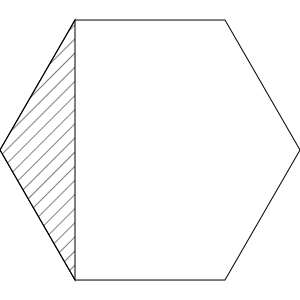
-
Question from sources: Stage A, Grades 5-6(7) - Long Division
Calculate the value of the expression and write it as a decimal fraction:
`1/(1+1/(1+1/(1+1/(1+1/(1))))`
Sources: -
Question from sources: Stage A, Grades 3-4(8), Stage A, Grades 5-6(8) - Differences in the Multiplication Table
Color the `10xx10` multiplication table with a black and white chessboard coloring, such that the cell of `1xx1` is colored black.
Find the difference between the sum of all the numbers in the black cells and the sum of all the numbers in the white cells.
1 2 3 4 5 6 7 8 9 10 1 1 2 3 4 5 6 7 8 9 10 2 2 4 6 8 10 12 14 16 18 20 3 3 6 9 12 15 18 21 24 27 30 4 4 8 12 16 20 24 28 32 36 40 5 5 10 15 20 25 30 35 40 45 50 6 6 12 18 24 30 36 42 48 54 60 7 7 14 21 28 35 42 49 56 63 70 8 8 16 24 32 40 48 56 64 72 80 9 9 18 27 36 45 54 63 72 81 90 10 10 20 30 40 50 60 70 80 90 100 Sources: -
Question from sources: Final, Grades 3-4(1) - Toys
Jonathan has a collection of wooden toys. Some are cubes and some are spheres, some are red and some are blue.
It is known that there are more spheres than cubes, and it is known that there are more blue toys than red toys.
Prove that Jonathan has a blue sphere.
Sources: -
Question from sources: Final, Grades 3-4(2) - The Grasshopper
Consider an infinite grid of squares. A grasshopper sits on one of the squares. The grasshopper can jump two squares in any horizontal or vertical direction, and it can jump to the adjacent square diagonally. Can the grasshopper ever reach a square that is adjacent to its starting square by a side?
Sources:Topics:Combinatorics -> Combinatorial Geometry Combinatorics -> Invariants Combinatorics -> Colorings -> Chessboard Coloring -
Question from sources: Final, Grades 3-4(3) - Digits in a circle
The digits from 1 to 5 are written in a circle in some order. Danny summed five two-digit numbers formed from pairs
of adjacent digits on the circle (clockwise). Find all the possible values for this sum.Sources:Topics:Arithmetic -
Question from sources: Final, Grades 3-4(4) - Products of Areas
In the figure, there is a rectangle and a point inside it. Two segments are drawn through the point, parallel to the sides of the rectangle, dividing the rectangle into 4 smaller rectangles.
Prove that the product of the areas of the shaded rectangles inside the rectangle is equal to the product of the areas of the unshaded rectangles inside the rectangle.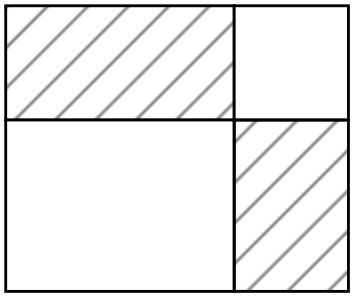 Sources: