Combinatorics, Combinatorial Geometry, Cut a Shape / Dissection Problems
Dissection problems involve cutting a given geometric shape into pieces that can be rearranged to form another specified shape, or to satisfy certain conditions (e.g., forming identical pieces). Questions test spatial reasoning and understanding of area preservation.
-
Question
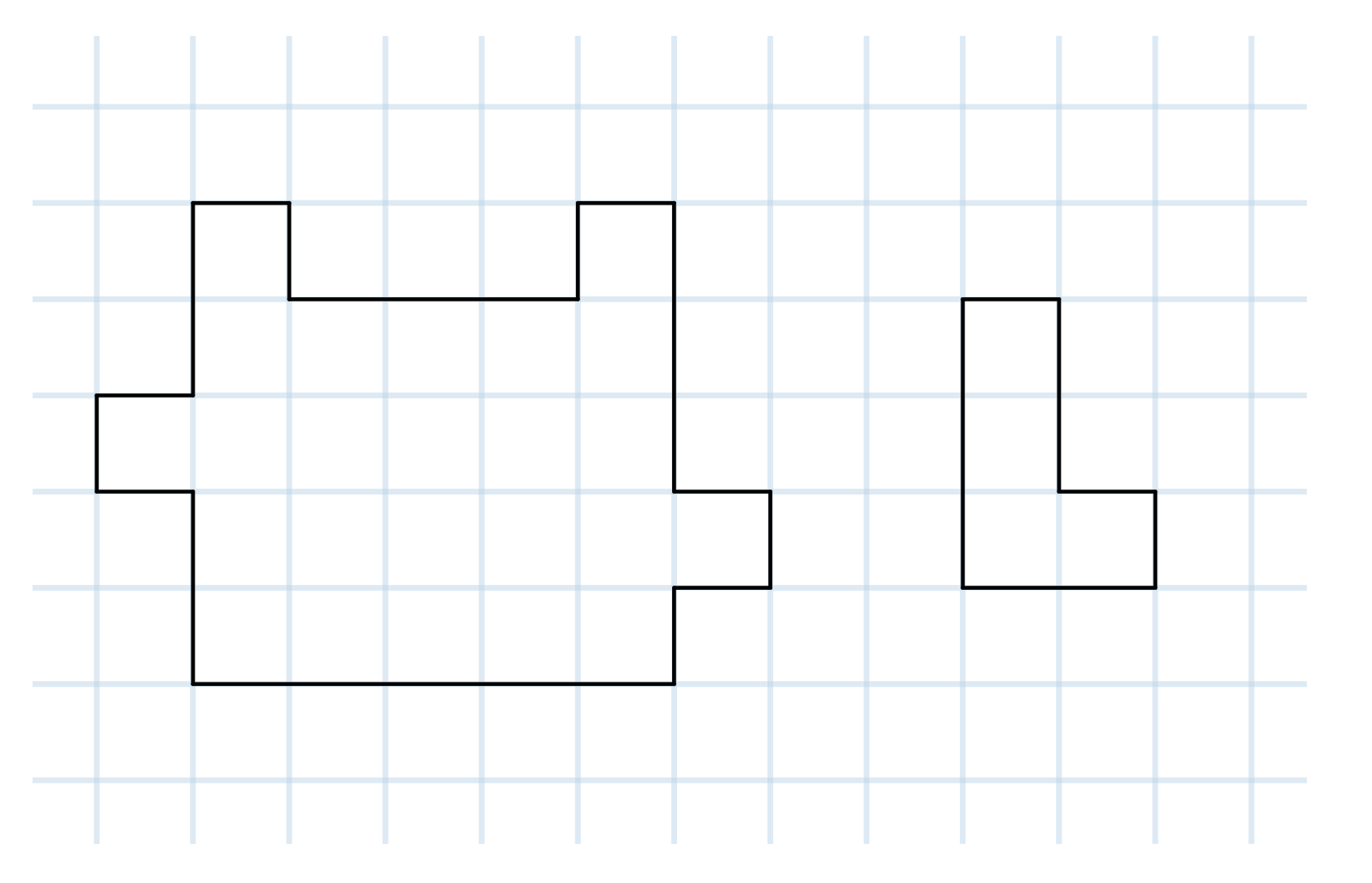
Prove that the given shape cannot be cut into dominoes:

-
Question
Can you cut the shape on the left into six shapes like the shape on the right?
-
Area of the Shape
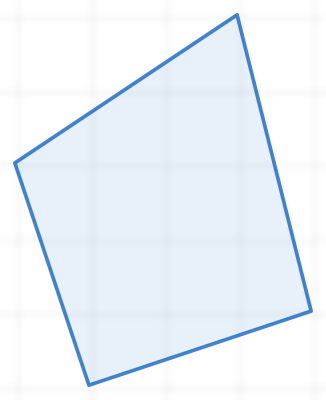
Given a grid paper where the area of each square is one unit area. Find the area of the shape (in unit areas)
 Sources:
 -
Cutting
What is the largest number of rectangles of size `2 times 5` that can be cut from a `9 times 9` square?
Sources: -
Squares
You have many cardboard squares of sizes `1 times 1`, `2 times 2`, and `3 times 3`, and you must assemble them into a square of size `7 times 7`.
Sources:
What is the smallest possible number of squares you will need? -
Dissect into four parts
Geometric shapes are called congruent if they coincide when superimposed. Cut the following shape into four congruent parts:
Sources: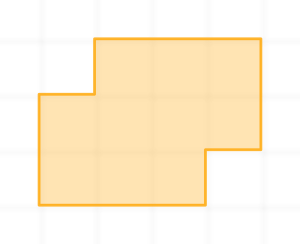
-
Cut a Boat in Half
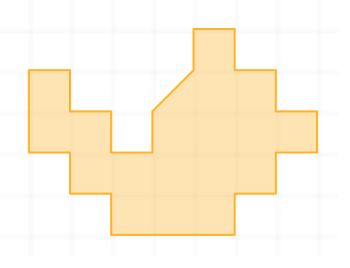
Geometric shapes are called congruent if they coincide when placed on top of each other. Cut the shape into two congruent parts
 Sources:Topics:Geometry -> Plane Geometry -> Symmetry Combinatorics -> Combinatorial Geometry -> Cut a Shape / Dissection Problems
 -
THE SILK PATCHWORK
The lady members of the Wilkinson family had made a simple patchwork quilt, as a small Christmas present, all composed of square pieces of the same size, as shown in the illustration. It only lacked the four corner pieces to make it complete. Somebody pointed out to them that if you unpicked the Greek cross in the middle and then cut the stitches along the dark joins, the four pieces all of the same size and shape would fit together and form a square. This the reader knows, from the solution in Fig. `39`, is quite easily done. But George Wilkinson suddenly suggested to them this poser. He said, "Instead of picking out the cross entire, and forming the square from four equal pieces, can you cut out a square entire and four equal pieces that will form a perfect Greek cross?" The puzzle is, of course, now quite easy.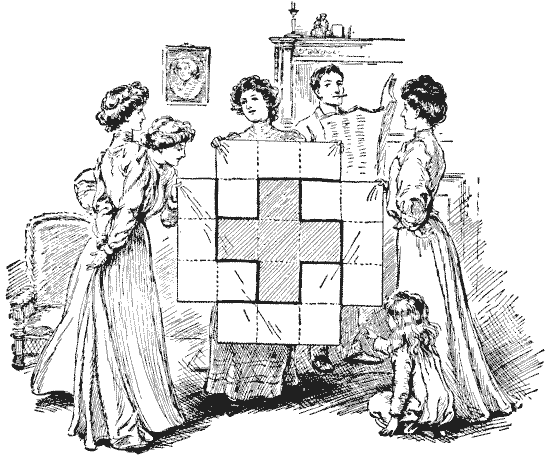 Sources:Topics:Geometry -> Plane Geometry Geometry -> Area Calculation Combinatorics -> Combinatorial Geometry -> Cut a Shape / Dissection Problems
- Amusements in Mathematics, Henry Ernest Dudeney Question 142
-
TWO CROSSES FROM ONE
Cut a Greek cross into five pieces that will form two such crosses, both of the same size. The solution of this puzzle is very beautiful. Sources:- Amusements in Mathematics, Henry Ernest Dudeney Question 143
-
THE CROSS AND THE TRIANGLE
Cut a Greek cross into six pieces that will form an equilateral triangle. This is another hard problem, and I will state here that a solution is practically impossible without a previous knowledge of my method of transforming an equilateral triangle into a square (see No. `26`, "Canterbury Puzzles").Sources:Topics:Geometry -> Area Calculation Geometry -> Plane Geometry -> Triangles Combinatorics -> Combinatorial Geometry -> Cut a Shape / Dissection Problems- Amusements in Mathematics, Henry Ernest Dudeney Question 144