Combinatorics, Combinatorial Geometry, Grid Paper Geometry / Lattice Geometry
This involves geometric problems set on a grid of equally spaced points (a lattice), often where coordinates are integers. Questions might involve finding areas of polygons using grid points (e.g., Pick's Theorem), counting lattice points, or analyzing shapes drawn on grid paper.
-
BOARDS WITH AN ODD NUMBER OF SQUARES
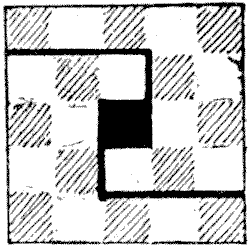
We will here consider the question of those boards that contain an odd number of squares. We will suppose that the central square is first cut out, so as to leave an even number of squares for division. Now, it is obvious that a square three by three can only be divided in one way, as shown in Fig. `1`. It will be seen that the pieces A and B are of the same size and shape, and that any other way of cutting would only produce the same shaped pieces, so remember that these variations are not counted as different ways. The puzzle I propose is to cut the board five by five (Fig. `2`) into two pieces of the same size and shape in as many different ways as possible. I have shown in the illustration one way of doing it. How many different ways are there altogether? A piece which when turned over resembles another piece is not considered to be of a different shape.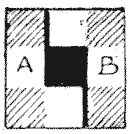
 Sources:Topics:Geometry -> Plane Geometry -> Symmetry Combinatorics -> Combinatorial Geometry -> Cut a Shape / Dissection Problems Combinatorics -> Combinatorial Geometry -> Grid Paper Geometry / Lattice Geometry
- Amusements in Mathematics, Henry Ernest Dudeney Question 290
-
THE FIVE CRESCENTS OF BYZANTIUM
When Philip of Macedon, the father of Alexander the Great, found himself confronted with great difficulties in the siege of Byzantium, he set his men to undermine the walls. His desires, however, miscarried, for no sooner had the operations been begun than a crescent moon suddenly appeared in the heavens and discovered his plans to his adversaries. The Byzantines were naturally elated, and in order to show their gratitude they erected a statue to Diana, and the crescent became thenceforward a symbol of the state. In the temple that contained the statue was a square pavement composed of sixty-four large and costly tiles. These were all plain, with the exception of five, which bore the symbol of the crescent. These five were for occult reasons so placed that every tile should be watched over by (that is, in a straight line, vertically, horizontally, or diagonally with) at least one of the crescents. The arrangement adopted by the Byzantine architect was as follows:—
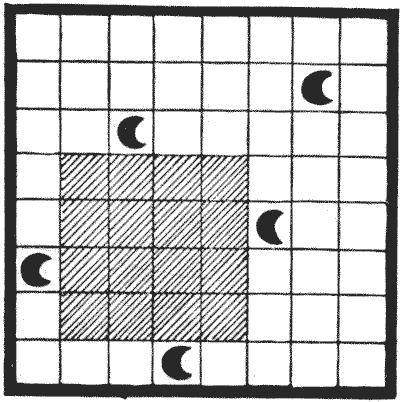
Now, to cover up one of these five crescents was a capital offence, the death being something very painful and lingering. But on a certain occasion of festivity it was necessary to lay down on this pavement a square carpet of the largest dimensions possible, and I have shown in the illustration by dark shading the largest dimensions that would be available.
The puzzle is to show how the architect, if he had foreseen this question of the carpet, might have so arranged his five crescent tiles in accordance with the required conditions, and yet have allowed for the largest possible square carpet to be laid down without any one of the five crescent tiles being covered, or any portion of them.
Sources:Topics:Combinatorics -> Case Analysis / Checking Cases -> Processes / Procedures Combinatorics -> Combinatorial Geometry -> Grid Paper Geometry / Lattice Geometry Puzzles and Rebuses- Amusements in Mathematics, Henry Ernest Dudeney Question 312
-
THE SOUTHERN CROSS
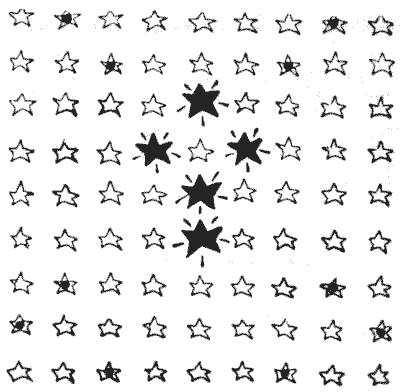
In the above illustration we have five Planets and eighty-one Fixed Stars, five of the latter being hidden by the Planets. It will be found that every Star, with the exception of the ten that have a black spot in their centres, is in a straight line, vertically, horizontally, or diagonally, with at least one of the Planets. The puzzle is so to rearrange the Planets that all the Stars shall be in line with one or more of them.
In rearranging the Planets, each of the five may be moved once in a straight line, in either of the three directions mentioned. They will, of course, obscure five other Stars in place of those at present covered.
Sources:Topics:Logic -> Reasoning / Logic Combinatorics -> Combinatorial Geometry -> Grid Paper Geometry / Lattice Geometry Puzzles and Rebuses- Amusements in Mathematics, Henry Ernest Dudeney Question 314
-
A PUZZLE WITH PAWNS
Place two pawns in the middle of the chessboard, one at Q `4` and the other at K `5`. Now, place the remaining fourteen pawns (sixteen in all) so that no three shall be in a straight line in any possible direction.
Note that I purposely do not say queens, because by the words "any possible direction" I go beyond attacks on diagonals. The pawns must be regarded as mere points in space—at the centres of the squares. See dotted lines in the case of No. `300`, "The Eight Queens."
Sources:- Amusements in Mathematics, Henry Ernest Dudeney Question 317
-
LION-HUNTING
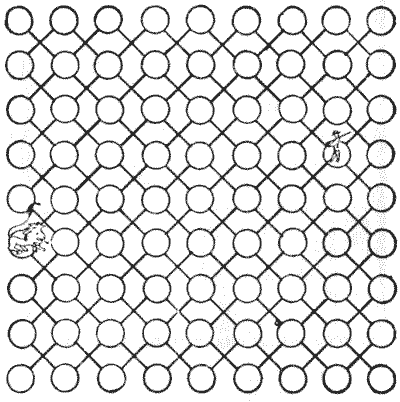
My friend Captain Potham Hall, the renowned hunter of big game, says there is nothing more exhilarating than a brush with a herd—a pack—a team—a flock—a swarm (it has taken me a full quarter of an hour to recall the right word, but I have it at last)—a pride of lions. Why a number of lions are called a "pride," a number of whales a "school," and a number of foxes a "skulk" are mysteries of philology into which I will not enter.
Well, the captain says that if a spirited lion crosses your path in the desert it becomes lively, for the lion has generally been looking for the man just as much as the man has sought the king of the forest. And yet when they meet they always quarrel and fight it out. A little contemplation of this unfortunate and long-standing feud between two estimable families has led me to figure out a few calculations as to the probability of the man and the lion crossing one another's path in the jungle. In all these cases one has to start on certain more or less arbitrary assumptions. That is why in the above illustration I have thought it necessary to represent the paths in the desert with such rigid regularity. Though the captain assures me that the tracks of the lions usually run much in this way, I have doubts.
The puzzle is simply to find out in how many different ways the man and the lion may be placed on two different spots that are not on the same path. By "paths" it must be understood that I only refer to the ruled lines. Thus, with the exception of the four corner spots, each combatant is always on two paths and no more. It will be seen that there is a lot of scope for evading one another in the desert, which is just what one has always understood.
Sources:Topics:Combinatorics -> Product Rule / Rule of Product Combinatorics -> Combinatorial Geometry -> Grid Paper Geometry / Lattice Geometry- Amusements in Mathematics, Henry Ernest Dudeney Question 318
-
THE ROOK'S JOURNEY
This puzzle I call "The Rook's Journey," because the word "tour" (derived from a turner's wheel) implies that we return to the point from which we set out, and we do not do this in the present case. We should not be satisfied with a personally conducted holiday tour that ended by leaving us, say, in the middle of the Sahara. The rook here makes twenty-one moves, in the course of which journey it visits every square of the board once and only once, stopping at the square marked `10` at the end of its tenth move, and ending at the square marked `21`. Two consecutive moves cannot be made in the same direction—that is to say, you must make a turn after every move.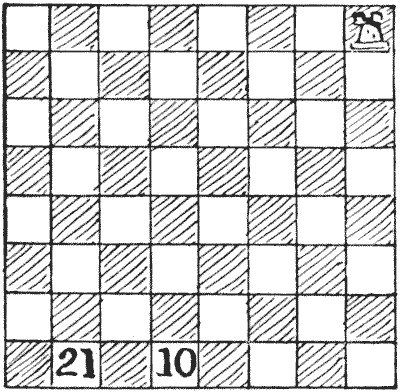 Sources:Topics:Logic -> Reasoning / Logic Combinatorics -> Case Analysis / Checking Cases -> Processes / Procedures Combinatorics -> Combinatorial Geometry -> Grid Paper Geometry / Lattice Geometry Puzzles and Rebuses
- Amusements in Mathematics, Henry Ernest Dudeney Question 321
-
THE YACHT RACE
Now then, ye land-lubbers, hoist your baby-jib-topsails, break out your spinnakers, ease off your balloon sheets, and get your head-sails set!
Our race consists in starting from the point at which the yacht is lying in the illustration and touching every one of the sixty-four buoys in fourteen straight courses, returning in the final tack to the buoy from which we start. The seventh course must finish at the buoy from which a flag is flying.
This puzzle will call for a lot of skilful seamanship on account of the sharp angles at which it will occasionally be necessary to tack. The point of a lead pencil and a good nautical eye are all the outfit that we require.
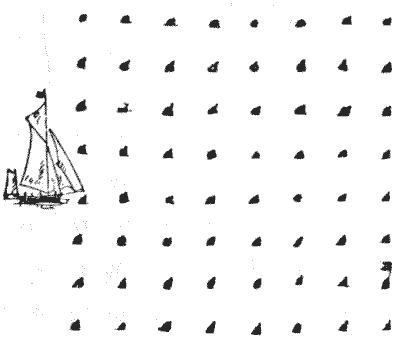
This is difficult, because of the condition as to the flag-buoy, and because it is a re-entrant tour. But again we are allowed those oblique lines.
Sources:Topics:Geometry -> Plane Geometry -> Angle Calculation Combinatorics -> Combinatorial Geometry -> Grid Paper Geometry / Lattice Geometry- Amusements in Mathematics, Henry Ernest Dudeney Question 330
-
ST. GEORGE AND THE DRAGON
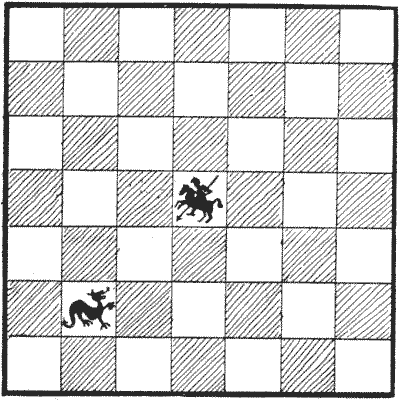 Here is a little puzzle on a reduced chessboard of forty-nine squares. St. George wishes to kill the dragon. Killing dragons was a well-known pastime of his, and, being a knight, it was only natural that he should desire to perform the feat in a series of knight's moves. Can you show how, starting from that central square, he may visit once, and only once, every square of the board in a chain of chess knight's moves, and end by capturing the dragon on his last move? Of course a variety of different ways are open to him, so try to discover a route that forms some pretty design when you have marked each successive leap by a straight line from square to square.
Sources:Topics:Combinatorics -> Graph Theory Combinatorics -> Combinatorial Geometry -> Grid Paper Geometry / Lattice Geometry
Here is a little puzzle on a reduced chessboard of forty-nine squares. St. George wishes to kill the dragon. Killing dragons was a well-known pastime of his, and, being a knight, it was only natural that he should desire to perform the feat in a series of knight's moves. Can you show how, starting from that central square, he may visit once, and only once, every square of the board in a chain of chess knight's moves, and end by capturing the dragon on his last move? Of course a variety of different ways are open to him, so try to discover a route that forms some pretty design when you have marked each successive leap by a straight line from square to square.
Sources:Topics:Combinatorics -> Graph Theory Combinatorics -> Combinatorial Geometry -> Grid Paper Geometry / Lattice Geometry- Amusements in Mathematics, Henry Ernest Dudeney Question 334
-
FARMER LAWRENCE'S CORNFIELDS
One of the most beautiful districts within easy distance of London for a summer ramble is that part of Buckinghamshire known as the Valley of the Chess—at least, it was a few years ago, before it was discovered by the speculative builder. At the beginning of the present century there lived, not far from Latimers, a worthy but eccentric farmer named Lawrence. One of his queer notions was that every person who lived near the banks of the river Chess ought to be in some way acquainted with the noble game of the same name, and in order to impress this fact on his men and his neighbours he adopted at times strange terminology. For example, when one of his ewes presented him with a lamb, he would say that it had "queened a pawn"; when he put up a new barn against the highway, he called it "castling on the king's side"; and when he sent a man with a gun to keep his neighbour's birds off his fields, he spoke of it as "attacking his opponent's rooks." Everybody in the neighbourhood used to be amused at Farmer Lawrence's little jokes, and one boy (the wag of the village) who got his ears pulled by the old gentleman for stealing his "chestnuts" went so far as to call him "a silly old chess-protector!"
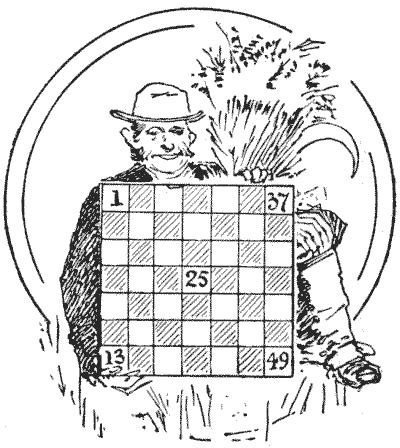
One year he had a large square field divided into forty-nine square plots, as shown in the illustration. The white squares were sown with wheat and the black squares with barley. When the harvest time came round he gave orders that his men were first to cut the corn in the patch marked `1`, and that each successive cutting should be exactly a knight's move from the last one, the thirteenth cutting being in the patch marked `13`, the twenty-fifth in the patch marked `25`, the thirty-seventh in the one marked `37`, and the last, or forty-ninth cutting, in the patch marked `49`. This was too much for poor Hodge, and each day Farmer Lawrence had to go down to the field and show which piece had to be operated upon. But the problem will perhaps present no difficulty to my readers.
 Sources:Topics:Combinatorics -> Graph Theory Combinatorics -> Combinatorial Geometry -> Grid Paper Geometry / Lattice Geometry
- Amusements in Mathematics, Henry Ernest Dudeney Question 335
-
THE FOUR KANGAROOS
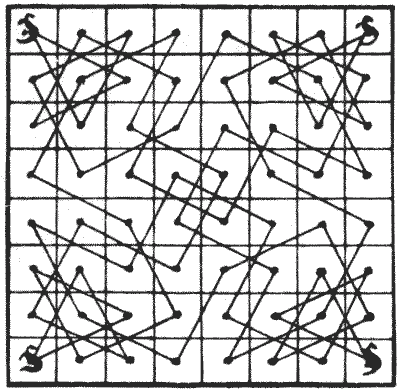 In introducing a little Commonwealth problem, I must first explain that the diagram represents the sixty-four fields, all properly fenced off from one another, of an Australian settlement, though I need hardly say that our kith and kin "down under" always do set out their land in this methodical and exact manner. It will be seen that in every one of the four corners is a kangaroo. Why kangaroos have a marked preference for corner plots has never been satisfactorily explained, and it would be out of place to discuss the point here. I should also add that kangaroos, as is well known, always leap in what we call "knight's moves." In fact, chess players would probably have adopted the better term "kangaroo's move" had not chess been invented before kangaroos.
The puzzle is simply this. One morning each kangaroo went for his morning hop, and in sixteen consecutive knight's leaps visited just fifteen different fields and jumped back to his corner. No field was visited by more than one of the kangaroos. The diagram shows how they arranged matters. What you are asked to do is to show how they might have performed the feat without any kangaroo ever crossing the horizontal line in the middle of the square that divides the board into two equal parts.
Sources:Topics:Combinatorics -> Graph Theory Combinatorics -> Case Analysis / Checking Cases -> Processes / Procedures Combinatorics -> Colorings -> Chessboard Coloring Combinatorics -> Combinatorial Geometry -> Grid Paper Geometry / Lattice Geometry- Amusements in Mathematics, Henry Ernest Dudeney Question 337