Amusements in Mathematics, Henry Ernest Dudeney
-
Question 221 - THE EIGHT ENGINES
The diagram represents the engine-yard of a railway company under eccentric management. The engines are allowed to be stationary only at the nine points indicated, one of which is at present vacant. It is required to move the engines, one at a time, from point to point, in seventeen moves, so that their numbers shall be in numerical order round the circle, with the central point left vacant. But one of the engines has had its fire drawn, and therefore cannot move. How is the thing to be done? And which engine remains stationary throughout?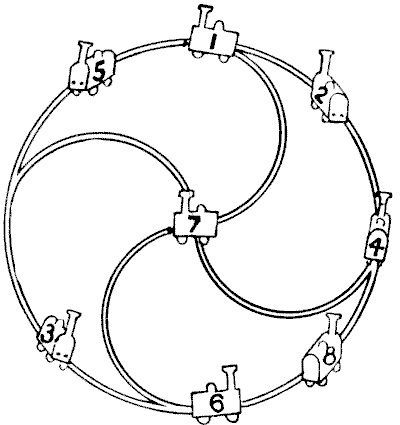 Topics:Puzzles and Rebuses
 -
Question 222 - A RAILWAY PUZZLE
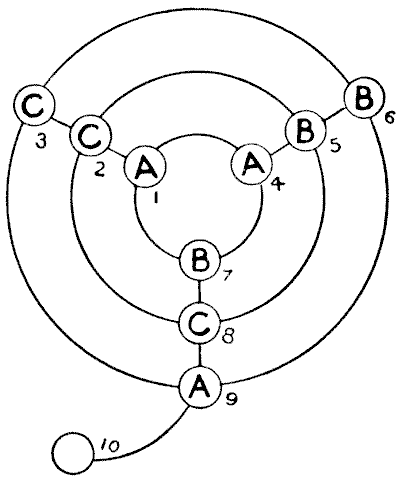 Make a diagram, on a large sheet of paper, like the illustration, and have three counters marked A, three marked B, and three marked C. It will be seen that at the intersection of lines there are nine stopping-places, and a tenth stopping-place is attached to the outer circle like the tail of a Q. Place the three counters or engines marked A, the three marked B, and the three marked C at the places indicated. The puzzle is to move the engines, one at a time, along the lines, from stopping-place to stopping-place, until you succeed in getting an A, a B, and a C on each circle, and also A, B, and C on each straight line. You are required to do this in as few moves as possible. How many moves do you need?
Topics:Combinatorics -> Graph Theory
Make a diagram, on a large sheet of paper, like the illustration, and have three counters marked A, three marked B, and three marked C. It will be seen that at the intersection of lines there are nine stopping-places, and a tenth stopping-place is attached to the outer circle like the tail of a Q. Place the three counters or engines marked A, the three marked B, and the three marked C at the places indicated. The puzzle is to move the engines, one at a time, along the lines, from stopping-place to stopping-place, until you succeed in getting an A, a B, and a C on each circle, and also A, B, and C on each straight line. You are required to do this in as few moves as possible. How many moves do you need?
Topics:Combinatorics -> Graph Theory -
Question 223 - A RAILWAY MUDDLE
The plan represents a portion of the line of the London, Clodville, and Mudford Railway Company. It is a single line with a loop. There is only room for eight wagons, or seven wagons and an engine, between B and C on either the left line or the right line of the loop. It happened that two goods trains (each consisting of an engine and sixteen wagons) got into the position shown in the illustration. It looked like a hopeless deadlock, and each engine-driver wanted the other to go back to the next station and take off nine wagons. But an ingenious stoker undertook to pass the trains and send them on their respective journeys with their engines properly in front. He also contrived to reverse the engines the fewest times possible. Could you have performed the feat? And how many times would you require to reverse the engines? A "reversal" means a change of direction, backward or forward. No rope-shunting, fly-shunting, or other trick is allowed. All the work must be done legitimately by the two engines. It is a simple but interesting puzzle if attempted with counters.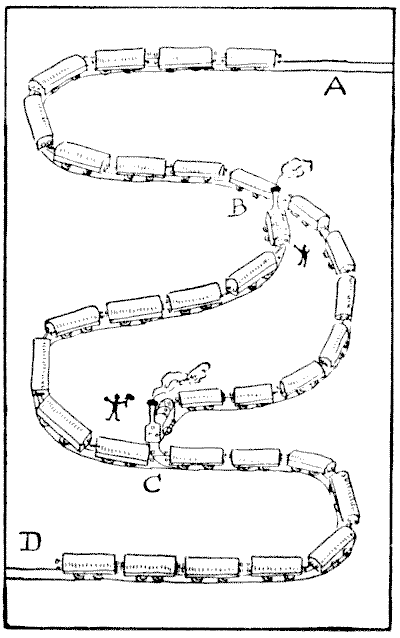 Topics:Puzzles and Rebuses
 -
Question 224 - THE MOTOR-GARAGE PUZZLE
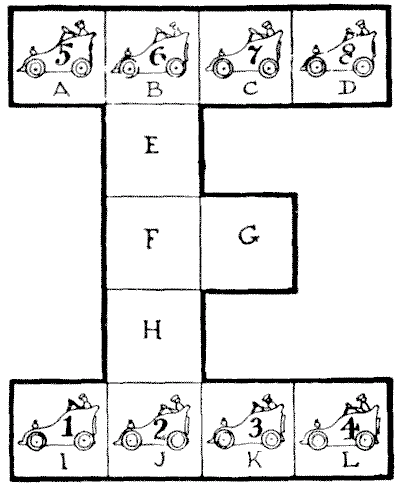
The difficulties of the proprietor of a motor garage are converted into a little pastime of a kind that has a peculiar fascination. All you need is to make a simple plan or diagram on a sheet of paper or cardboard and number eight counters, `1` to `8`. Then a whole family can enter into an amusing competition to find the best possible solution of the difficulty.
The illustration represents the plan of a motor garage, with accommodation for twelve cars. But the premises are so inconveniently restricted that the proprietor is often caused considerable perplexity. Suppose, for example, that the eight cars numbered `1` to `8` are in the positions shown, how are they to be shifted in the quickest possible way so that `1, 2, 3`, and `4` shall change places with `5, 6, 7`, and `8`—that is, with the numbers still running from left to right, as at present, but the top row exchanged with the bottom row? What are the fewest possible moves?
One car moves at a time, and any distance counts as one move. To prevent misunderstanding, the stopping-places are marked in squares, and only one car can be in a square at the same time.
-
Question 225 - THE TEN PRISONERS
If prisons had no other use, they might still be preserved for the special benefit of puzzle-makers. They appear to be an inexhaustible mine of perplexing ideas. Here is a little poser that will perhaps interest the reader for a short period. We have in the illustration a prison of sixteen cells. The locations of the ten prisoners will be seen. The jailer has queer superstitions about odd and even numbers, and he wants to rearrange the ten prisoners so that there shall be as many even rows of men, vertically, horizontally, and diagonally, as possible. At present it will be seen, as indicated by the arrows, that there are only twelve such rows of `2` and `4`. I will state at once that the greatest number of such rows that is possible is sixteen. But the jailer only allows four men to be removed to other cells, and informs me that, as the man who is seated in the bottom right-hand corner is infirm, he must not be moved. Now, how are we to get those sixteen rows of even numbers under such conditions?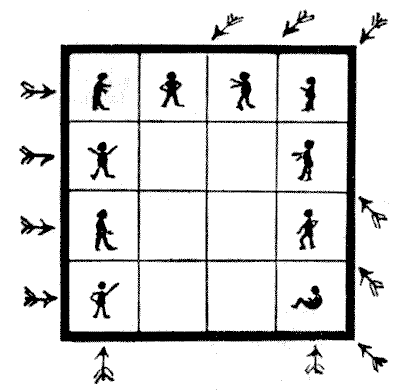 Topics:Puzzles and Rebuses
 -
Question 226 - ROUND THE COAST
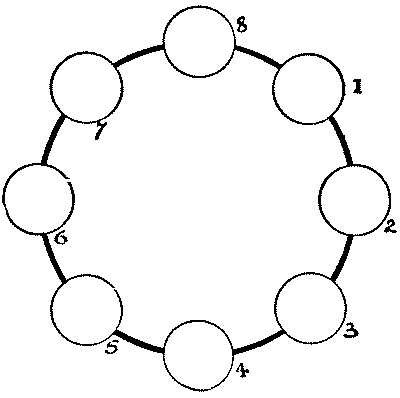 Here is a puzzle that will, I think, be found as amusing as instructive. We are given a ring of eight circles. Leaving circle `8` blank, we are required to write in the name of a seven-lettered port in the United Kingdom in this manner. Touch a blank circle with your pencil, then jump over two circles in either direction round the ring, and write down the first letter. Then touch another vacant circle, jump over two circles, and write down your second letter. Proceed similarly with the other letters in their proper order until you have completed the word. Thus, suppose we select "Glasgow," and proceed as follows: `6`—`1, 7`—`2, 8`—`3, 7`—`4, 8`—`5`, which means that we touch `6`, jump over `7` and and write down "G" on `1`; then touch `7`, jump over `8` and `1`, and write down "l" on `2`; and so on. It will be found that after we have written down the first five letters—"Glasg"—as above, we cannot go any further. Either there is something wrong with "Glasgow," or we have not managed our jumps properly. Can you get to the bottom of the mystery?
-
Question 227 - CENTRAL SOLITAIRE
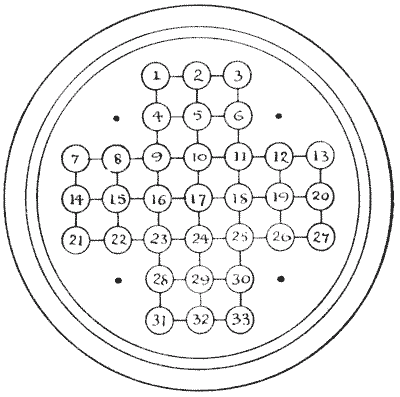
This ancient puzzle was a great favourite with our grandmothers, and most of us, I imagine, have on occasions come across a "Solitaire" board—a round polished board with holes cut in it in a geometrical pattern, and a glass marble in every hole. Sometimes I have noticed one on a side table in a suburban front parlour, or found one on a shelf in a country cottage, or had one brought under my notice at a wayside inn. Sometimes they are of the form shown above, but it is equally common for the board to have four more holes, at the points indicated by dots. I select the simpler form.
Though "Solitaire" boards are still sold at the toy shops, it will be sufficient if the reader will make an enlarged copy of the above on a sheet of cardboard or paper, number the "holes," and provide himself with `33` counters, buttons, or beans. Now place a counter in every hole except the central one, No. `17`, and the puzzle is to take off all the counters in a series of jumps, except the last counter, which must be left in that central hole. You are allowed to jump one counter over the next one to a vacant hole beyond, just as in the game of draughts, and the counter jumped over is immediately taken off the board. Only remember every move must be a jump; consequently you will take off a counter at each move, and thirty-one single jumps will of course remove all the thirty-one counters. But compound moves are allowed (as in draughts, again), for so long as one counter continues to jump, the jumps all count as one move.
Here is the beginning of an imaginary solution which will serve to make the manner of moving perfectly plain, and show how the solver should write out his attempts: `5-17`, `12-10`, `26-12`, `24-26` (`13-11`, `11-25`), `9-11` (`26-24`, `24-10`, `10-12`), etc., etc. The jumps contained within brackets count as one move, because they are made with the same counter. Find the fewest possible moves. Of course, no diagonal jumps are permitted; you can only jump in the direction of the lines.
-
Question 228 - THE TEN APPLES
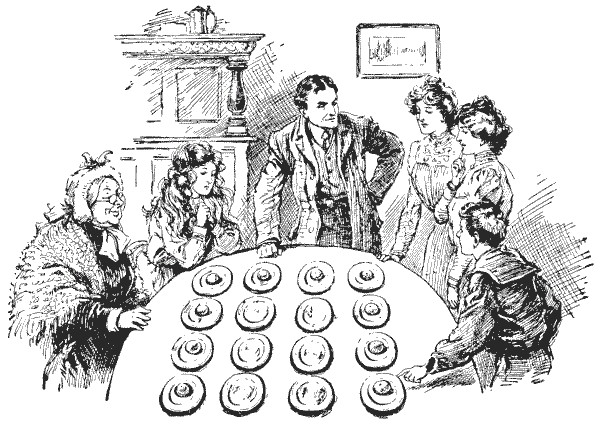 The family represented in the illustration are amusing themselves with this little puzzle, which is not very difficult but quite interesting. They have, it will be seen, placed sixteen plates on the table in the form of a square, and put an apple in each of ten plates. They want to find a way of removing all the apples except one by jumping over one at a time to the next vacant square, as in draughts; or, better, as in solitaire, for you are not allowed to make any diagonal moves—only moves parallel to the sides of the square. It is obvious that as the apples stand no move can be made, but you are permitted to transfer any single apple you like to a vacant plate before starting. Then the moves must be all leaps, taking off the apples leaped over.
Topics:Puzzles and Rebuses
The family represented in the illustration are amusing themselves with this little puzzle, which is not very difficult but quite interesting. They have, it will be seen, placed sixteen plates on the table in the form of a square, and put an apple in each of ten plates. They want to find a way of removing all the apples except one by jumping over one at a time to the next vacant square, as in draughts; or, better, as in solitaire, for you are not allowed to make any diagonal moves—only moves parallel to the sides of the square. It is obvious that as the apples stand no move can be made, but you are permitted to transfer any single apple you like to a vacant plate before starting. Then the moves must be all leaps, taking off the apples leaped over.
Topics:Puzzles and Rebuses -
Question 229 - THE NINE ALMONDS
"Here is a little puzzle," said a Parson, "that I have found peculiarly fascinating. It is so simple, and yet it keeps you interested indefinitely."
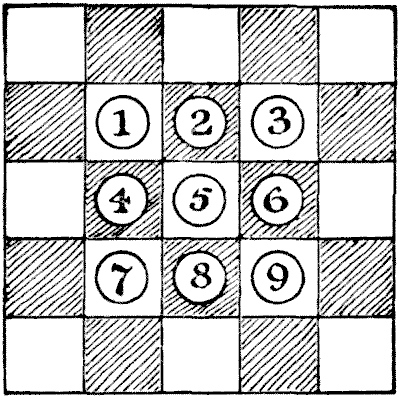
The reverend gentleman took a sheet of paper and divided it off into twenty-five squares, like a square portion of a chessboard. Then he placed nine almonds on the central squares, as shown in the illustration, where we have represented numbered counters for convenience in giving the solution.
"Now, the puzzle is," continued the Parson, "to remove eight of the almonds and leave the ninth in the central square. You make the removals by jumping one almond over another to the vacant square beyond and taking off the one jumped over—just as in draughts, only here you can jump in any direction, and not diagonally only. The point is to do the thing in the fewest possible moves."
The following specimen attempt will make everything clear. Jump `4` over `1, 5` over `9, 3` over `6, 5` over `3, 7` over `5` and `2, 4` over `7, 8` over `4`. But `8` is not left in the central square, as it should be. Remember to remove those you jump over. Any number of jumps in succession with the same almond count as one move.
-
Question 230 - THE TWELVE PENNIES
Here is a pretty little puzzle that only requires twelve pennies or counters. Arrange them in a circle, as shown in the illustration. Now take up one penny at a time and, passing it over two pennies, place it on the third penny. Then take up another single penny and do the same thing, and so on, until, in six such moves, you have the coins in six pairs in the positions `1, 2, 3, 4, 5, 6`. You can move in either direction round the circle at every play, and it does not matter whether the two jumped over are separate or a pair. This is quite easy if you use just a little thought.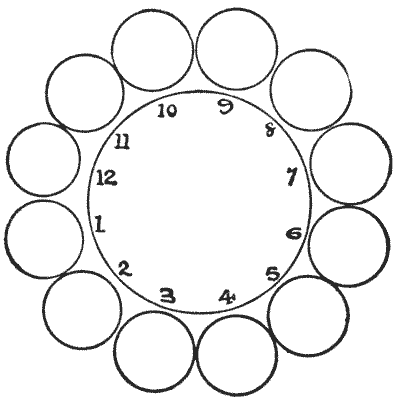 Topics:Puzzles and Rebuses