Amusements in Mathematics, Henry Ernest Dudeney
-
Question 201 - HOW TO MAKE CISTERNS
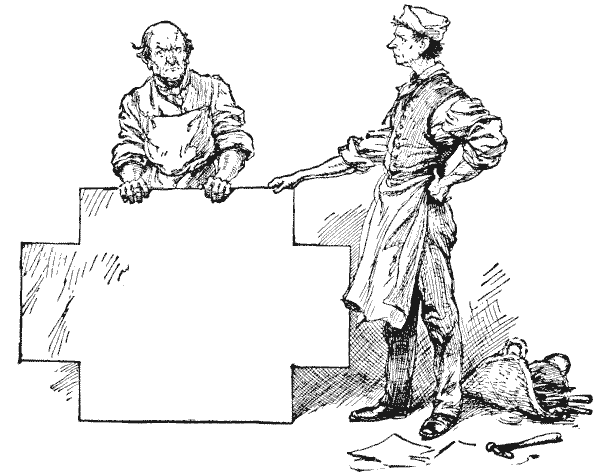 Our friend in the illustration has a large sheet of zinc, measuring (before cutting) eight feet by three feet, and he has cut out square pieces (all of the same size) from the four corners and now proposes to fold up the sides, solder the edges, and make a cistern. But the point that puzzles him is this: Has he cut out those square pieces of the correct size in order that the cistern may hold the greatest possible quantity of water? You see, if you cut them very small you get a very shallow cistern; if you cut them large you get a tall and slender one. It is all a question of finding a way of cutting put these four square pieces exactly the right size. How are we to avoid making them too small or too large?
-
Question 202 - THE CONE PUZZLE
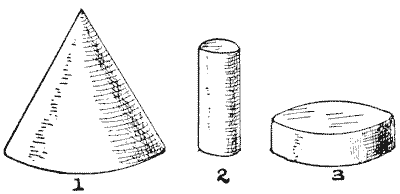 I have a wooden cone, as shown in Fig. `1`. How am I to cut out of it the greatest possible cylinder? It will be seen that I can cut out one that is long and slender, like Fig. `2`, or short and thick, like Fig. `3`. But neither is the largest possible. A child could tell you where to cut, if he knew the rule. Can you find this simple rule?
-
Question 203 - CONCERNING WHEELS
There are some curious facts concerning the movements of wheels that are apt to perplex the novice. For example: when a railway train is travelling from London to Crewe certain parts of the train at any given moment are actually moving from Crewe towards London. Can you indicate those parts? It seems absurd that parts of the same train can at any time travel in opposite directions, but such is the case.
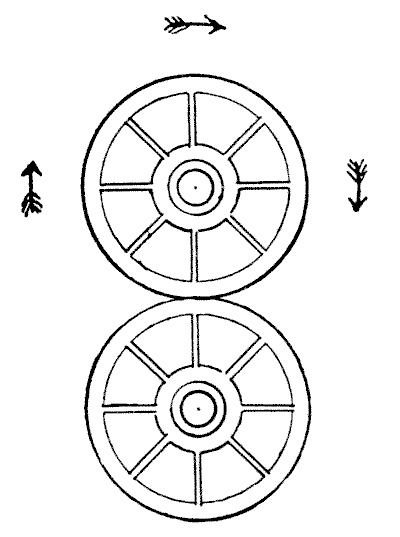
In the accompanying illustration we have two wheels. The lower one is supposed to be fixed and the upper one running round it in the direction of the arrows. Now, how many times does the upper wheel turn on its own axis in making a complete revolution of the other wheel? Do not be in a hurry with your answer, or you are almost certain to be wrong. Experiment with two pennies on the table and the correct answer will surprise you, when you succeed in seeing it.
Topics:Geometry -> Plane Geometry -> Circles Geometry -> Plane Geometry -> Plane Transformations -> Congruence Transformations (Isometries) -> Rotation -
Question 204 - A NEW MATCH PUZZLE
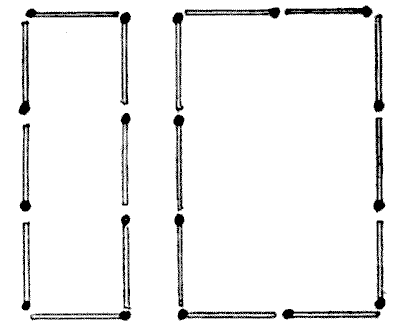 In the illustration eighteen matches are shown arranged so that they enclose two spaces, one just twice as large as the other. Can you rearrange them (`1`) so as to enclose two four-sided spaces, one exactly three times as large as the other, and (`2`) so as to enclose two five-sided spaces, one exactly three times as large as the other? All the eighteen matches must be fairly used in each case; the two spaces must be quite detached, and there must be no loose ends or duplicated matches.
-
Question 205 - THE SIX SHEEP-PENS
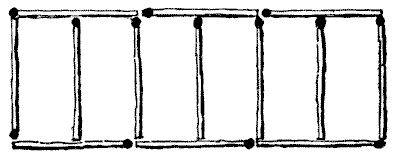
Here is a new little puzzle with matches. It will be seen in the illustration that thirteen matches, representing a farmer's hurdles, have been so placed that they enclose six sheep-pens all of the same size. Now, one of these hurdles was stolen, and the farmer wanted still to enclose six pens of equal size with the remaining twelve. How was he to do it? All the twelve matches must be fairly used, and there must be no duplicated matches or loose ends.
Topics:Puzzles and Rebuses -> Matchstick Puzzles -
Question 206 - THE KING AND THE CASTLES
There was once, in ancient times, a powerful king, who had eccentric ideas on the subject of military architecture. He held that there was great strength and economy in symmetrical forms, and always cited the example of the bees, who construct their combs in perfect hexagonal cells, to prove that he had nature to support him. He resolved to build ten new castles in his country all to be connected by fortified walls, which should form five lines with four castles in every line. The royal architect presented his preliminary plan in the form I have shown. But the monarch pointed out that every castle could be approached from the outside, and commanded that the plan should be so modified that as many castles as possible should be free from attack from the outside, and could only be reached by crossing the fortified walls. The architect replied that he thought it impossible so to arrange them that even one castle, which the king proposed to use as a royal residence, could be so protected, but his majesty soon enlightened him by pointing out how it might be done. How would you have built the ten castles and fortifications so as best to fulfil the king's requirements? Remember that they must form five straight lines with four castles in every line.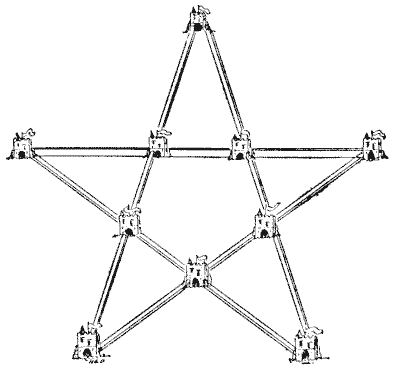
-
Question 207 - CHERRIES AND PLUMS
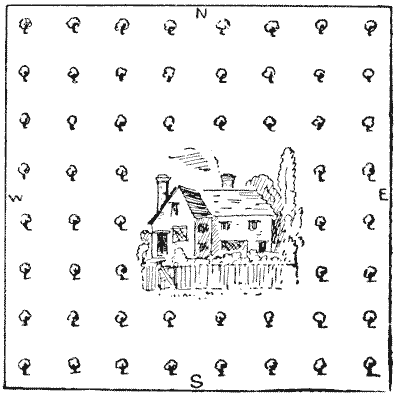 The illustration is a plan of a cottage as it stands surrounded by an orchard of fifty-five trees. Ten of these trees are cherries, ten are plums, and the remainder apples. The cherries are so planted as to form five straight lines, with four cherry trees in every line. The plum trees are also planted so as to form five straight lines with four plum trees in every line. The puzzle is to show which are the ten cherry trees and which are the ten plums. In order that the cherries and plums should have the most favourable aspect, as few as possible (under the conditions) are planted on the north and east sides of the orchard. Of course in picking out a group of ten trees (cherry or plum, as the case may be) you ignore all intervening trees. That is to say, four trees may be in a straight line irrespective of other trees (or the house) being in between. After the last puzzle this will be quite easy.
-
Question 208 - A PLANTATION PUZZLE
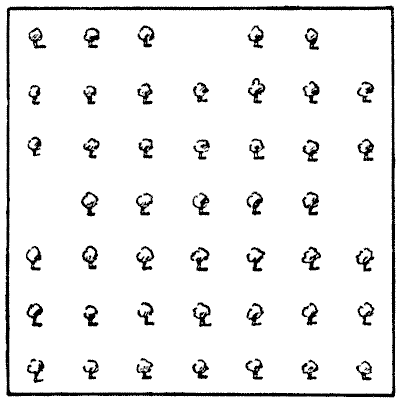 A man had a square plantation of forty-nine trees, but, as will be seen by the omissions in the illustration, four trees were blown down and removed. He now wants to cut down all the remainder except ten trees, which are to be so left that they shall form five straight rows with four trees in every row. Which are the ten trees that he must leave?
-
Question 209 - THE TWENTY-ONE TREES
A gentleman wished to plant twenty-one trees in his park so that they should form twelve straight rows with five trees in every row. Could you have supplied him with a pretty symmetrical arrangement that would satisfy these conditions? -
Question 210 - THE TEN COINS
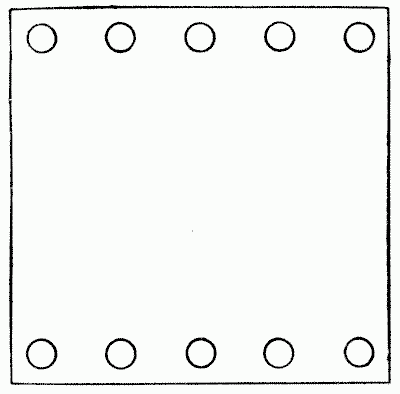
Place ten pennies on a large sheet of paper or cardboard, as shown in the diagram, five on each edge. Now remove four of the coins, without disturbing the others, and replace them on the paper so that the ten shall form five straight lines with four coins in every line. This in itself is not difficult, but you should try to discover in how many different ways the puzzle may be solved, assuming that in every case the two rows at starting are exactly the same.