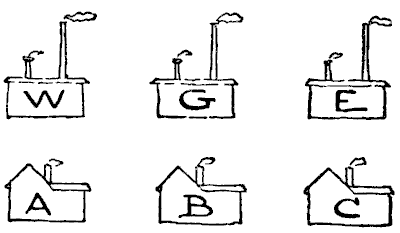
There are some half-dozen puzzles, as old as the hills, that are perpetually cropping up, and there is hardly a month in the year that does not bring inquiries as to their solution. Occasionally one of these, that one had thought was an extinct volcano, bursts into eruption in a surprising manner. I have received an extraordinary number of letters respecting the ancient puzzle that I have called "Water, Gas, and Electricity." It is much older than electric lighting, or even gas, but the new dress brings it up to date. The puzzle is to lay on water, gas, and electricity, from W, G, and E, to each of the three houses, A, B, and C, without any pipe crossing another. Take your pencil and draw lines showing how this should be done. You will soon find yourself landed in difficulties.
Eight motorists drove to church one morning. Their respective houses and churches, together with the only roads available (the dotted lines), are shown. One went from his house A to his church A, another from his house B to his church B, another from C to C, and so on, but it was afterwards found that no driver ever crossed the track of another car. Take your pencil and try to trace out their various routes.
Two friends were spending their bank holiday on a cycling trip. Stopping for a rest at a village inn, they consulted a route map, which is represented in our illustration in an exceedingly simplified form, for the puzzle is interesting enough without all the original complexities. They started from the town in the top left-hand corner marked A. It will be seen that there are one hundred and twenty such towns, all connected by straight roads. Now they discovered that there are exactly `1,365` different routes by which they may reach their destination, always travelling either due south or due east. The puzzle is to discover which town is their destination. Of course, if you find that there are more than `1,365` different routes to a town it cannot be the right one.
In the above diagram the circles represent towns and the lines good roads. In just how many different ways can a motorist, starting from London (marked with an L), make a tour of all these towns, visiting every town once, and only once, on a tour, and always coming back to London on the last ride? The exact reverse of any route is not counted as different.
This is a simple counting puzzle. In how many different ways can you spell out the word LEVEL by placing the point of your pencil on an L and then passing along the lines from letter to letter. You may go in any direction, backwards or forwards. Of course you are not allowed to miss letters—that is to say, if you come to a letter you must use it.
IN how many different ways may the word DIAMOND be read in the arrangement shown? You may start wherever you like at a D and go up or down, backwards or forwards, in and out, in any direction you like, so long as you always pass from one letter to another that adjoins it. How many ways are there?
In how many different ways may the word DEIFIED be read in this arrangement under the same conditions as in the last puzzle, with the addition that you can use any letters twice in the same reading?
Here we have, perhaps, the most interesting form of the puzzle. In how many different ways can you read the political injunction, "RISE TO VOTE, SIR," under the same conditions as before? In this case every reading of the palindrome requires the use of the central V as the middle letter.
A man was in love with a young lady whose Christian name was Hannah. When he asked her to be his wife she wrote down the letters of her name in this manner:— and promised that she would be his if he could tell her correctly in how many different ways it was possible to spell out her name, always passing from one letter to another that was adjacent. Diagonal steps are here allowed. Whether she did this merely to tease him or to test his cleverness is not recorded, but it is satisfactory to know that he succeeded. Would you have been equally successful? Take your pencil and try. You may start from any of the H's and go backwards or forwards and in any direction, so long as all the letters in a spelling are adjoining one another. How many ways are there, no two exactly alike?
Here is a little puzzle with the simplest possible conditions. Place the point of your pencil on a letter in one of the cells of the honeycomb, and trace out a very familiar proverb by passing always from a cell to one that is contiguous to it. If you take the right route you will have visited every cell once, and only once. The puzzle is much easier than it looks.
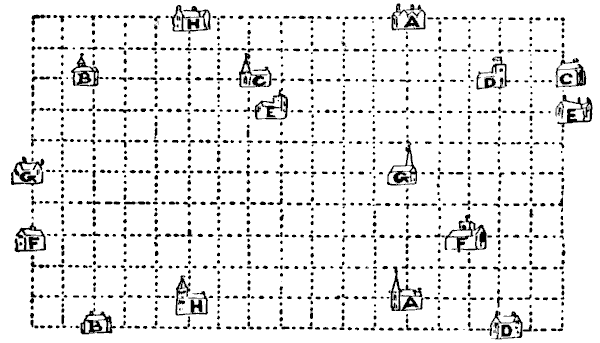 Eight motorists drove to church one morning. Their respective houses and churches, together with the only roads available (the dotted lines), are shown. One went from his house A to his church A, another from his house B to his church B, another from C to C, and so on, but it was afterwards found that no driver ever crossed the track of another car. Take your pencil and try to trace out their various routes.
Topics:Combinatorics -> Graph Theory
Eight motorists drove to church one morning. Their respective houses and churches, together with the only roads available (the dotted lines), are shown. One went from his house A to his church A, another from his house B to his church B, another from C to C, and so on, but it was afterwards found that no driver ever crossed the track of another car. Take your pencil and try to trace out their various routes.
Topics:Combinatorics -> Graph Theory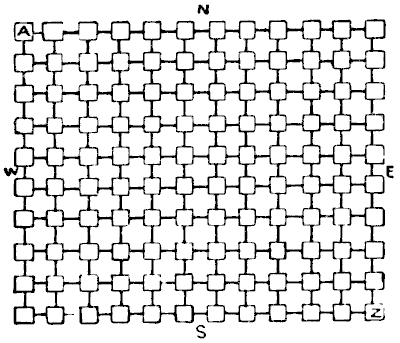 Of course, if you find that there are more than `1,365` different routes to a town it cannot be the right one.
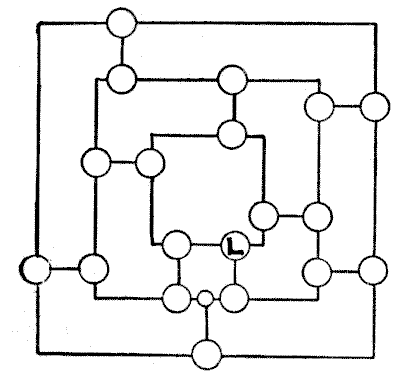 In the above diagram the circles represent towns and the lines good roads. In just how many different ways can a motorist, starting from London (marked with an L), make a tour of all these towns, visiting every town once, and only once, on a tour, and always coming back to London on the last ride? The exact reverse of any route is not counted as different.
Topics:Combinatorics -> Graph Theory
In the above diagram the circles represent towns and the lines good roads. In just how many different ways can a motorist, starting from London (marked with an L), make a tour of all these towns, visiting every town once, and only once, on a tour, and always coming back to London on the last ride? The exact reverse of any route is not counted as different.
Topics:Combinatorics -> Graph Theory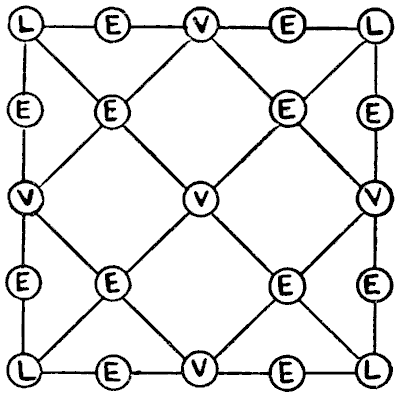 This is a simple counting puzzle. In how many different ways can you spell out the word LEVEL by placing the point of your pencil on an L and then passing along the lines from letter to letter. You may go in any direction, backwards or forwards. Of course you are not allowed to miss letters—that is to say, if you come to a letter you must use it.
Topics:Combinatorics
This is a simple counting puzzle. In how many different ways can you spell out the word LEVEL by placing the point of your pencil on an L and then passing along the lines from letter to letter. You may go in any direction, backwards or forwards. Of course you are not allowed to miss letters—that is to say, if you come to a letter you must use it.
Topics:Combinatorics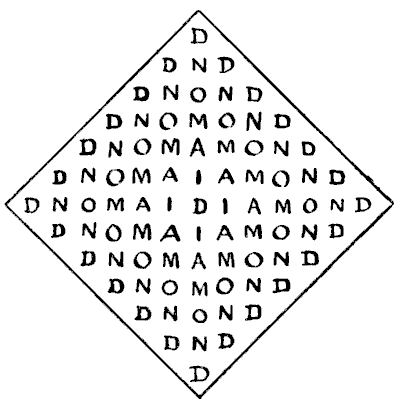 Topics:Combinatorics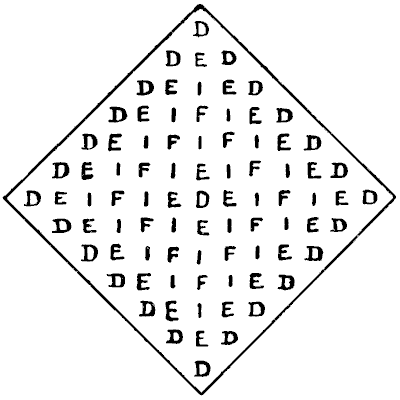
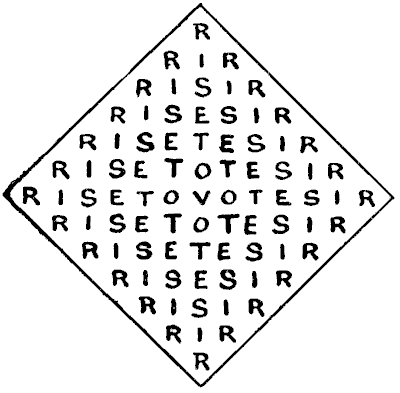 Here we have, perhaps, the most interesting form of the puzzle. In how many different ways can you read the political injunction, "RISE TO VOTE, SIR," under the same conditions as before? In this case every reading of the palindrome requires the use of the central V as the middle letter.
Topics:Combinatorics -> Number Tables
Here we have, perhaps, the most interesting form of the puzzle. In how many different ways can you read the political injunction, "RISE TO VOTE, SIR," under the same conditions as before? In this case every reading of the palindrome requires the use of the central V as the middle letter.
Topics:Combinatorics -> Number Tables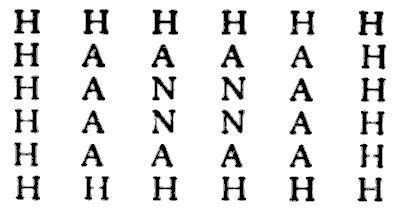 and promised that she would be his if he could tell her correctly in how many different ways it was possible to spell out her name, always passing from one letter to another that was adjacent. Diagonal steps are here allowed. Whether she did this merely to tease him or to test his cleverness is not recorded, but it is satisfactory to know that he succeeded. Would you have been equally successful? Take your pencil and try. You may start from any of the H's and go backwards or forwards and in any direction, so long as all the letters in a spelling are adjoining one another. How many ways are there, no two exactly alike?
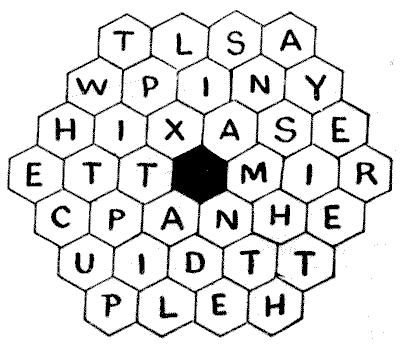 Here is a little puzzle with the simplest possible conditions. Place the point of your pencil on a letter in one of the cells of the honeycomb, and trace out a very familiar proverb by passing always from a cell to one that is contiguous to it. If you take the right route you will have visited every cell once, and only once. The puzzle is much easier than it looks.
Topics:Puzzles and Rebuses
Here is a little puzzle with the simplest possible conditions. Place the point of your pencil on a letter in one of the cells of the honeycomb, and trace out a very familiar proverb by passing always from a cell to one that is contiguous to it. If you take the right route you will have visited every cell once, and only once. The puzzle is much easier than it looks.
Topics:Puzzles and Rebuses