Amusements in Mathematics, Henry Ernest Dudeney
-
Question 241 - THE DISSECTED CIRCLE
How many continuous strokes, without lifting your pencil from the paper, do you require to draw the design shown in our illustration? Directly you change the direction of your pencil it begins a new stroke. You may go over the same line more than once if you like. It requires just a little care, or you may find yourself beaten by one stroke.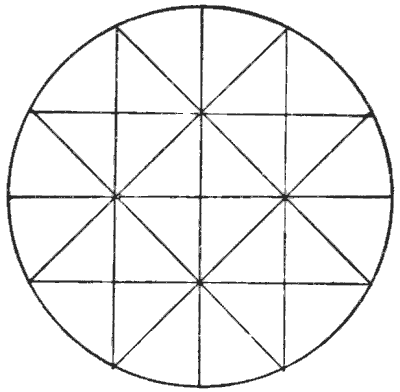 Topics:Combinatorics -> Graph Theory
 -
Question 242 - THE TUBE INSPECTOR'S PUZZLE
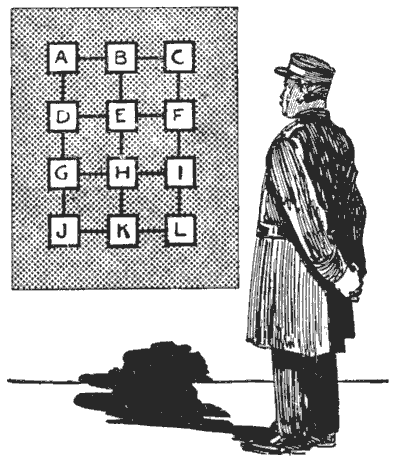
The man in our illustration is in a little dilemma. He has just been appointed inspector of a certain system of tube railways, and it is his duty to inspect regularly, within a stated period, all the company's seventeen lines connecting twelve stations, as shown on the big poster plan that he is contemplating. Now he wants to arrange his route so that it shall take him over all the lines with as little travelling as possible. He may begin where he likes and end where he likes. What is his shortest route?
Could anything be simpler? But the reader will soon find that, however he decides to proceed, the inspector must go over some of the lines more than once. In other words, if we say that the stations are a mile apart, he will have to travel more than seventeen miles to inspect every line. There is the little difficulty. How far is he compelled to travel, and which route do you recommend?
 Topics:Combinatorics -> Graph Theory
 -
Question 243 - VISITING THE TOWNS
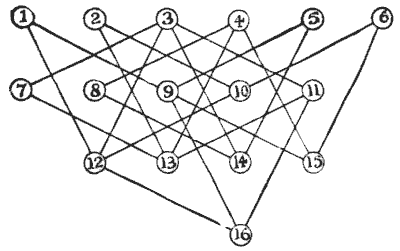 A traveller, starting from town No. `1`, wishes to visit every one of the towns once, and once only, going only by roads indicated by straight lines. How many different routes are there from which he can select? Of course, he must end his journey at No. `1`, from which he started, and must take no notice of cross roads, but go straight from town to town. This is an absurdly easy puzzle, if you go the right way to work.
Topics:Combinatorics -> Graph Theory
A traveller, starting from town No. `1`, wishes to visit every one of the towns once, and once only, going only by roads indicated by straight lines. How many different routes are there from which he can select? Of course, he must end his journey at No. `1`, from which he started, and must take no notice of cross roads, but go straight from town to town. This is an absurdly easy puzzle, if you go the right way to work.
Topics:Combinatorics -> Graph Theory -
Question 244 - THE FIFTEEN TURNINGS
Here is another queer travelling puzzle, the solution of which calls for ingenuity. In this case the traveller starts from the black town and wishes to go as far as possible while making only fifteen turnings and never going along the same road twice. The towns are supposed to be a mile apart. Supposing, for example, that he went straight to A, then straight to B, then to C, D, E, and F, you will then find that he has travelled thirty-seven miles in five turnings. Now, how far can he go in fifteen turnings?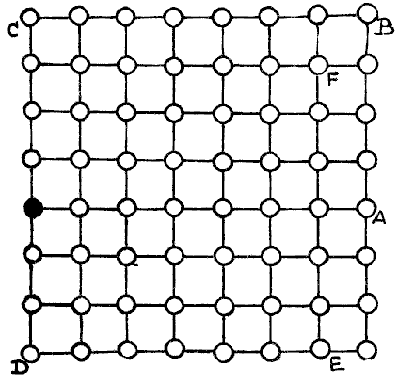 Topics:Combinatorics -> Graph Theory
 -
Question 245 - THE FLY ON THE OCTAHEDRON
"Look here," said the professor to his colleague, "I have been watching that fly on the octahedron, and it confines its walks entirely to the edges. What can be its reason for avoiding the sides?"
"Perhaps it is trying to solve some route problem," suggested the other. "Supposing it to start from the top point, how many different routes are there by which it may walk over all the edges, without ever going twice along the same edge in any route?"
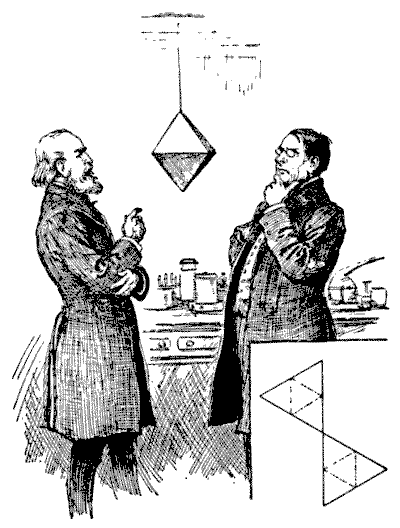
The problem was a harder one than they expected, and after working at it during leisure moments for several days their results did not agree—in fact, they were both wrong. If the reader is surprised at their failure, let him attempt the little puzzle himself. I will just explain that the octahedron is one of the five regular, or Platonic, bodies, and is contained under eight equal and equilateral triangles. If you cut out the two pieces of cardboard of the shape shown in the margin of the illustration, cut half through along the dotted lines and then bend them and put them together, you will have a perfect octahedron. In any route over all the edges it will be found that the fly must end at the point of departure at the top.
-
Question 246 - THE ICOSAHEDRON PUZZLE
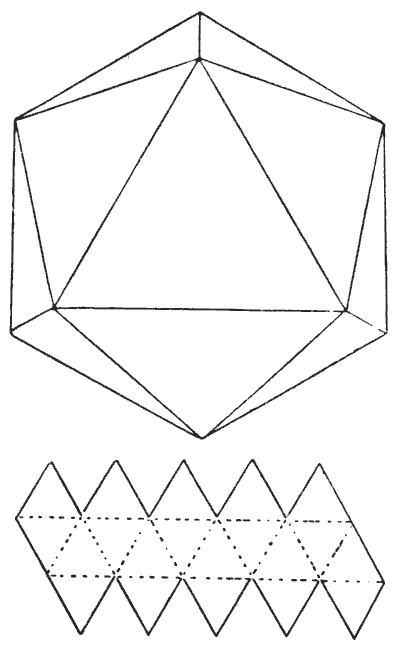
The icosahedron is another of the five regular, or Platonic, bodies having all their sides, angles, and planes similar and equal. It is bounded by twenty similar equilateral triangles. If you cut out a piece of cardboard of the form shown in the smaller diagram, and cut half through along the dotted lines, it will fold up and form a perfect icosahedron.
Now, a Platonic body does not mean a heavenly body; but it will suit the purpose of our puzzle if we suppose there to be a habitable planet of this shape. We will also suppose that, owing to a superfluity of water, the only dry land is along the edges, and that the inhabitants have no knowledge of navigation. If every one of those edges is `10,000` miles long and a solitary traveller is placed at the North Pole (the highest point shown), how far will he have to travel before he will have visited every habitable part of the planet—that is, have traversed every one of the edges?
-
Question 247 - INSPECTING A MINE
The diagram is supposed to represent the passages or galleries in a mine. We will assume that every passage, A to B, B to C, C to H, H to I, and so on, is one furlong in length. It will be seen that there are thirty-one of these passages. Now, an official has to inspect all of them, and he descends by the shaft to the point A. How far must he travel, and what route do you recommend? The reader may at first say, "As there are thirty-one passages, each a furlong in length, he will have to travel just thirty-one furlongs." But this is assuming that he need never go along a passage more than once, which is not the case. Take your pencil and try to find the shortest route. You will soon discover that there is room for considerable judgment. In fact, it is a perplexing puzzle.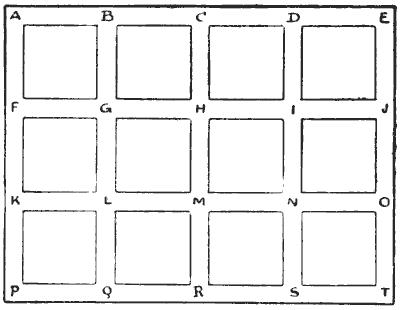 Topics:Combinatorics -> Graph Theory
 -
Question 248 - THE CYCLISTS' TOUR
Two cyclists were consulting a road map in preparation for a little tour together. The circles represent towns, and all the good roads are represented by lines. They are starting from the town with a star, and must complete their tour at E. But before arriving there they want to visit every other town once, and only once. That is the difficulty. Mr. Spicer said, "I am certain we can find a way of doing it;" but Mr. Maggs replied, "No way, I'm sure." Now, which of them was correct? Take your pencil and see if you can find any way of doing it. Of course you must keep to the roads indicated.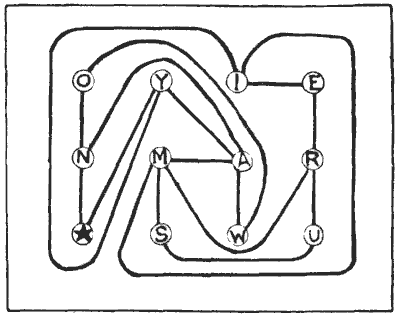
-
Question 249 - THE SAILOR'S PUZZLE
The sailor depicted in the illustration stated that he had since his boyhood been engaged in trading with a small vessel among some twenty little islands in the Pacific. He supplied the rough chart of which I have given a copy, and explained that the lines from island to island represented the only routes that he ever adopted. He always started from island A at the beginning of the season, and then visited every island once, and once only, finishing up his tour at the starting-point A. But he always put off his visit to C as long as possible, for trade reasons that I need not enter into. The puzzle is to discover his exact route, and this can be done with certainty. Take your pencil and, starting at A, try to trace it out. If you write down the islands in the order in which you visit them—thus, for example, A, I, O, L, G, etc.—you can at once see if you have visited an island twice or omitted any. Of course, the crossings of the lines must be ignored—that is, you must continue your route direct, and you are not allowed to switch off at a crossing and proceed in another direction. There is no trick of this kind in the puzzle. The sailor knew the best route. Can you find it?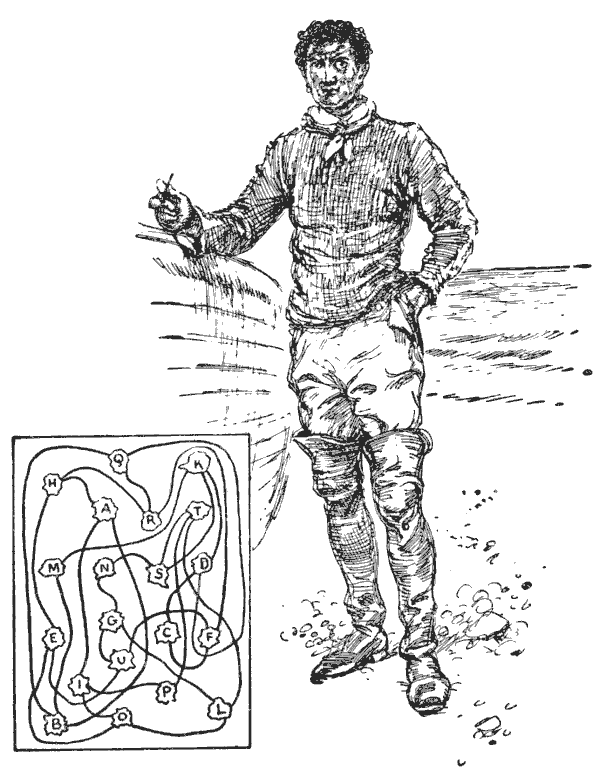 Topics:Combinatorics -> Graph Theory
 -
Question 250 - THE GRAND TOUR
One of the everyday puzzles of life is the working out of routes. If you are taking a holiday on your bicycle, or a motor tour, there always arises the question of how you are to make the best of your time and other resources. You have determined to get as far as some particular place, to include visits to such-and-such a town, to try to see something of special interest elsewhere, and perhaps to try to look up an old friend at a spot that will not take you much out of your way. Then you have to plan your route so as to avoid bad roads, uninteresting country, and, if possible, the necessity of a return by the same way that you went. With a map before you, the interesting puzzle is attacked and solved. I will present a little poser based on these lines.
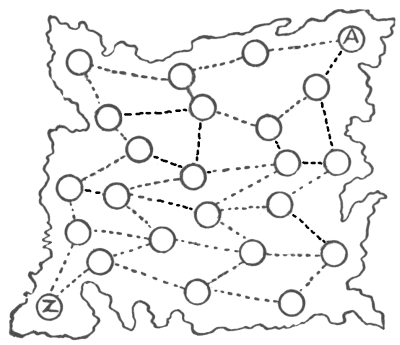
I give a rough map of a country—it is not necessary to say what particular country—the circles representing towns and the dotted lines the railways connecting them. Now there lived in the town marked A a man who was born there, and during the whole of his life had never once left his native place. From his youth upwards he had been very industrious, sticking incessantly to his trade, and had no desire whatever to roam abroad. However, on attaining his fiftieth birthday he decided to see something of his country, and especially to pay a visit to a very old friend living at the town marked Z. What he proposed was this: that he would start from his home, enter every town once and only once, and finish his journey at Z. As he made up his mind to perform this grand tour by rail only, he found it rather a puzzle to work out his route, but he at length succeeded in doing so. How did he manage it? Do not forget that every town has to be visited once, and not more than once.