The following is a prize puzzle propounded by me some years ago. Produce a game of chess which, after sixteen moves, shall leave White with all his sixteen men on their original squares and Black in possession of his king alone (not necessarily on his own square). White is then to force mate in three moves.
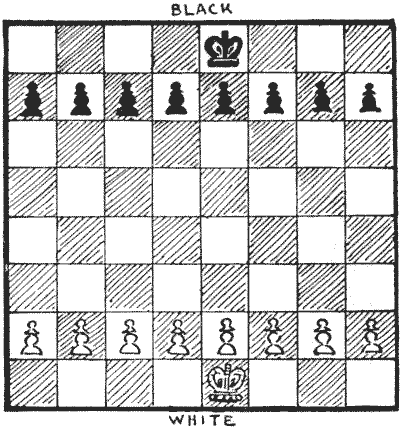
Starting from the ordinary arrangement of the pieces as for a game, what is the smallest possible number of moves necessary in order to arrive at the following position? The moves for both sides must, of course, be played strictly in accordance with the rules of the game, though the result will necessarily be a very weird kind of chess.
Place the remaining eight White pieces in such a position that White shall have the choice of thirty-six different mates on the move. Every move that checkmates and leaves a different position is a different mate. The pieces already placed must not be moved.
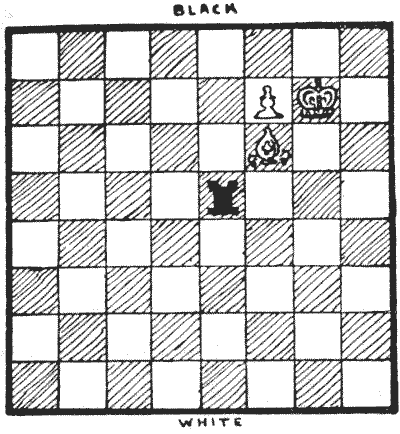
In a game of chess between Mr. Black and Mr. White, Black was in difficulties, and as usual was obliged to catch a train. So he proposed that White should complete the game in his absence on condition that no moves whatever should be made for Black, but only with the White pieces. Mr. White accepted, but to his dismay found it utterly impossible to win the game under such conditions. Try as he would, he could not checkmate his opponent. On which square did Mr. Black leave his king? The other pieces are in their proper positions in the diagram. White may leave Black in check as often as he likes, for it makes no difference, as he can never arrive at a checkmate position.
Strolling into one of the rooms of a London club, I noticed a position left by two players who had gone. This position is shown in the diagram. It is evident that White has checkmated Black. But how did he do it? That is the puzzle.
Can you place two White rooks and a White knight on the board so that the Black king (who must be on one of the four squares in the middle of the board) shall be in check with no possible move open to him? "In other words," the reader will say, "the king is to be shown checkmated." Well, you can use the term if you wish, though I intentionally do not employ it myself. The mere fact that there is no White king on the board would be a sufficient reason for my not doing so.
My next puzzle is supposed to be Chinese, many hundreds of years old, and never fails to interest. White to play and mate, moving each of the three pieces once, and once only.
In how many different ways may I place six pawns on the chessboard so that there shall be an even number of unoccupied squares in every row and every column? We are not here considering the diagonals at all, and every different six squares occupied makes a different solution, so we have not to exclude reversals or reflections.
Here is a little game of solitaire that is quite easy, but not so easy as to be uninteresting. You can either rule out the squares on a sheet of cardboard or paper, or you can use a portion of your chessboard. I have shown numbered counters in the illustration so as to make the solution easy and intelligible to all, but chess pawns or draughts will serve just as well in practice. The puzzle is to remove all the counters except one, and this one that is left must be No. `1`. You remove a counter by jumping over another counter to the next space beyond, if that square is vacant, but you cannot make a leap in a diagonal direction. The following moves will make the play quite clear: `1-9`, `2-10`, `1-2`, and so on. Here `1` jumps over `9`, and you remove `9` from the board; then `2` jumps over `10`, and you remove `10`; then `1` jumps over `2`, and you remove `2`. Every move is thus a capture, until the last capture of all is made by No. `1`.
Here is an extension of the last game of solitaire. All you need is a chessboard and the thirty-two pieces, or the same number of draughts or counters. In the illustration numbered counters are used. The puzzle is to remove all the counters except two, and these two must have originally been on the same side of the board; that is, the two left must either belong to the group `1` to `16` or to the other group, `17` to `32`. You remove a counter by jumping over it with another counter to the next square beyond, if that square is vacant, but you cannot make a leap in a diagonal direction. The following moves will make the play quite clear: `3-11`, `4-12`, `3-4`, `13-3`. Here `3` jumps over `11`, and you remove `11`; `4` jumps over `12`, and you remove `12`; and so on. It will be found a fascinating little game of patience, and the solution requires the exercise of some ingenuity.
 Topics:Combinatorics -> Game Theory
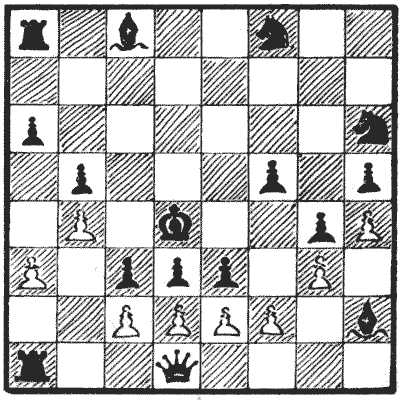 Place the remaining eight White pieces in such a position that White shall have the choice of thirty-six different mates on the move. Every move that checkmates and leaves a different position is a different mate. The pieces already placed must not be moved.
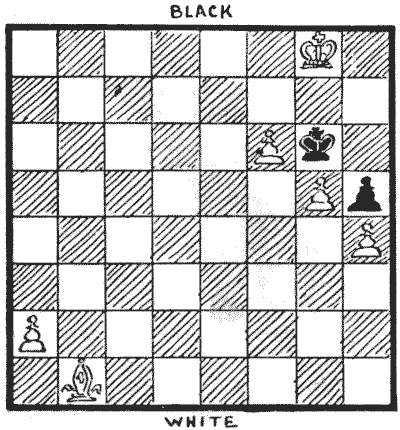 Strolling into one of the rooms of a London club, I noticed a position left by two players who had gone. This position is shown in the diagram. It is evident that White has checkmated Black. But how did he do it? That is the puzzle.
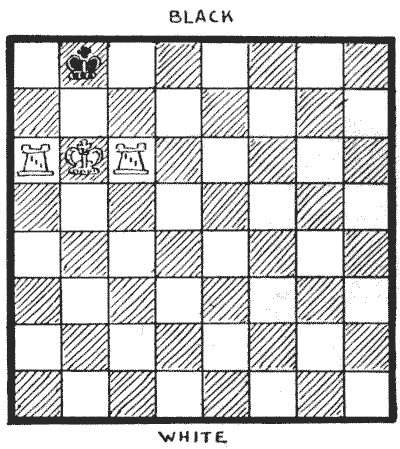 My next puzzle is supposed to be Chinese, many hundreds of years old, and never fails to interest. White to play and mate, moving each of the three pieces once, and once only.
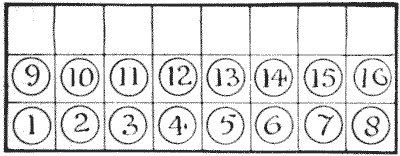 The puzzle is to remove all the counters except one, and this one that is left must be No. `1`. You remove a counter by jumping over another counter to the next space beyond, if that square is vacant, but you cannot make a leap in a diagonal direction. The following moves will make the play quite clear: `1-9`, `2-10`, `1-2`, and so on. Here `1` jumps over `9`, and you remove `9` from the board; then `2` jumps over `10`, and you remove `10`; then `1` jumps over `2`, and you remove `2`. Every move is thus a capture, until the last capture of all is made by No. `1`.
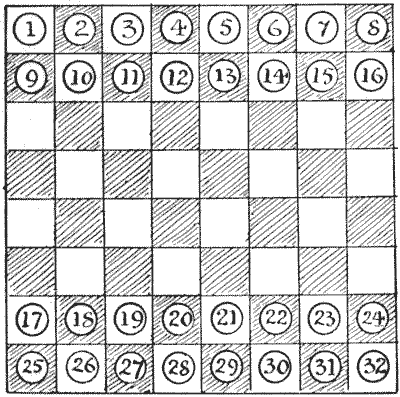 Here is an extension of the last game of solitaire. All you need is a chessboard and the thirty-two pieces, or the same number of draughts or counters. In the illustration numbered counters are used. The puzzle is to remove all the counters except two, and these two must have originally been on the same side of the board; that is, the two left must either belong to the group `1` to `16` or to the other group, `17` to `32`. You remove a counter by jumping over it with another counter to the next square beyond, if that square is vacant, but you cannot make a leap in a diagonal direction. The following moves will make the play quite clear: `3-11`, `4-12`, `3-4`, `13-3`. Here `3` jumps over `11`, and you remove `11`; `4` jumps over `12`, and you remove `12`; and so on. It will be found a fascinating little game of patience, and the solution requires the exercise of some ingenuity.