Amusements in Mathematics, Henry Ernest Dudeney
-
Question 371 - GOLD PACKING IN RUSSIA
The editor of the Times newspaper was invited by a high Russian official to inspect the gold stored in reserve at St. Petersburg, in order that he might satisfy himself that it was not another "Humbert safe." He replied that it would be of no use whatever, for although the gold might appear to be there, he would be quite unable from a mere inspection to declare that what he saw was really gold. A correspondent of the Daily Mail thereupon took up the challenge, but, although he was greatly impressed by what he saw, he was compelled to confess his incompetence (without emptying and counting the contents of every box and sack, and assaying every piece of gold) to give any assurance on the subject. In presenting the following little puzzle, I wish it to be also understood that I do not guarantee the real existence of the gold, and the point is not at all material to our purpose. Moreover, if the reader says that gold is not usually "put up" in slabs of the dimensions that I give, I can only claim problematic licence.
Russian officials were engaged in packing `800` gold slabs, each measuring `12`½ inches long, `11` inches wide, and `1` inch deep. What are the interior dimensions of a box of equal length and width, and necessary depth, that will exactly contain them without any space being left over? Not more than twelve slabs may be laid on edge, according to the rules of the government. It is an interesting little problem in packing, and not at all difficult.
-
Question 372 - THE BARRELS OF HONEY
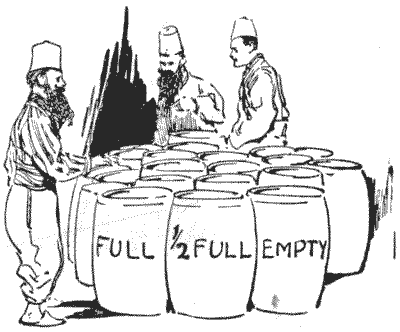
Once upon a time there was an aged merchant of Bagdad who was much respected by all who knew him. He had three sons, and it was a rule of his life to treat them all exactly alike. Whenever one received a present, the other two were each given one of equal value. One day this worthy man fell sick and died, bequeathing all his possessions to his three sons in equal shares.
The only difficulty that arose was over the stock of honey. There were exactly twenty-one barrels. The old man had left instructions that not only should every son receive an equal quantity of honey, but should receive exactly the same number of barrels, and that no honey should be transferred from barrel to barrel on account of the waste involved. Now, as seven of these barrels were full of honey, seven were half-full, and seven were empty, this was found to be quite a puzzle, especially as each brother objected to taking more than four barrels of, the same description—full, half-full, or empty. Can you show how they succeeded in making a correct division of the property?
-
Question 373 - CROSSING THE STREAM
During a country ramble Mr. and Mrs. Softleigh found themselves in a pretty little dilemma. They had to cross a stream in a small boat which was capable of carrying only `150` lbs. weight. But Mr. Softleigh and his wife each weighed exactly `150` lbs., and each of their sons weighed `75` lbs. And then there was the dog, who could not be induced on any terms to swim. On the principle of "ladies first," they at once sent Mrs. Softleigh over; but this was a stupid oversight, because she had to come back again with the boat, so nothing was gained by that operation. How did they all succeed in getting across? The reader will find it much easier than the Softleigh family did, for their greatest enemy could not have truthfully called them a brilliant quartette—while the dog was a perfect fool. -
Question 374 - CROSSING THE RIVER AXE
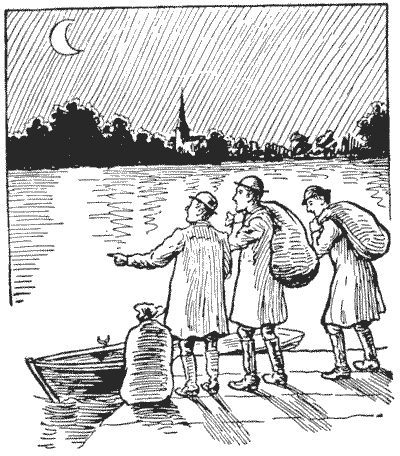 Many years ago, in the days of the smuggler known as "Rob Roy of the West," a piratical band buried on the coast of South Devon a quantity of treasure which was, of course, abandoned by them in the usual inexplicable way. Some time afterwards its whereabouts was discovered by three countrymen, who visited the spot one night and divided the spoil between them, Giles taking treasure to the value of £`800`, Jasper £`500` worth, and Timothy £`300` worth. In returning they had to cross the river Axe at a point where they had left a small boat in readiness. Here, however, was a difficulty they had not anticipated. The boat would only carry two men, or one man and a sack, and they had so little confidence in one another that no person could be left alone on the land or in the boat with more than his share of the spoil, though two persons (being a check on each other) might be left with more than their shares. The puzzle is to show how they got over the river in the fewest possible crossings, taking their treasure with them. No tricks, such as ropes, "flying bridges," currents, swimming, or similar dodges, may be employed.
-
Question 375 - FIVE JEALOUS HUSBANDS
During certain local floods five married couples found themselves surrounded by water, and had to escape from their unpleasant position in a boat that would only hold three persons at a time. Every husband was so jealous that he would not allow his wife to be in the boat or on either bank with another man (or with other men) unless he was himself present. Show the quickest way of getting these five men and their wives across into safety.
Call the men A, B, C, D, E, and their respective wives a, b, c, d, e. To go over and return counts as two crossings. No tricks such as ropes, swimming, currents, etc., are permitted.
-
Question 376 - THE FOUR ELOPEMENTS
Colonel B—— was a widower of a very taciturn disposition. His treatment of his four daughters was unusually severe, almost cruel, and they not unnaturally felt disposed to resent it. Being charming girls with every virtue and many accomplishments, it is not surprising that each had a fond admirer. But the father forbade the young men to call at his house, intercepted all letters, and placed his daughters under stricter supervision than ever. But love, which scorns locks and keys and garden walls, was equal to the occasion, and the four youths conspired together and planned a general elopement.
At the foot of the tennis lawn at the bottom of the garden ran the silver Thames, and one night, after the four girls had been safely conducted from a dormitory window to terra firma, they all crept softly down to the bank of the river, where a small boat belonging to the Colonel was moored. With this they proposed to cross to the opposite side and make their way to a lane where conveyances were waiting to carry them in their flight. Alas! here at the water's brink their difficulties already began.
The young men were so extremely jealous that not one of them would allow his prospective bride to remain at any time in the company of another man, or men, unless he himself were present also. Now, the boat would only hold two persons, though it could, of course, be rowed by one, and it seemed impossible that the four couples would ever get across. But midway in the stream was a small island, and this seemed to present a way out of the difficulty, because a person or persons could be left there while the boat was rowed back or to the opposite shore. If they had been prepared for their difficulty they could have easily worked out a solution to the little poser at any other time. But they were now so hurried and excited in their flight that the confusion they soon got into was exceedingly amusing—or would have been to any one except themselves.
As a consequence they took twice as long and crossed the river twice as often as was really necessary. Meanwhile, the Colonel, who was a very light sleeper, thought he heard a splash of oars. He quickly raised the alarm among his household, and the young ladies were found to be missing. Somebody was sent to the police-station, and a number of officers soon aided in the pursuit of the fugitives, who, in consequence of that delay in crossing the river, were quickly overtaken. The four girls returned sadly to their homes, and afterwards broke off their engagements in disgust.
For a considerable time it was a mystery how the party of eight managed to cross the river in that little boat without any girl being ever left with a man, unless her betrothed was also present. The favourite method is to take eight counters or pieces of cardboard and mark them A, B, C, D, a, b, c, d, to represent the four men and their prospective brides, and carry them from one side of a table to the other in a matchbox (to represent the boat), a penny being placed in the middle of the table as the island.
Readers are now asked to find the quickest method of getting the party across the river. How many passages are necessary from land to land? By "land" is understood either shore or island. Though the boat would not necessarily call at the island every time of crossing, the possibility of its doing so must be provided for. For example, it would not do for a man to be alone in the boat (though it were understood that he intended merely to cross from one bank to the opposite one) if there happened to be a girl alone on the island other than the one to whom he was engaged.
-
Question 377 - STEALING THE CASTLE TREASURE
The ingenious manner in which a box of treasure, consisting principally of jewels and precious stones, was stolen from Gloomhurst Castle has been handed down as a tradition in the De Gourney family. The thieves consisted of a man, a youth, and a small boy, whose only mode of escape with the box of treasure was by means of a high window. Outside the window was fixed a pulley, over which ran a rope with a basket at each end. When one basket was on the ground the other was at the window. The rope was so disposed that the persons in the basket could neither help themselves by means of it nor receive help from others. In short, the only way the baskets could be used was by placing a heavier weight in one than in the other.
Now, the man weighed `195` lbs., the youth `105` lbs., the boy `90` lbs., and the box of treasure `75` lbs. The weight in the descending basket could not exceed that in the other by more than `15` lbs. without causing a descent so rapid as to be most dangerous to a human being, though it would not injure the stolen property. Only two persons, or one person and the treasure, could be placed in the same basket at one time. How did they all manage to escape and take the box of treasure with them?
The puzzle is to find the shortest way of performing the feat, which in itself is not difficult. Remember, a person cannot help himself by hanging on to the rope, the only way being to go down "with a bump," with the weight in the other basket as a counterpoise.
-
Question 378 - DOMINOES IN PROGRESSION
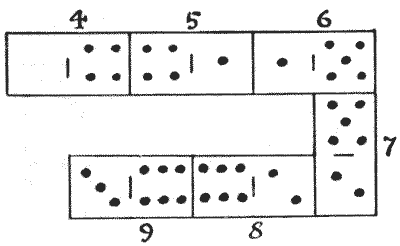 It will be seen that I have played six dominoes, in the illustration, in accordance with the ordinary rules of the game, `4` against `4, 1` against `1`, and so on, and yet the sum of the spots on the successive dominoes, `4, 5, 6, 7, 8, 9`, are in arithmetical progression; that is, the numbers taken in order have a common difference of `1`. In how many different ways may we play six dominoes, from an ordinary box of twenty-eight, so that the numbers on them may lie in arithmetical progression? We must always play from left to right, and numbers in decreasing arithmetical progression (such as `9, 8, 7, 6, 5, 4`) are not admissible.
-
Question 379 - THE FIVE DOMINOES
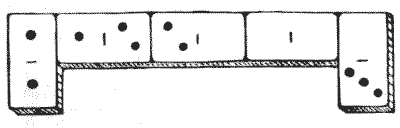
Here is a new little puzzle that is not difficult, but will probably be found entertaining by my readers. It will be seen that the five dominoes are so arranged in proper sequence (that is, with `1` against `1, 2` against `2`, and so on), that the total number of pips on the two end dominoes is five, and the sum of the pips on the three dominoes in the middle is also five. There are just three other arrangements giving five for the additions. They are: —
(1—0) (0—0) (0—2) (2—1) (1—3) (4—0) (0—0) (0—2) (2—1) (1—0) (2—0) (0—0) (0—1) (1—3) (3—0) Now, how many similar arrangements are there of five dominoes that shall give six instead of five in the two additions?
-
Question 380 - THE DOMINO FRAME PUZZLE
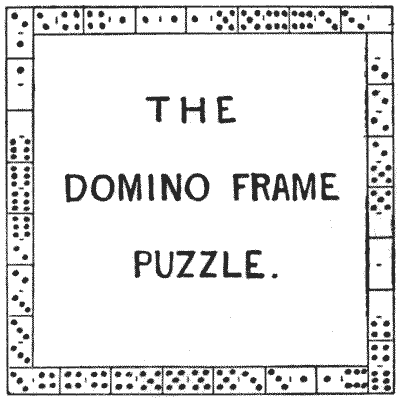 It will be seen in the illustration that the full set of twenty-eight dominoes is arranged in the form of a square frame, with `6` against `6, 2` against `2`, blank against blank, and so on, as in the game. It will be found that the pips in the top row and left-hand column both add up `44`. The pips in the other two sides sum to `59` and `32` respectively. The puzzle is to rearrange the dominoes in the same form so that all of the four sides shall sum to `44`. Remember that the dominoes must be correctly placed one against another as in the game.