Amusements in Mathematics, Henry Ernest Dudeney
-
Question 361 - THE MONSTROSITY
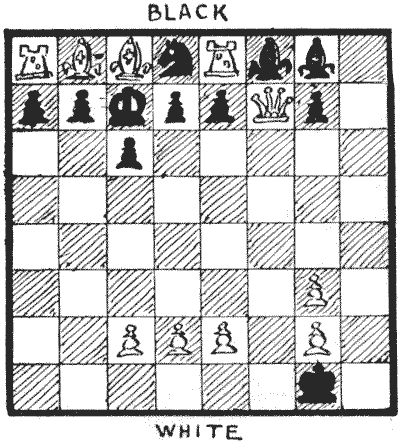
One Christmas Eve I was travelling by rail to a little place in one of the southern counties. The compartment was very full, and the passengers were wedged in very tightly. My neighbour in one of the corner seats was closely studying a position set up on one of those little folding chessboards that can be carried conveniently in the pocket, and I could scarcely avoid looking at it myself. Here is the position:—
My fellow-passenger suddenly turned his head and caught the look of bewilderment on my face.
"Do you play chess?" he asked.
"Yes, a little. What is that? A problem?"
"Problem? No; a game."
"Impossible!" I exclaimed rather rudely. "The position is a perfect monstrosity!"
He took from his pocket a postcard and handed it to me. It bore an address at one side and on the other the words "`43`. K to Kt `8`."
"It is a correspondence game." he exclaimed. "That is my friend's last move, and I am considering my reply."
"But you really must excuse me; the position seems utterly impossible. How on earth, for example—"
"Ah!" he broke in smilingly. "I see; you are a beginner; you play to win."
"Of course you wouldn't play to lose or draw!"
He laughed aloud."You have much to learn. My friend and myself do not play for results of that antiquated kind. We seek in chess the wonderful, the whimsical, the weird. Did you ever see a position like that?"
I inwardly congratulated myself that I never had.
"That position, sir, materializes the sinuous evolvements and syncretic, synthetic, and synchronous concatenations of two cerebral individualities. It is the product of an amphoteric and intercalatory interchange of—"
"Have you seen the evening paper, sir?" interrupted the man opposite, holding out a newspaper. I noticed on the margin beside his thumb some pencilled writing. Thanking him, I took the paper and read—"Insane, but quite harmless. He is in my charge."
After that I let the poor fellow run on in his wild way until both got out at the next station.
But that queer position became fixed indelibly in my mind, with Black's last move `43`. K to Kt `8`; and a short time afterwards I found it actually possible to arrive at such a position in forty-three moves. Can the reader construct such a sequence? How did White get his rooks and king's bishop into their present positions, considering Black can never have moved his king's bishop? No odds were given, and every move was perfectly legitimate.
-
Question 362 - THE WASSAIL BOWL
One Christmas Eve three Weary Willies came into possession of what was to them a veritable wassail bowl, in the form of a small barrel, containing exactly six quarts of fine ale. One of the men possessed a five-pint jug and another a three-pint jug, and the problem for them was to divide the liquor equally amongst them without waste. Of course, they are not to use any other vessels or measures. If you can show how it was to be done at all, then try to find the way that requires the fewest possible manipulations, every separate pouring from one vessel to another, or down a man's throat, counting as a manipulation.
-
Question 363 - THE DOCTOR'S QUERY
"A curious little point occurred to me in my dispensary this morning," said a doctor. "I had a bottle containing ten ounces of spirits of wine, and another bottle containing ten ounces of water. I poured a quarter of an ounce of spirits into the water and shook them up together. The mixture was then clearly forty to one. Then I poured back a quarter-ounce of the mixture, so that the two bottles should again each contain the same quantity of fluid. What proportion of spirits to water did the spirits of wine bottle then contain?" -
Question 364 - THE BARREL PUZZLE
The men in the illustration are disputing over the liquid contents of a barrel. What the particular liquid is it is impossible to say, for we are unable to look into the barrel; so we will call it water. One man says that the barrel is more than half full, while the other insists that it is not half full. What is their easiest way of settling the point? It is not necessary to use stick, string, or implement of any kind for measuring. I give this merely as one of the simplest possible examples of the value of ordinary sagacity in the solving of puzzles. What are apparently very difficult problems may frequently be solved in a similarly easy manner if we only use a little common sense.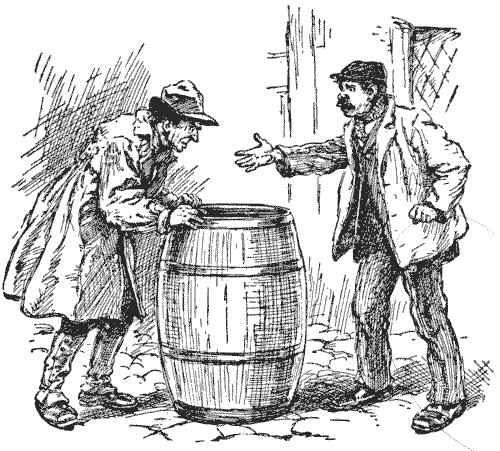
-
Question 365 - NEW MEASURING PUZZLE
Here is a new poser in measuring liquids that will be found interesting. A man has two ten-quart vessels full of wine, and a five-quart and a four-quart measure. He wants to put exactly three quarts into each of the two measures. How is he to do it? And how many manipulations (pourings from one vessel to another) do you require? Of course, waste of wine, tilting, and other tricks are not allowed. -
Question 366 - THE HONEST DAIRYMAN
An honest dairyman in preparing his milk for public consumption employed a can marked B, containing milk, and a can marked A, containing water. From can A he poured enough to double the contents of can B. Then he poured from can B into can A enough to double its contents. Then he finally poured from can A into can B until their contents were exactly equal. After these operations he would send the can A to London, and the puzzle is to discover what are the relative proportions of milk and water that he provides for the Londoners' breakfast-tables. Do they get equal proportions of milk and water—or two parts of milk and one of water—or what? It is an interesting question, though, curiously enough, we are not told how much milk or water he puts into the cans at the start of his operations.Topics:Algebra -> Word Problems -
Question 367 - WINE AND WATER
Mr. Goodfellow has adopted a capital idea of late. When he gives a little dinner party and the time arrives to smoke, after the departure of the ladies, he sometimes finds that the conversation is apt to become too political, too personal, too slow, or too scandalous. Then he always manages to introduce to the company some new poser that he has secreted up his sleeve for the occasion. This invariably results in no end of interesting discussion and debate, and puts everybody in a good humour.
Here is a little puzzle that he propounded the other night, and it is extraordinary how the company differed in their answers. He filled a wine-glass half full of wine, and another glass twice the size one-third full of wine. Then he filled up each glass with water and emptied the contents of both into a tumbler. "Now," he said, "what part of the mixture is wine and what part water?" Can you give the correct answer?
-
Question 368 - THE KEG OF WINE
Here is a curious little problem. A man had a ten-gallon keg full of wine and a jug. One day he drew off a jugful of wine and filled up the keg with water. Later on, when the wine and water had got thoroughly mixed, he drew off another jugful and again filled up the keg with water. It was then found that the keg contained equal proportions of wine and water. Can you find from these facts the capacity of the jug? -
Question 369 - MIXING THE TEA
"Mrs. Spooner called this morning," said the honest grocer to his assistant. "She wants twenty pounds of tea at `2`s. `4`½d. per lb. Of course we have a good `2`s. `6`d. tea, a slightly inferior at `2`s. `3`d., and a cheap Indian at `1`s. `9`d., but she is very particular always about her prices."
"What do you propose to do?" asked the innocent assistant.
"Do?" exclaimed the grocer. "Why, just mix up the three teas in different proportions so that the twenty pounds will work out fairly at the lady's price. Only don't put in more of the best tea than you can help, as we make less profit on that, and of course you will use only our complete pound packets. Don't do any weighing."
How was the poor fellow to mix the three teas? Could you have shown him how to do it?
-
Question 370 - A PACKING PUZZLE
As we all know by experience, considerable ingenuity is often required in packing articles into a box if space is not to be unduly wasted. A man once told me that he had a large number of iron balls, all exactly two inches in diameter, and he wished to pack as many of these as possible into a rectangular box `24` `9/10` inches long, `22` `4/5` inches wide, and `14` inches deep. Now, what is the greatest number of the balls that he could pack into that box?