Geometry, Area Calculation
This topic focuses on methods for determining the size of a two-dimensional surface or region. Questions involve calculating the areas of various geometric shapes like triangles, quadrilaterals, circles, and more complex composite figures, often requiring application of specific formulas.
-
THE TETHERED GOAT
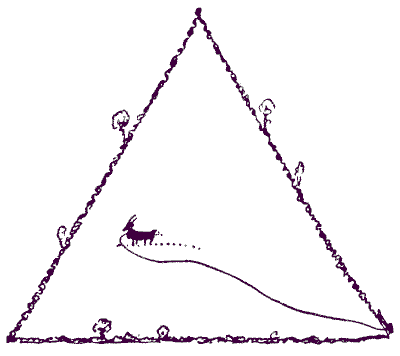 Here is a little problem that everybody should know how to solve. The goat is placed in a half-acre meadow, that is in shape an equilateral triangle. It is tethered to a post at one corner of the field. What should be the length of the tether (to the nearest inch) in order that the goat shall be able to eat just half the grass in the field? It is assumed that the goat can feed to the end of the tether.
Sources:Topics:Geometry -> Area Calculation Geometry -> Plane Geometry -> Triangles Geometry -> Plane Geometry -> Angle Calculation
Here is a little problem that everybody should know how to solve. The goat is placed in a half-acre meadow, that is in shape an equilateral triangle. It is tethered to a post at one corner of the field. What should be the length of the tether (to the nearest inch) in order that the goat shall be able to eat just half the grass in the field? It is assumed that the goat can feed to the end of the tether.
Sources:Topics:Geometry -> Area Calculation Geometry -> Plane Geometry -> Triangles Geometry -> Plane Geometry -> Angle Calculation- Amusements in Mathematics, Henry Ernest Dudeney Question 196
-
A KITE-FLYING PUZZLE
While accompanying my friend Professor Highflite during a scientific kite-flying competition on the South Downs of Sussex I was led into a little calculation that ought to interest my readers. The Professor was paying out the wire to which his kite was attached from a winch on which it had been rolled into a perfectly spherical form. This ball of wire was just two feet in diameter, and the wire had a diameter of one-hundredth of an inch. What was the length of the wire?
Now, a simple little question like this that everybody can perfectly understand will puzzle many people to answer in any way. Let us see whether, without going into any profound mathematical calculations, we can get the answer roughly—say, within a mile of what is correct! We will assume that when the wire is all wound up the ball is perfectly solid throughout, and that no allowance has to be made for the axle that passes through it. With that simplification, I wonder how many readers can state within even a mile of the correct answer the length of that wire.
Sources:Topics:Geometry -> Solid Geometry / Geometry in Space Arithmetic Geometry -> Area Calculation Algebra -> Word Problems Units of Measurement- Amusements in Mathematics, Henry Ernest Dudeney Question 200
-
A NEW MATCH PUZZLE
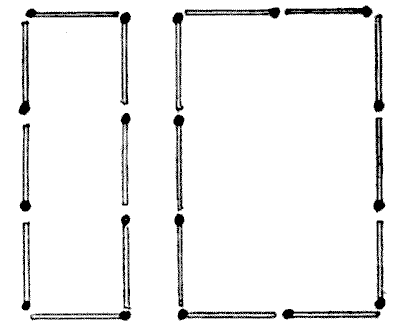 In the illustration eighteen matches are shown arranged so that they enclose two spaces, one just twice as large as the other. Can you rearrange them (`1`) so as to enclose two four-sided spaces, one exactly three times as large as the other, and (`2`) so as to enclose two five-sided spaces, one exactly three times as large as the other? All the eighteen matches must be fairly used in each case; the two spaces must be quite detached, and there must be no loose ends or duplicated matches.
Sources:Topics:Geometry -> Area Calculation Combinatorics -> Combinatorial Geometry -> Cut a Shape / Dissection Problems Puzzles and Rebuses -> Matchstick Puzzles
In the illustration eighteen matches are shown arranged so that they enclose two spaces, one just twice as large as the other. Can you rearrange them (`1`) so as to enclose two four-sided spaces, one exactly three times as large as the other, and (`2`) so as to enclose two five-sided spaces, one exactly three times as large as the other? All the eighteen matches must be fairly used in each case; the two spaces must be quite detached, and there must be no loose ends or duplicated matches.
Sources:Topics:Geometry -> Area Calculation Combinatorics -> Combinatorial Geometry -> Cut a Shape / Dissection Problems Puzzles and Rebuses -> Matchstick Puzzles- Amusements in Mathematics, Henry Ernest Dudeney Question 204
-
COUNTING THE RECTANGLES
Can you say correctly just how many squares and other rectangles the chessboard contains? In other words, in how great a number of different ways is it possible to indicate a square or other rectangle enclosed by lines that separate the squares of the board? Sources:- Amusements in Mathematics, Henry Ernest Dudeney Question 347
-
A CHESSBOARD FALLACY
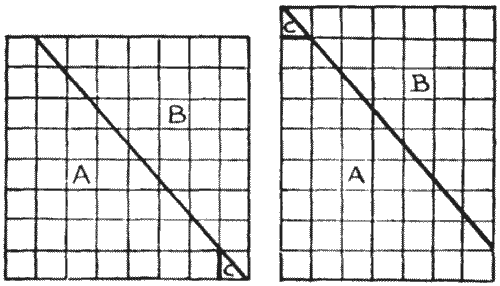
"Here is a diagram of a chessboard," he said. "You see there are sixty-four squares—eight by eight. Now I draw a straight line from the top left-hand corner, where the first and second squares meet, to the bottom right-hand corner. I cut along this line with the scissors, slide up the piece that I have marked B, and then clip off the little corner C by a cut along the first upright line. This little piece will exactly fit into its place at the top, and we now have an oblong with seven squares on one side and nine squares on the other. There are, therefore, now only sixty-three squares, because seven multiplied by nine makes sixty-three. Where on earth does that lost square go to? I have tried over and over again to catch the little beggar, but he always eludes me. For the life of me I cannot discover where he hides himself."
"It seems to be like the other old chessboard fallacy, and perhaps the explanation is the same," said Reginald—"that the pieces do not exactly fit."
"But they do fit," said Uncle John. "Try it, and you will see."
Later in the evening Reginald and George, were seen in a corner with their heads together, trying to catch that elusive little square, and it is only fair to record that before they retired for the night they succeeded in securing their prey, though some others of the company failed to see it when captured. Can the reader solve the little mystery?
Sources:Topics:Geometry -> Plane Geometry Geometry -> Area Calculation Combinatorics -> Combinatorial Geometry -> Cut a Shape / Dissection Problems- Amusements in Mathematics, Henry Ernest Dudeney Question 413